Last updated: February 14, 2026
How is the market for Exelon shaped by current therapeutics and competition?
Exelon (rivastigmine) is a cholinesterase inhibitor approved for treating mild to moderate Alzheimer's disease and Parkinson’s disease dementia. It is marketed as a transdermal patch and oral capsule. The drug’s global sales peaked at approximately $1.8 billion in 2019, before declining in recent years due to generic competition and evolving treatment guidelines (IQVIA, 2022).
The Alzheimer's therapeutics market is highly competitive, with rivastigmine competing against other cholinesterase inhibitors, such as donepezil and galantamine, and against NMDA receptor antagonists like memantine. These drugs have similar efficacy profiles but differ in tolerability, dosing, and formulation. The growing global prevalence of dementia, projected to reach 152 million by 2050 (Alzheimer’s Disease International, 2018), sustains demand but exerts downward pressure on prices due to generic options.
Patent expirations for Exelon in key markets diverged between 2017 (U.S.) and 2019 (Europe), leading to increased generic availability and significant price erosion. The entry of generics has reduced the average retail price of rivastigmine by approximately 60-70% in the U.S., decreasing overall market revenues and constraining new price increases by brand manufacturers.
What are the current price dynamics and projections for Exelon?
Current Pricing
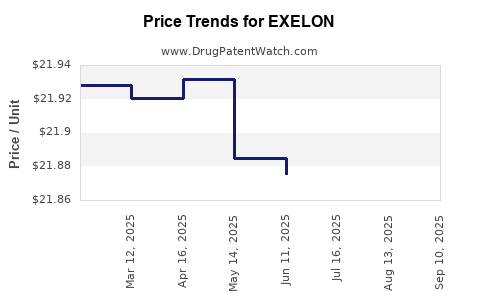
In the U.S., the average wholesale price (AWP) for branded Exelon is around $300 for a 30-day supply of the capsule. The transdermal patch costs approximately $350 for a month. Post-generic entry, prices for the branded drug have dropped substantially, with retail prices in 2023 roughly $70-100 for capsules and $120-150 for patches, depending on quantities and pharmacy contracts.
Market Trends Impacting Prices
- Generic Competition: Since patent expiry, generics dominate retail markets, comprising over 85% of prescription volumes. Brands have reduced prices in response to increased generic penetration, and payers push for generic substitution.
- Formulation Preferences: The patch form incurs higher costs, but some prescribers prefer it for compliance. This maintains a niche pricing tier for exelon patches, which retain a relative premium over generics.
- Regulatory and Reimbursement Policies: Reforms emphasizing cost-effective treatments continue to pressure prices, especially in publicly funded healthcare systems like the UK’s NHS and Medicare in the U.S.
Price Projections
Analysts forecast a continued decline in the retail price of rivastigmine by 10-15% annually over the next three years, primarily driven by increased generic volume, with some stabilization around $50-75 for capsules and $100-125 for patches in the U.S. market.
In Europe, where generic uptake varies by country, prices are expected to decline similarly but at a slower pace, maintaining a small premium for branded patches where prescribed.
Revenue Outlook
Global sales are projected to decline from a peak of $1.8 billion in 2019 to approximately $500 million by 2025, due to loss of exclusivity and competition. The premium part of the market, defined by branded patches, could retain 15-20% of total sales, mainly in niche segments requiring specific formulations.
Which factors could influence future pricing and market size?
- New formulations or biosimilars: These could introduce additional price competition, especially if they demonstrate superior safety or convenience.
- Regulatory changes: Cost containment policies, particularly aimed at dementia drugs, can further suppress prices.
- Market adoption: Variations in dementia diagnosis rates and physician preferences could alter consumption volumes and brand loyalty.
- Patent strategies: In rare cases, brand companies may pursue secondary patents to delay generic entry, influencing pricing trajectories.
What are the key takeaways for stakeholders?
- The Exelon market faces significant downward pressure due to patent expiration and generic competition.
- Prices have decreased sharply since 2017, with further declines expected at approximately 10-15% annually.
- The branded patch form maintains a niche price premium, but its share of sales diminishes.
- U.S. and European markets are aligned in trend but differ in speed and magnitude of price erosion.
- Revenue projections indicate a substantial decline over the next three years, emphasizing the importance of innovation and strategic pricing.
FAQs
1. Will Exelon maintain a premium over generics?
Limited. The branded patch may retain a small premium in specific segments but generally follows the downward trend driven by generics.
2. How does pricing vary across regions?
U.S. prices are higher in absolute terms but have declined sharply post-generic entry. European prices are more tightly regulated, leading to steadier, slower declines.
3. Can innovative formulations rescue Exelon’s market share?
Potentially. New delivery methods or formulations offering better tolerability or compliance might command higher prices, but evidence must justify these premiums.
4. What is the outlook for investment in rivastigmine development?
Limited expected returns due to market saturation and declining revenues. Focus shifts to pipeline candidates or combination therapies.
5. How significant is the off-label use in pricing considerations?
Off-label prescriptions are low in volume but may influence formulary decisions and reimbursement policies, indirectly impacting prices.
Sources:
[1] IQVIA. (2022). Global Prescription Market Report.
[2] Alzheimer’s Disease International. (2018). Dementia Statistics.
[3] U.S. Food and Drug Administration. (2017). Patent and Exclusivity Data for Rivastigmine.