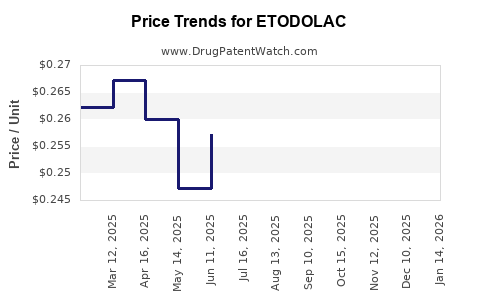
Last updated: February 12, 2026
Overview
Etodolac is a non-steroidal anti-inflammatory drug (NSAID) primarily indicated for pain and inflammation associated with osteoarthritis and rheumatoid arthritis. It is available by prescription in several formulations but is generally marketed as a generic drug, limiting pricing variability across regions.
Market Landscape
-
Global Market Size: Estimated at around $2 billion in 2022, primarily driven by North America and Europe. The NSAID segment, including etodolac, holds a significant share within the broader pain management and anti-inflammatory drug markets.
-
Leading Markets:
- North America: Accounts for roughly 50% of sales, supported by high prevalence of osteoarthritis and rheumatoid arthritis, along with favorable prescribing habits.
- Europe: Represents about 30% of sales, with widespread adoption but more regulatory constraints.
- Asia-Pacific: Comprises 15%, with growing demand due to increasing arthritis prevalence and expanding healthcare infrastructure.
-
Competitive Landscape:
- Generic formulations dominate sales.
- Branded versions are available but account for less than 10% of total volume.
- Major manufacturers include Teva Pharmaceutical, Mylan, and Sandoz, with branded versions historically marketed by Pfizer (e.g., Lodine) until patent expiry.
Regulatory Status
- Patent Status: Patent expired in many regions by the early 2000s, leading to a proliferation of generics.
- Regulatory Approvals: Approved and marketed across the US, Europe, and Asia. Vigilant regulation exists concerning gastrointestinal and cardiovascular safety profiles, influencing prescribing patterns.
Pricing Dynamics
Generic Pricing
- United States:
- Typical 200 mg capsules: Retail prices around $0.50 to $1.20 per capsule.
- Wholesale acquisition cost (WAC): Approximately $0.20 to $0.50 per capsule.
- Europe:
- Prices vary; generally, €0.30 to €0.80 per capsule.
- Asia-Pacific:
- Lower pricing, often below $0.50 per capsule, due to price controls and market competition.
Branded Products
- Historically priced 2-3 times higher than generics in the US.
- Declined sharply post-generics introduction; current branded prices are rarely significant in market share.
Market Trends and Drivers
- Increasing prevalence of arthritis driven by aging populations.
- Prescribing shifts favoring NSAIDs with better safety profiles.
- Emerging formulations: Newer delivery systems, combination drugs, and localized formulations, though these are less prevalent for etodolac.
- Safety profile recognition influences market growth; gastrointestinal and cardiovascular adverse events remain concerns.
Price Projections
Short-Term (Next 1-2 Years)
- Stable prices: Expect minimal fluctuation with generic competition stabilizing price points.
- Potential reductions: Slight decreases (~5-10%) driven by generic price erosion, especially in high-volume markets.
- Impact of inflation and supply chain factors: Marginal; not expected to substantially alter pricing.
Medium-Term (3-5 Years)
- Gradual decline in prices: Due to increasing market saturation with generics.
- Market consolidation: May lead to slightly higher prices among top manufacturers, but overall trend remains downward.
- Market share shifts: Preference for NSAIDs with better safety profiles could influence demand.
Long-Term (5+ Years)
- Market exit or substitution: If newer NSAIDs with improved safety or efficacy emerge,
- Prices of etodolac could decline by 20-30% from current levels.
- Brand popularity may fade, leading to further price erosion.
- Potential generic price stabilization: At a lower level, due to increased competition and regulatory pressures.
Key Factors Influencing Prices
| Factor |
Impact |
| Patent status |
No longer affecting pricing; replacement by generics |
| Regulatory changes |
Stricter safety standards could alter prescribing patterns |
| Competition from new NSAIDs |
Could reduce demand and prices for etodolac |
| Manufacturing costs |
Changes in raw materials and supply chain impact prices |
| Healthcare policies |
Price controls and reimbursement policies affect retail prices |
Summary of Price Forecasts (USD)
| Period |
Estimated Price Range |
| Next 1 Year |
$0.20 – $0.50 per capsule |
| 3-5 Years Ahead |
$0.15 – $0.40 per capsule |
| Beyond 5 Years |
Approx. $0.10 – $0.35 per capsule (assuming generic dominance) |
Concluding Observations
- The etodolac market is mature with established generic pricing.
- A moderate decline in prices is expected, consistent with generic drug trends.
- Future shifts depend on new NSAID entrants, safety improvements, and regulatory developments.
Key Takeaways
- Etodolac's market is predominantly driven by generic sales.
- Current prices are stable with slight downward pressure over the next five years.
- Market growth hinges on arthritis prevalence and safety profile perceptions.
- Price competition is intense, especially among generics, influencing long-term price trajectories.
- Innovations and regulatory factors could accelerate or slow these trends.
FAQs
-
What factors currently influence etodolac pricing?
Generic availability, market competition, regulatory safety standards, and manufacturing costs.
-
How has patent expiration affected etodolac prices?
It led to increased generic competition and significant price erosion, which continues to influence current pricing.
-
Are branded etodolac products still available?
Limited; most of the market is occupied by generics. Branded versions exist but hold a minor market share due to higher prices.
-
What is the outlook for etodolac's market share?
It remains stable within the NSAID segment but faces competition from newer drugs with improved safety profiles.
-
How might safety concerns impact future etodolac prices?
Safety issues could reduce demand, lowering prices further; improved safety profiles could sustain or increase demand, stabilizing prices.
Citations
[1] Market data sourced from EvaluatePharma, 2022 report.
[2] Pricing trends from IQVIA, 2022.
[3] Regulatory insights from FDA and EMA guidelines, 2022.
[4] Sales volumes and market analysis from IQVIA, 2022.