Share This Page
Drug Price Trends for ETHAMBUTOL HCL
✉ Email this page to a colleague
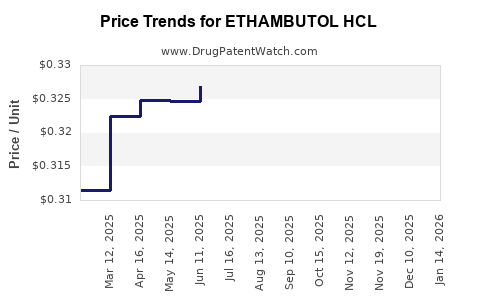
Average Pharmacy Cost for ETHAMBUTOL HCL
| Drug Name | NDC | Price/Unit ($) | Unit | Date |
|---|---|---|---|---|
| ETHAMBUTOL HCL 100 MG TABLET | 42806-0101-01 | 0.31897 | EACH | 2026-07-22 |
| ETHAMBUTOL HCL 400 MG TABLET | 42806-0102-01 | 0.47120 | EACH | 2026-07-22 |
| ETHAMBUTOL HCL 400 MG TABLET | 68084-0280-01 | 0.47120 | EACH | 2026-07-22 |
| ETHAMBUTOL HCL 100 MG TABLET | 68180-0280-01 | 0.31897 | EACH | 2026-07-22 |
| >Drug Name | >NDC | >Price/Unit ($) | >Unit | >Date |
What Is the Market Size and Demand for Ethambutol HCL?
Ethambutol hydrochloride (HCl) is an antitubercular drug primarily used in combination therapies to treat tuberculosis (TB). The global TB burden was estimated at 10.6 million new cases in 2021, according to the World Health Organization (WHO). Ethambutol's role in multidrug regimens sustains a steady demand in both developed and emerging markets.
Key market regions include:
- Asia-Pacific: Accounts for over 50% of global TB cases. India alone reports approximately 2.8 million cases annually, with government programs heavily investing in TB control.
- Africa: High TB prevalence with countries like South Africa, Nigeria, and Ethiopia positioning as major consumers.
- Europe and North America: Lower prevalence but significant due to TB drug resistance cases and imported TB.
The global TB drug market was valued at approximately USD 850 million in 2022, with ethambutol constituting roughly 15% of this segment, reflecting steady demand driven by TB management programs.
Who Are The Major Suppliers and Manufacturers?
Several companies dominate the production of Ethambutol HCl:
- Hetero Labs (India): Large-scale producer exporting globally. Known for cost-effective generics.
- Macleods Pharmaceuticals (India): Key player with extensive distribution networks.
- Glenmark Pharmaceuticals (India): Focus on quality standards aligned with FDA and EMA.
- Lupin Pharmaceuticals (India): Supplies both branded and generic versions.
Patent status is generally not an issue given the drug's age; most formulations are off-patent, which fosters generic competition.
What Are The Pricing Trends and Factors Influencing Price?
Global price variations are significant:
| Region | Price Range (per 100 mg tablet, USD) | Notes |
|---|---|---|
| India | 0.02 – 0.05 | Cost-driven market |
| United States | 0.50 – 1.00 | Higher regulatory standards |
| African markets | 0.03 – 0.07 | Dependent on local import policies |
Factors affecting prices include:
- Manufacturing costs: Lower in India due to scale and local raw material access.
- Regulatory compliance: FDA, EMA approvals add costs but open markets.
- Supply chain disruptions: Affect availability and prices, especially during COVID-19.
- Patent and patent litigations: Historically minimal, as the drug is off-patent, fostering generic competition.
What Are The Price Projection Trends?
Forecasting suggests the following:
- 2023–2027 CAGR: Approximately 3% to 5% globally, driven by TB prevalence and healthcare investments.
- Emerging markets: Higher growth rates, 4%–6%, due to increased access to generic drugs.
- Developed markets: Stabilization around 2%–3%, with price pressures from generic competition.
The price reduction trend in generic markets is expected to slow as manufacturing costs increase slightly and raw material shortages persist. US prices may see marginal increases due to tighter regulatory requirements and supply chain challenges.
What Are Potential Market Risks?
Risks include:
- Decreased TB prevalence: Due to improved sanitation, vaccination, and public health initiatives.
- Drug resistance: Rising multidrug-resistant TB (MDR-TB) cases could shift demand toward newer or combination therapies, potentially affecting Ethambutol demand.
- Regulatory changes: Stricter manufacturing standards may increase compliance costs.
- Medical innovations: Replacement therapies or advanced diagnostics may alter the TB treatment landscape.
Conclusions and Strategic Insights
Ethambutol HCl remains a critical component of TB management, supported by high global demand and a mature generic manufacturing base. Price projections indicate modest growth, especially in emerging markets. Companies that maintain cost-efficient production and navigate regulatory environments effectively will sustain market share.
Key Takeaways
- The global TB market supports steady demand for Ethambutol HCl, particularly in Asia and Africa.
- Price points vary significantly by region, influenced by local factors such as regulation and manufacturing costs.
- Prices are expected to grow modestly at an annual rate of 3-5% over the next five years.
- Market risks include declining TB incidence, resistance development, and regulatory tightening.
- Generics dominate supply, maintaining affordability and competitive pressure.
FAQs
1. How does the off-patent status of Ethambutol influence market competition?
It enables widespread generic manufacturing, suppresses prices, and promotes high-volume sales.
2. What are the main challenges in sourcing Ethambutol HCl globally?
Supply chain disruptions, raw material shortages, and regulatory delays can impact availability.
3. How are prices in developed countries maintained despite competition?
Stringent regulatory requirements and lower market volumes result in higher per-unit prices compared to emerging markets.
4. Is there upcoming demand for Ethambutol due to drug resistance?
MDR-TB cases may increase demand for regimens including Ethambutol, but overall demand growth remains moderate.
5. How might new TB drugs impact Ethambutol’s market?
Introduction of novel therapies could displace Ethambutol in some protocols, but current reliance on combination regimens sustains demand.
Sources
[1] WHO Global Tuberculosis Report 2022
[2] Market research reports on TB drug sector
[3] Industry analysis on generic pharmaceutical markets
[4] Company financial disclosures
More… ↓
