Share This Page
Drug Price Trends for ETHAMBUTOL
✉ Email this page to a colleague
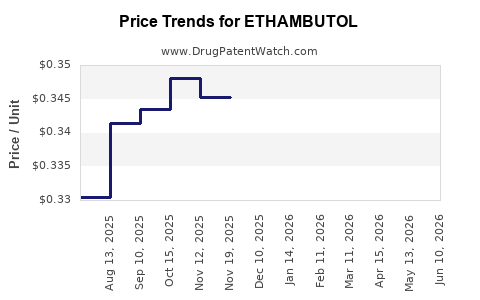
Average Pharmacy Cost for ETHAMBUTOL
| Drug Name | NDC | Price/Unit ($) | Unit | Date |
|---|---|---|---|---|
| ETHAMBUTOL HCL 400 MG TABLET | 42806-0102-01 | 0.46382 | EACH | 2026-06-17 |
| ETHAMBUTOL HCL 100 MG TABLET | 68180-0280-01 | 0.32379 | EACH | 2026-06-17 |
| ETHAMBUTOL HCL 400 MG TABLET | 68180-0281-01 | 0.46382 | EACH | 2026-06-17 |
| >Drug Name | >NDC | >Price/Unit ($) | >Unit | >Date |
Market Analysis and Price Projections for Ethambutol
Ethambutol, a crucial antibiotic in the treatment of tuberculosis (TB), has been experiencing significant growth in the global pharmaceutical market. This comprehensive analysis delves into the market trends, drivers, and price projections for Ethambutol, providing valuable insights for industry professionals and stakeholders.
Market Overview
The global Ethambutol market is on a trajectory of substantial growth. As of 2023, the market size was valued at approximately $250 million, with projections indicating it could reach $350 million by 2031[2]. This growth is driven by a compound annual growth rate (CAGR) of 4% from 2024 to 2031[2].
Key Market Drivers
Increasing Prevalence of Tuberculosis
The enduring global burden of tuberculosis remains a significant driver for the Ethambutol market. Despite advancements in healthcare, TB continues to be a major health concern worldwide, necessitating effective treatments like Ethambutol.
Rise in Multi-Drug Resistant TB
The increasing prevalence of multi-drug resistant TB strains has further fueled the demand for Ethambutol. As a first-line treatment in combination therapy, Ethambutol plays a crucial role in combating these resistant strains.
Global Health Initiatives
Ongoing initiatives to enhance TB treatment availability and upgrade healthcare infrastructure in developing nations are contributing to market expansion. These efforts align with broader global health strategies to control tuberculosis and ensure successful treatment outcomes[2].
Market Segmentation
By Application
The Ethambutol market is primarily segmented based on its application in various pharmaceutical formulations:
- Tablets: This segment holds a significant market share due to its widespread use and ease of administration.
- Capsules: The capsule formulation is gaining traction, especially in regions where patient preference leans towards this form.
- Syrup: Liquid formulations cater to specific patient groups, particularly pediatric patients.
- Injection: While less common, injectable forms of Ethambutol are used in certain clinical scenarios[2].
By Region
The market is geographically segmented into:
- North America: A key market with established healthcare systems and ongoing pharmaceutical research.
- Europe: Shows significant demand, particularly in advanced pharmaceutical formulations.
- Asia-Pacific: The fastest-growing region, driven by high TB prevalence and improving healthcare infrastructure.
- Latin America and Middle East & Africa: Emerging markets with growing healthcare awareness and increasing TB treatment initiatives[2].
Price Analysis and Projections
Current Pricing Trends
As of December 2024, the pricing for Ethambutol varies based on dosage and formulation:
- 100 mg tablet: Priced at approximately $0.30 per unit
- 400 mg tablet: Priced at approximately $0.43 per unit[1]
These prices reflect the wholesale acquisition cost and may vary based on region and supplier.
Future Price Projections
"The global Ethambutol HCL price has been analyzed from 2018 to 2023, showing a trend of stability with minor fluctuations. For the forecast period of 2024 to 2029, prices are expected to remain relatively stable, with slight increases due to inflation and market dynamics[2][3]."
Factors influencing future pricing include:
- Production costs: Any changes in raw material costs or manufacturing processes could impact pricing.
- Regulatory environment: Stricter regulations may lead to increased compliance costs, potentially affecting prices.
- Market competition: The entry of new players or generic versions could exert downward pressure on prices.
- Demand fluctuations: Changes in TB prevalence or treatment protocols could influence demand and, consequently, pricing.
Regional Market Dynamics
Asia-Pacific: The Growth Engine
The Asia-Pacific region is poised to experience the fastest growth in the Ethambutol market. Key factors driving this growth include:
- High TB burden: Countries like India and China account for a significant portion of global TB cases.
- Improving healthcare infrastructure: Investments in healthcare systems are enhancing access to TB treatment.
- Generic drug production: The region is a hub for generic drug manufacturing, potentially leading to more competitive pricing.
North America and Europe: Steady Markets
These regions are characterized by:
- Advanced healthcare systems: Well-established healthcare infrastructure supports efficient TB diagnosis and treatment.
- Research and development: Ongoing R&D efforts in TB treatment could lead to new formulations or combinations involving Ethambutol.
- Regulatory environment: Stringent regulatory standards ensure high-quality products but may also impact pricing.
Market Challenges and Opportunities
Challenges
- Drug resistance: The emergence of drug-resistant TB strains poses a significant challenge to existing treatments.
- Side effects: Managing the side effects of Ethambutol, particularly its impact on vision, remains a concern for healthcare providers.
- Global supply chain disruptions: Events like the COVID-19 pandemic have highlighted vulnerabilities in pharmaceutical supply chains.
Opportunities
- Combination therapies: Development of new combination therapies incorporating Ethambutol could expand its market potential.
- Technological advancements: Innovations in drug delivery systems or formulations could enhance Ethambutol's efficacy and patient compliance.
- Emerging markets: Untapped markets in developing countries present growth opportunities as healthcare access improves.
Future Market Outlook
The Ethambutol market is expected to maintain steady growth over the coming years. Key trends shaping the future market include:
- Personalized medicine: Tailoring TB treatments to individual patient profiles could influence Ethambutol usage patterns.
- Digital health integration: The incorporation of digital health technologies in TB management could enhance treatment adherence and monitoring.
- Sustainable production: Growing emphasis on sustainable pharmaceutical production could impact manufacturing processes and costs.
Impact of Global Events
Recent global events have had significant impacts on the Ethambutol market:
COVID-19 Pandemic
The pandemic disrupted healthcare services worldwide, potentially leading to:
- Delayed TB diagnoses: Lockdowns and healthcare system strain may have delayed TB detection and treatment initiation.
- Supply chain challenges: Global supply chain disruptions affected pharmaceutical production and distribution.
Geopolitical Tensions
Events like the Russia-Ukraine conflict have:
- Affected global trade: Sanctions and trade restrictions could impact pharmaceutical supply chains.
- Shifted market dynamics: Changes in global economic patterns may influence healthcare spending and drug accessibility.
Key Market Players
The Ethambutol market is characterized by the presence of several key players, including:
- Macleods Pharmaceuticals Ltd.
- Novartis AG
- Johnson & Johnson
- Pfizer Inc.
- Teva Pharmaceutical Industries Ltd.
- Otsuka Pharmaceutical Co., Ltd.
- Sanofi
- Lupin[4]
These companies are engaged in various strategies such as product development, partnerships, and geographical expansion to strengthen their market position.
Regulatory Landscape
The regulatory environment plays a crucial role in shaping the Ethambutol market:
- FDA regulations: In the U.S., the Food and Drug Administration's guidelines on TB treatment influence Ethambutol's usage and production.
- WHO guidelines: The World Health Organization's recommendations on TB management significantly impact global Ethambutol demand.
- Regional regulations: Varying regulatory standards across different countries can affect market entry and product availability.
Research and Development Trends
Ongoing R&D efforts in the TB treatment space are likely to influence the Ethambutol market:
- New formulations: Research into novel drug delivery systems or combination therapies could expand Ethambutol's applications.
- Improved diagnostics: Advancements in TB diagnostics could lead to earlier treatment initiation, potentially increasing Ethambutol usage.
- Alternative treatments: Development of new TB drugs could either complement or compete with Ethambutol in treatment regimens.
Patient Accessibility and Affordability
Ensuring patient access to Ethambutol remains a critical factor in market growth:
- Generic availability: The presence of generic versions helps in maintaining affordability.
- Government initiatives: Public health programs and subsidies in many countries improve access to TB treatments.
- Patient assistance programs: Pharmaceutical companies often offer programs to help patients afford necessary medications.
Environmental and Sustainability Considerations
The pharmaceutical industry's growing focus on sustainability may impact Ethambutol production:
- Green chemistry: Adoption of environmentally friendly production processes could influence manufacturing costs.
- Packaging innovations: Sustainable packaging solutions may affect product pricing and market positioning.
- Carbon footprint reduction: Efforts to reduce the carbon footprint of drug production and distribution could shape future market strategies.
Key Takeaways
- The global Ethambutol market is projected to grow from $250 million in 2023 to $350 million by 2031, with a CAGR of 4%.
- Asia-Pacific is expected to be the fastest-growing region in the Ethambutol market.
- Current pricing for Ethambutol ranges from $0.30 to $0.43 per unit, depending on dosage.
- Future price projections indicate relative stability with slight increases due to inflation and market dynamics.
- Key market drivers include the ongoing global TB burden, rise in multi-drug resistant TB, and global health initiatives.
- Challenges include drug resistance and potential side effects, while opportunities lie in combination therapies and emerging markets.
- The market is influenced by global events such as the COVID-19 pandemic and geopolitical tensions.
- Regulatory landscape, R&D trends, and sustainability considerations will play crucial roles in shaping the future Ethambutol market.
FAQs
-
What is the primary use of Ethambutol? Ethambutol is primarily used in the treatment of tuberculosis, often in combination with other antibiotics.
-
How is the Ethambutol market expected to grow in the coming years? The Ethambutol market is projected to grow from $250 million in 2023 to $350 million by 2031, with a CAGR of 4%.
-
Which region is expected to see the fastest growth in the Ethambutol market? The Asia-Pacific region is anticipated to experience the fastest growth in the Ethambutol market due to high TB prevalence and improving healthcare infrastructure.
-
How has the COVID-19 pandemic affected the Ethambutol market? The pandemic has disrupted healthcare services, potentially leading to delayed TB diagnoses and treatment initiations, as well as challenges in the pharmaceutical supply chain.
-
What are the main factors driving the growth of the Ethambutol market? Key drivers include the increasing prevalence of tuberculosis, rise in multi-drug resistant TB cases, and ongoing global health initiatives to combat TB.
Sources cited: [1] https://www.drugpatentwatch.com/p/drug-price/drugname/ETHAMBUTOL+HCL [2] https://www.marketresearchintellect.com/product/ethambutol-market-size-and-forecast/ [3] https://www.verifiedmarketreports.com/product/ethambutol-market/ [4] https://www.alliedmarketresearch.com/tuberculosis-treatment-drugs-market-A13238
More… ↓
