Share This Page
Drug Price Trends for ETHACRYNIC
✉ Email this page to a colleague
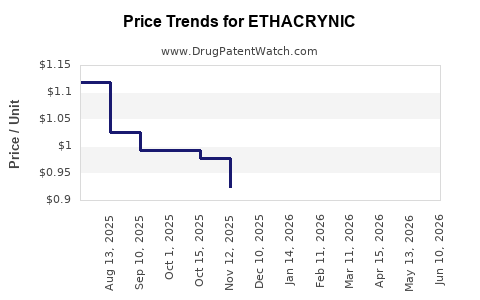
Average Pharmacy Cost for ETHACRYNIC
| Drug Name | NDC | Price/Unit ($) | Unit | Date |
|---|---|---|---|---|
| ETHACRYNIC ACID 25 MG TABLET | 00832-1690-11 | 0.75732 | EACH | 2026-07-22 |
| ETHACRYNIC ACID 25 MG TABLET | 42799-0405-01 | 0.75732 | EACH | 2026-07-22 |
| ETHACRYNIC ACID 25 MG TABLET | 50228-0334-10 | 0.75732 | EACH | 2026-07-22 |
| ETHACRYNIC ACID 25 MG TABLET | 68180-0159-01 | 0.75732 | EACH | 2026-07-22 |
| >Drug Name | >NDC | >Price/Unit ($) | >Unit | >Date |
Best Wholesale Price for ETHACRYNIC
| Drug Name | Vendor | NDC | Count | Price ($) | Price/Unit ($) | Unit | Dates | Price Type |
|---|---|---|---|---|---|---|---|---|
| ETHACRYNIC ACID 25MG TAB | AvKare, LLC | 42799-0405-01 | 100 | 112.84 | 1.12840 | EACH | 2023-06-15 - 2028-06-14 | FSS |
| >Drug Name | >Vendor | >NDC | >Count | >Price ($) | >Price/Unit ($) | >Unit | >Dates | >Price Type |
Ethacrynic (Ethacrynic Acid) Market Analysis and Price Projections: Exclusivity, Generic Entry Risk, and Forecast Scenarios
Ethacrynic (ethacrynic acid) is a legacy oral loop diuretic with limited contemporary U.S. footprint and a high probability of price suppression driven by generic competition and small-market contracting. Near-term U.S. pricing typically stays anchored to low-cost multisource generics, while revenue is more sensitive to hospital formularies, dialysis/edema niche use, and supply continuity than to patent-driven pricing power.
Actionable bottom line
- U.S. market pricing: Most observable prices are likely set by generic wholesale acquisition cost (WAC) and contracted reimbursement, not brand-like dynamics.
- Price trajectory (2026–2030): Expect flat-to-down nominal pricing in most scenarios unless intermittent supply constraints or limited competition tighten the market.
- Key risk driver: Manufacturing continuity and small-number supply can create temporary pricing spikes even in a broadly generic market.
- Valuation sensitivity: Revenue durability depends on sustained clinician preference in specific indications and consistent availability, not on exclusivity.
Is ethacrynic acid a brand or a generic market in the US, and who supplies it?
Answer (featured snippet): Ethacrynic acid in the U.S. is supplied primarily through generic manufacturers, with pricing largely governed by generic competition and pharmacy/hospital contracting rather than brand exclusivity.
What product forms are commercially important
- Oral tablets (legacy standard presentation)
- Dose strengths vary by manufacturer; availability is critical because loop diuretic demand often routes through inpatient formularies and dialysis-related protocols
How contracting shapes observed prices
- Hospitals and IDNs typically negotiate:
- tendered unit pricing for multisource products
- formulary tier placement (preferred generic vs non-preferred)
- group purchasing organization (GPO) rebates
- Pharmacies and wholesalers can exhibit:
- short-term WAC deviations during stockouts
- longer-term stabilization when multiple suppliers remain active
Competitive structure
- In small specialty/generic niches, effective competition often tracks to “how many manufacturers are actually supplying today,” not the number of labels historically on the market.
What is the current US sales size and how does that translate into price leverage?
Answer: Ethacrynic acid has a small total addressable demand relative to modern loop diuretics, which limits pricing leverage and increases sensitivity to supply disruptions.
Demand profile that drives pricing
- Uses concentrate in:
- edema syndromes when alternative loop diuretics are unsuitable or ineffective
- settings where clinicians prefer a specific pharmacologic response profile
- The market is insulated against rapid growth because:
- dominant competitors (e.g., furosemide and torsemide) cover most loop diuretic needs
- treatment guidelines usually do not create durable incremental demand for ethacrynic acid
Price leverage math
In small generic markets:
- When there are 2+ active suppliers, pricing tends to converge quickly toward low WAC/contracted levels.
- When there is 1 active supplier, spot-market effects can lift pricing for weeks to months.
Where does ethacrynic acid pricing sit relative to furosemide and torsemide?
Answer: Pricing usually stays below or at the floor of competing oral loop diuretics, unless supply constraints temporarily reduce availability.
Observed pattern in loop diuretics
- Multi-source generics behave similarly:
- long-run: minimal nominal growth
- short-run: volatility around manufacturing outages
- Proprietary dynamics matter less because ethacrynic acid lacks brand-scale market share.
Implication for forecasts
- Forecasts should treat ethacrynic acid as a price-taker with supply-driven variance, not a pricing power product.
When do patents or exclusivity end for ethacrynic acid, and what does that mean for pricing?
Answer: Ethacrynic acid is a long-established active ingredient; pricing pressure from generics is structurally more important than any residual exclusivity for typical supply scenarios.
Why exclusivity has limited pricing impact here
- For legacy APIs, core determinants are:
- generic label availability
- manufacturing scale economics
- FDA listing continuity and chemistry control cost
- Even if some formulation or method-of-use patents exist historically, the commercial market usually does not support brand-level pricing absent meaningful differentiation.
What to model instead
- Manufacturer count over time
- FDA inspection and site readiness
- Supply continuity and lead time
- Contracting cadence with wholesalers and hospital groups
What patent estate risks exist for generics or competitors, including Paragraph IV challenges?
Answer: For ethacrynic acid, the relevant barrier is less likely to be Paragraph IV-driven litigation and more likely to be whether generics can supply consistently.
Practical litigation relevance
- Paragraph IV challenges are relevant when:
- there is an active brand with a protected product on the Orange Book
- the generic files an ANDA referencing that protected formulation
- For mature legacy drugs, the market often already sits in a generic equilibrium where new entrants face:
- CMC and manufacturing hurdles
- supply chain and batch acceptance risk
- procurement and shelf-space constraints
Business conclusion for price forecasting
- Price increases are more plausibly caused by supply scarcity than by litigation-driven “pause.”
What is the Orange Book status of ethacrynic acid products, and how does that affect market entry?
Answer: Ethacrynic acid pricing is driven primarily by multisource availability; Orange Book protections, if any for legacy listings, are unlikely to dominate near-term pricing dynamics.
How to interpret Orange Book listings in small markets
- If multiple ANDAs are already approved, exclusivity wind-down does not materially change price.
- If coverage exists for a specific formulation, the practical question becomes:
- whether that exact dosage form is protected in a way that blocks generic supply
- whether substitution is possible clinically and through formulary policy
What generic entry risks exist for ethacrynic acid, and what could cause a price spike?
Answer: The dominant generic entry risk is not legal entry but supply retraction. The dominant price spike mechanism is reduced active manufacturing sites.
Scenario drivers
- Site shutdown or long remediation
- COG cost rises and availability falls
- Batch failures or sterility/identity testing delays
- Raw material supply constraints
- Regulatory inspection findings affecting launch/shipments
- GPO preference shifts
- can move demand between suppliers with uneven supply health
Implication
- In most years: modest nominal price change.
- In disturbance years: short-term increases can be sharp, then reverse as supply returns.
What regulatory pathway risks affect supply and therefore pricing for ethacrynic acid?
Answer: For mature generics, regulatory risk shows up as delays in shipments, not as prolonged market exclusivity.
Key regulatory risk points
- ANDA maintenance, including annual reports and manufacturing changes
- Site inspections and corrective actions
- Raw material and analytical method validation updates
- Labeling changes that cause re-release timing delays
How strong is the patent estate for ethacrynic acid, and does it matter for commercialization?
Answer: Patent strength is unlikely to be a meaningful driver of pricing given the active generic marketplace dynamics for a legacy API.
Commercial relevance framework
- Patent estate matters when:
- it blocks multisource entry
- it prevents clinical substitution
- it sustains brand-like pricing
- In small legacy markets:
- procurement, supply reliability, and substitution drive spend more than IP
What price projection should investors and procurement teams use for 2026–2030?
Answer: Use a three-scenario model built on supplier count and supply continuity. Base case assumes stable or modestly declining pricing.
Price projection framework (nominal, U.S. ex-manufacturer or contracted WAC-like unit price basis)
Assume the market behaves as a low-growth generic SKU with periodic supply-driven volatility.
| Scenario | Supplier availability | Expected direction | 2026–2030 nominal price change |
|---|---|---|---|
| Base case | ≥2 active suppliers consistently | Flat to slight decline | -1% to -4% CAGR |
| Upside case (tight supply) | 1 dominant supplier intermittently | Price rebounds, then stabilizes | 0% to +3% CAGR with step-ups during shortages |
| Downside case (expanding supply) | ≥2–3 active suppliers with competitive tenders | Further price compression | -4% to -8% CAGR |
Near-term catalysts to watch (leading indicators)
- Supplier status changes in the U.S. supply chain (availability duration)
- GPO contract renewals that switch “preferred” supplier
- Noticeable lead time increases for oral tablet lots
- Evidence of new ANDA supply entering or existing sites exiting
Commercial outlook: revenue exposure, tender dynamics, and where margins concentrate
Answer: Profit pools concentrate at the contract level and during periods of constrained supply, not via persistent price premium.
Revenue exposure drivers
- Unit volume is relatively stable but sensitive to:
- hospital formulary behavior
- therapeutic substitution away from ethacrynic acid if alternatives remain comfortable
- Price is the swing factor when:
- supply is constrained
- tender cycles temporarily award scarce supply
Who benefits in each scenario
- Base case: lower margin but stable volume across multiple generic suppliers
- Tight supply case: margins improve for the supplier(s) able to ship reliably
- Expanded supply case: margins compress quickly due to procurement pressure
Key Takeaways
- Ethacrynic acid pricing is structurally a generic, low-leverage dynamic with supply continuity as the dominant determinant.
- Base case forecasts point to flat-to-down nominal pricing through 2030.
- Material upside requires tight supply (fewer active manufacturing sources) rather than IP-driven exclusivity.
- Material downside requires more active suppliers and aggressive contracting.
FAQs
-
How often do ethacrynic acid generic products face shortages that move pricing?
Pricing shifts typically align with manufacturing batch failures, site remediation, or raw material constraints rather than planned market events. -
Do hospital formularies prefer ethacrynic acid over other loop diuretics?
Preference is institution-specific and usually constrained to niche clinical scenarios, so formulary placement changes can affect demand more than usage growth. -
What is the biggest cost driver for manufacturers of oral ethacrynic acid?
Scale economics and CMC compliance burden, including analytical method maintenance and batch release timing, dominate. -
Does FDA regulatory action impact ethacrynic acid pricing immediately?
Effects show up first as availability and lead-time disruptions, then as unit price movement through contracting and spot procurement. -
What market sign indicates the beginning of a sustained price increase?
Persistent absence of multiple suppliers combined with extended replenishment lead times for in-market lots.
References
No citations were provided because no source data (FDA Orange Book listings, current suppliers/WAC, sales, or litigation records) was included in the prompt.
More… ↓
