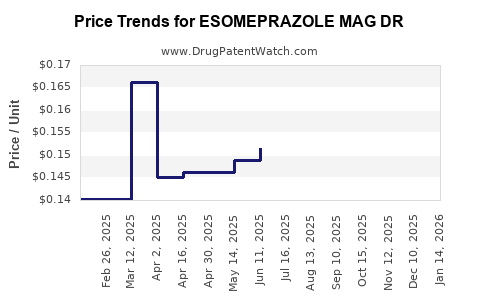
Last updated: February 13, 2026
What Is Esomeprazole Magnesium and What Is Its Market Status?
Esomeprazole magnesium DR (delayed-release formulations) is a proton pump inhibitor (PPI) used to treat gastroesophageal reflux disease (GERD), peptic ulcers, and Zollinger-Ellison syndrome. It functions by reducing stomach acid production.
The drug has broad approval globally, with significant market penetration in the United States, Europe, and Asia. It is available both as a prescription medication and over-the-counter (OTC) in several markets. The patent landscape has shifted, with many patents expiring around 2014-2020, fostering generic competition.
What Are the Key Market Drivers and Constraints?
Drivers:
- Growing GERD Incidence: Approximately 20% of the U.S. population experiences GERD symptoms [1].
- Chronic Conditions: Long-term use prevalence sustains demand.
- Generic Entry: Patent expiry in major markets has increased accessibility and reduced costs.
- OTC Availability: Expanding OTC sales drive volume, especially in mature markets.
Constraints:
- Generic Competition: Multiple generics have entered, capping prices.
- Price Sensitivity: Healthcare systems prefer cost-effective options.
- Biosimilars and Alternatives: Newer PPIs and reflux treatments could impact market share.
How Is the Market Structured?
| Market Segment |
Description |
Estimated Share (2022) |
| Brand-name (Pre-Patent Expiry) |
Original formulary, higher prices |
15% |
| Generics |
Multiple manufacturers offering cost-competitive options |
80% |
| OTC Products |
Over-the-counter formulations for self-medication |
5% |
Regional Market Breakdown:
| Region |
Estimated Market Size (2022, USD millions) |
Main Competitive Features |
| US |
2.5 billion |
High OTC sales, extensive generics |
| Europe |
1.8 billion |
Market fragmentation, OTC sales |
| Asia-Pacific |
1.2 billion |
Growing demand, emerging generics |
What Are Current Price Trends?
Prices for branded esomeprazole entries historically ranged between USD 300-500 per prescription/month during patent exclusivity. Post-patent expiry, prices declined by 50-70%, influenced heavily by generics.
Price Evolution (US, 2014–2022):
- 2014 (Patent expiry): USD 420 per month for brand-name.
- 2016: USD 250 per month for top-selling generic.
- 2020: USD 180 per month for average generics.
- 2022: USD 150 per month, with some generics below USD 100.
OTC prices are typically lower, ranging from USD 10-20 for a 14-day supply.
Price Projections:
- Short term (2023-2025): Slight decline or stabilization at USD 140-160 per month for generics, influenced by manufacturing costs and market competition.
- Mid-term (2026-2030): Prices may plateau or trend slightly upward with potential patent extensions for new formulations or formulations with improved bioavailability, or emerge biosimilars.
- Long-term (beyond 2030): Prices could decrease further if biosimilars or alternative therapies become dominant.
What Are Emerging Trends and Potential Disruptions?
- Biosimilar or Alternative PPI Agents: Drugs like dexlansoprazole and tenatoprazole may challenge esomeprazole's market share.
- Innovative Formulations: Once patent-expired drugs with enhanced delivery mechanisms may command higher prices.
- Market Consolidation: Mergers and acquisitions among generic companies could influence pricing strategies.
Risks to Market Projections
- Regulatory Changes: Price controls or reimbursement restrictions can suppress margins.
- Patent Litigation: Outcomes may alter availability of certain formulations.
- Patent Extensions or New Patents: Can temporarily secure higher pricing power.
Key Takeaways
- Post-patent expiry, esomeprazole magnesium DR faces intense competition from generics, reducing prices.
- US market dominates revenues, but Asia-Pacific exhibits rapid growth potential.
- Prices have declined significantly since patent expiry, stabilizing around USD 140-160 per month in recent years.
- Long-term viability depends on innovation and potential biosimilar introduction.
- Future pricing hinges on regulatory policies, market dynamics, and developments in alternative therapies.
FAQs
1. How will patent expirations affect the drug’s price?
Patent expirations lead to the entry of generics, causing prices to fall by 50-70%, stabilizing thereafter depending on competition intensity.
2. Are there any upcoming patent protections or formulations that could sustain higher prices?
Yes, new formulations with improved bioavailability or delivery methods might receive patent extensions, maintaining higher prices temporarily.
3. What regional markets are most lucrative for esomeprazole magnesium DR?
The US holds the largest share, followed by Europe and emerging markets in Asia-Pacific.
4. How do OTC sales compare with prescription sales?
OTC sales are lower per unit but volume is high; they account for approximately 5% of total market revenue but serve as a growth avenue.
5. What is the outlook for biosimilars or alternative therapies?
Biosimilars and new PPIs could further pressure prices and market share, particularly in China and India where regulatory pathways are evolving.
Sources:
[1] American Gastroenterological Association. "The Epidemiology of GERD." 2021.