Last updated: July 27, 2025
The global esomeprazole market is poised for significant growth in the coming years, driven by an aging population, changing lifestyles, and increasing prevalence of gastrointestinal disorders. This article provides an in-depth analysis of the market trends, growth projections, and price forecasts for esomeprazole, a widely prescribed proton pump inhibitor (PPI) used to treat acid-related gastrointestinal conditions.
Market Size and Growth Projections
The esomeprazole market has shown steady growth in recent years and is expected to continue expanding at a healthy rate. In 2023, the market was valued at USD 1,810.61 million[1]. Looking ahead, the market is projected to grow from USD 1,904.40 million in 2024 to USD 2,872.07 million by 2032, exhibiting a compound annual growth rate (CAGR) of 5.3% during the forecast period[1].
By 2032, the esomeprazole market is expected to reach USD 2,872.07 million, growing at a CAGR of 5.3% from 2024 to 2032[1].
This growth trajectory is supported by multiple factors, including:
- Increasing prevalence of gastroesophageal reflux disease (GERD) and peptic ulcers
- Growing elderly population
- Rising awareness about gastrointestinal health
- Advancements in drug delivery technologies
Key Market Drivers
Rising Gastroenteritis Cases
One of the primary factors driving the demand for esomeprazole is the increasing incidence of gastroenteritis and other stomach-related health issues. In April 2023, hospitals in India reported a 25-30% rise in gastroenteritis cases over a few weeks[1]. This trend is likely to continue, fueling the demand for esomeprazole and similar medications.
Aging Population and Lifestyle Changes
The growing elderly population and changing lifestyles are significant contributors to the rising demand for esomeprazole. Many working individuals follow hectic schedules with limited time for balanced meals, leading to digestive system complications and acidity disorders[1]. This demographic shift is creating a critical need for medications that can effectively reduce stomach acid levels.
Increasing Prevalence of GERD
Gastroesophageal reflux disease (GERD) is becoming increasingly common, particularly in North America. According to the Centre for Disease Control, approximately 25 million people in the United States are expected to experience peptic ulcers at least once in their lifetime[1]. This high prevalence of GERD and related conditions is a key driver of esomeprazole demand.
Market Segmentation
By Product Type
The esomeprazole market can be segmented into various product types, including:
- Capsules
- Tablets
- Injections
- Others
Among these, the capsule segment is expected to witness significant growth due to its advantages over other dosage forms. Capsules are fast-acting, break down more quickly than tablets, and are less likely to have an unpleasant taste or odor[4].
By Application
Esomeprazole is used to treat various gastrointestinal conditions, including:
- Gastroesophageal Reflux Disease (GERD)
- Duodenal Ulcers
- Peptic Ulcers
- Others
The growing prevalence of these conditions, particularly GERD, is expected to drive market growth across all application segments.
By Distribution Channel
The market can also be segmented based on distribution channels:
- Hospitals and Clinical Pharmacies
- Retail Pharmacies
- Online Pharmacies
The hospitals and clinical pharmacies segment held a significant market share in revenue in 2023, driven by the rising number of people seeking treatment for peptic ulcers, GERD, and other gastrointestinal diseases in healthcare settings[1].
Regional Market Analysis
North America: Market Leader
North America currently dominates the global esomeprazole market, primarily due to the high prevalence of GERD and peptic ulcers in the region. The United States, in particular, is a major contributor to regional growth, with approximately 20% of adults experiencing GERD symptoms[4].
Asia Pacific: Fastest-Growing Region
The Asia Pacific region is projected to be the fastest-growing market for esomeprazole, with a healthy CAGR during the forecast period. This growth is attributed to the increasing elderly population, rising gastroesophageal reflux cases, and growing number of companies engaging in esomeprazole production in the region[1].
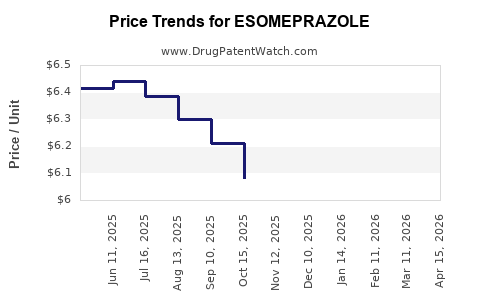
Price Trends and Projections
While specific price projections for esomeprazole are not readily available, several factors are likely to influence pricing in the coming years:
-
Manufacturing Costs: Esomeprazole production requires significant investment due to its complex manufacturing process. This could lead to higher costs per medication[1].
-
Generic Competition: As patents expire and more generic versions enter the market, prices may experience downward pressure.
-
Demand Fluctuations: Increasing demand, particularly in emerging markets, could potentially drive prices up.
-
Regulatory Environment: Changes in healthcare policies and regulations may impact pricing strategies.
Market Challenges
Despite the positive growth outlook, the esomeprazole market faces several challenges:
-
High Production Costs: The complex manufacturing process of esomeprazole leads to high production costs, which can result in lower supply and higher medication costs[1].
-
Generic Competition: As patents expire, increased competition from generic versions of esomeprazole may impact market share and pricing for branded products.
-
Side Effects Concerns: Long-term use of proton pump inhibitors like esomeprazole has been associated with certain side effects, which may influence prescribing patterns and patient preferences.
Future Market Trends
Several trends are expected to shape the esomeprazole market in the coming years:
-
Growing Demand for Proton Pump Inhibitors (PPIs): The increasing incidence of acid-related gastrointestinal disorders is likely to drive demand for PPIs like esomeprazole[3].
-
Increasing Availability of Over-the-Counter Esomeprazole: The trend towards OTC availability may increase the popularity of esomeprazole as a self-management option for heartburn and acid reflux[3].
-
Focus on Gastrointestinal Health and Wellness: Growing awareness of the importance of digestive health may lead to increased preventive use of medications like esomeprazole[3].
-
Innovation in Drug Delivery Technologies: Advancements in drug delivery systems may improve the efficacy and convenience of esomeprazole administration[3].
Competitive Landscape
The esomeprazole market is characterized by the presence of several key players, including:
- Teva Pharmaceutical Industries Ltd.
- AstraZeneca
- Amneal Pharmaceuticals LLC
- Viatris Inc.
- DAIICHI SANKYO COMPANY, LIMITED
- Sun Pharmaceutical Industries Ltd.
These companies are engaged in various strategic initiatives, including mergers and acquisitions, product launches, and research and development activities to strengthen their market position[4].
Key Takeaways
- The global esomeprazole market is projected to reach USD 2,872.07 million by 2032, growing at a CAGR of 5.3% from 2024 to 2032.
- Rising gastroenteritis cases, an aging population, and increasing prevalence of GERD are key drivers of market growth.
- North America currently leads the market, while Asia Pacific is expected to be the fastest-growing region.
- The capsule segment is anticipated to witness significant growth due to its advantages over other dosage forms.
- High production costs and generic competition pose challenges to the market.
- Future trends include growing demand for PPIs, increased OTC availability, and focus on gastrointestinal health and wellness.
FAQs
-
Q: What is the projected market size for esomeprazole by 2032?
A: The esomeprazole market is expected to reach USD 2,872.07 million by 2032.
-
Q: What is the compound annual growth rate (CAGR) for the esomeprazole market from 2024 to 2032?
A: The market is projected to grow at a CAGR of 5.3% during this period.
-
Q: Which region is currently leading the esomeprazole market?
A: North America currently dominates the global esomeprazole market.
-
Q: What are the main factors driving the growth of the esomeprazole market?
A: Key drivers include rising gastroenteritis cases, an aging population, increasing prevalence of GERD, and changing lifestyles.
-
Q: What are some challenges facing the esomeprazole market?
A: Major challenges include high production costs, generic competition, and concerns about side effects associated with long-term use of proton pump inhibitors.
Sources cited:
[1] https://www.polarismarketresearch.com/industry-analysis/esomeprazole-market
[3] https://www.theinsightpartners.com/reports/esomeprazole-market
[4] https://www.mordorintelligence.com/industry-reports/esomeprazole-market