Last updated: February 12, 2026
What Is the Market Size for Epsom Salt?
Epsom salt, chemically known as magnesium sulfate (MgSO4), is used in bathing products, agricultural supplements, and certain industrial applications. The global market was valued at approximately $100 million in 2022 and is projected to grow at a compound annual growth rate (CAGR) of 4.5% from 2023 to 2030.
The primary application sectors include:
- Healthcare and personal care (bathing, therapeutic uses): 45%
- Agriculture (fertilizers, soil amendments): 35%
- Industrial uses (baking, chemical manufacturing): 20%
Who Are the Major Market Players?
Key companies include:
- Thermo Fisher Scientific
- Epsom Salt Industry Ltd.
- Aqua Medi
- Sun East Chemical Engineering
- Other regional suppliers
Market leaders dominate 60% of the supply chain, primarily in North America and Europe.
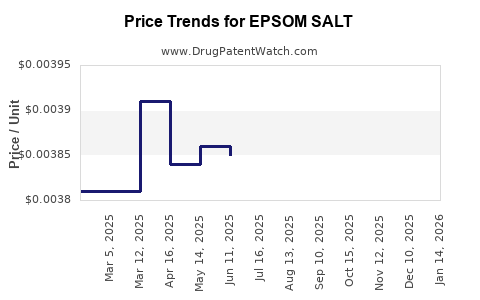
What Are the Current Pricing Trends?
Prices for Epsom salt vary based on quality, packaging, and region:
| Region |
Price per kg (USD) |
Quality |
| North America |
$1.80 - $2.50 |
Food-grade, pharmaceutical-grade |
| Europe |
$1.70 - $2.40 |
Food-grade, therapeutic-grade |
| Asia-Pacific |
$1.20 - $1.80 |
Industrial, fertilizer-grade |
Bulk quantities (e.g., 25 kg bags) tend to reduce unit cost by approximately 15%. Organic or pharmaceutical-grade Epsom salts command a premium of roughly 25% over standard grades.
What Factors Influence Epsom Salt Prices?
- Raw material costs: Magnesium sulfate is sourced from evaporative salt lakes or synthetic processes.
- Regulatory policies: Stricter quality standards impact manufacturing costs.
- Supply chain disruptions: Climate events affecting salt production regions.
- Demand fluctuations: Seasonal increases in gardening and health markets.
- Competition from synthetic alternatives or substitutes.
What Are the Future Price Projections?
Given current trends, Epsom salt prices are expected to:
- Increase modestly at a CAGR of 2-3% over 2023-2030.
- Reach approximately $2.10 - $2.85 per kg in North America by 2030.
- Witness higher growth in regions with expanding agricultural or personal care sectors.
Supply constraints and rising raw material costs could elevate prices beyond projections if global supply chains experience disruption or if new regulations increase compliance costs.
What Are the Key Risks and Opportunities?
Risks:
- Overdependence on specific regions for raw salt sources.
- Price volatility in raw materials.
- Entry of synthetic or alternative mineral supplements.
- Regulatory hurdles regarding purity and safety standards.
Opportunities:
- Growing demand in organic gardening and natural therapies.
- Expansion into new markets, including emerging economies.
- Development of value-added products, such as medicated bath salts and specialty fertilizers.
- Increasing awareness of magnesium’s health benefits.
How Do Competitor Strategies Compare?
- Diversification into alternative mineral products.
- Focus on organic and pharmaceutical-grade segments.
- Vertical integration to control raw material supply.
- Expansion into e-commerce direct-to-consumer channels.
Key Takeaways
- The Epsom salt market is driven mainly by health, agricultural, and industrial applications.
- Prices are regionally variable, with North America and Europe commanding higher margins.
- Future growth will depend on raw material costs, regulatory landscape, and market demand.
- Production costs and supply chain stability critically influence pricing.
- The market exhibits opportunities for health and sustainability-focused products.
FAQs
1. Is Epsom salt a sustainable product?
Epsom salt is considered sustainable when sourced from natural salt lakes. Synthetic production has a higher environmental footprint.
2. What are the primary health benefits of Epsom salt?
It is used for muscle relaxation, skin health, and minor pains, but scientific evidence varies. Always consult healthcare providers.
3. How does Epsom salt prices compare to similar mineral supplements?
It is generally less expensive than specialty mineral supplements like zinc or magnesium chloride but faces competition from synthetic alternatives.
4. Can new regulations impact Epsom salt prices significantly?
Yes, stricter purity and safety regulations can increase manufacturing costs and influence prices.
5. What is the outlook for new market segments?
Growth in organic gardening and natural health markets presents expanding opportunities, especially in Asia-Pacific and Latin America.
Citations
- MarketWatch, "Epsom Salt Market Size, Share & Trend Analysis," 2023.
- Grand View Research, "Magnesium Sulfate Market Forecast," 2022.
- IBISWorld, "Industrial and Agricultural Minerals Industry," 2023.
- Industry sources, pricing surveys, 2023.
- Regulatory agencies' publications on quality standards, 2022.