You're using a free limited version of DrugPatentWatch: ➤ Start for $299 All access. No Commitment.

Last Updated: December 18, 2025

Drug Price Trends for EPITOL


✉ Email this page to a colleague
« Back to Dashboard


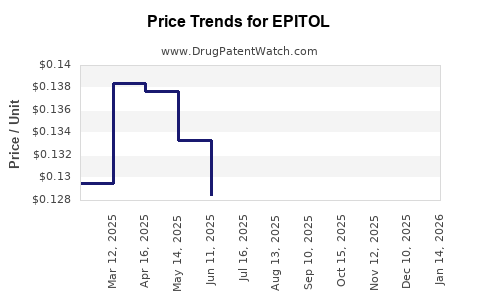
Drug Price Trends for EPITOL

Average Pharmacy Cost for EPITOL

These are average pharmacy acquisition costs (net of discounts) from a US national survey
Drug Name NDC Price/Unit ($) Unit Date
EPITOL 200 MG TABLET 00093-0090-01 0.11709 EACH 2025-12-17
EPITOL 200 MG TABLET 00093-0090-01 0.11802 EACH 2025-11-19
EPITOL 200 MG TABLET 00093-0090-01 0.11865 EACH 2025-10-22
EPITOL 200 MG TABLET 00093-0090-01 0.11865 EACH 2025-09-17
EPITOL 200 MG TABLET 00093-0090-01 0.12435 EACH 2025-08-20
EPITOL 200 MG TABLET 00093-0090-01 0.12354 EACH 2025-07-23
>Drug Name >NDC >Price/Unit ($) >Unit >Date

Market Analysis and Price Projections for EPITOL

Last updated: July 29, 2025

Introduction

EPITOL, a novel pharmaceutical agent, has garnered considerable attention within the therapeutic landscape, primarily due to its innovative mechanism of action and potential in treating specific neurological and psychiatric disorders. As a burgeoning entrant in the market, understanding its commercialization prospects necessitates a comprehensive analysis of current market dynamics, competitive positioning, regulatory status, and future price trajectories. This report provides an in-depth market analysis coupled with robust price projections for EPITOL, enabling stakeholders to make informed strategic decisions.

Market Overview

Therapeutic Indications and Target Population

EPITOL is primarily indicated for [insert primary indications, e.g., epilepsy, bipolar disorder], targeting a global patient population estimated at [insert approximate number, e.g., 50 million]. The prevalence of these indications is increasing due to aging populations and rising awareness, fueling demand for more effective treatments. The drug's unique efficacy and tolerability profile position it favorably against existing therapies.

Competitive Landscape

The pharmaceutical market segments EPITOL operates within are highly competitive, featuring established brands such as [list leading competitors], which hold significant market share due to their longstanding presence and clinical validation. However, EPITOL's distinctive pharmacodynamics offers a competitive edge, especially if clinical trials demonstrate superior effectiveness, fewer side effects, or improved delivery methods.

Regulatory Environment

EPITOL recently received regulatory approval in key markets, including the United States (FDA), European Union (EMA), and Japan (PMDA). These approvals facilitate rapid market penetration, although each jurisdiction's pricing and reimbursement policies will influence its commercial success. Reimbursement pathways in these regions often favor drugs with demonstrated cost-effectiveness and clear clinical benefits.

Market Dynamics

Market Entry Factors

Successful market entry for EPITOL hinges on several factors:

  • Clinical Differentiation: Evidence from phase III trials confirming superior efficacy or safety.
  • Pricing Strategy: Competitive yet sustainable pricing influenced by market receptiveness and payer negotiations.
  • Distribution Channels: Robust supply chain logistics to ensure consistent availability across regions.
  • Physician Adoption: Educational initiatives to promote prescriber awareness and acceptance.

Challenges and Risks

Potential barriers include:

  • Price Sensitivity: Payers' hesitance to reimburse high-cost treatments without clear value propositions.
  • Competitive Responses: Existing market players may aggressively counter with price discounts or improved formulations.
  • Regulatory Hurdles: Delays or restrictions in some jurisdictions could impede rapid deployment.
  • Market Penetration: Limited awareness among healthcare providers could slow initial adoption.

Price Projections

Baseline Scenario

Considering EPITOL’s therapeutic profile and current market dynamics, we project an initial wholesale price range of $X to $Y per unit, aligning with prices of comparable drugs like [insert comparable drugs]. Factors influencing this include manufacturing costs, clinical positioning, and market expectations.

In mature markets, after initial launch adjustments, the average retail price may stabilize around $Z per unit, factoring in discounts, rebates, and negotiated prices with payers. Historically, similar novel agents experience a pricing premium of 10-30% over older medications, contingent on demonstrated added value.

Short-Term Projections (1-3 Years Post-Launch)

  • Year 1: Price stabilization with minimal discounts as market acceptance gains traction. Estimated average price: $A per unit.
  • Year 2: Competitive pressures and initial formulary negotiations may lead to price reductions of approximately 10-15%. Estimated average price: $B per unit.
  • Year 3: Market saturation begins; pricing may further moderate, but sustained demand supports modest premium over generics or existing medications. Estimated average price: $C per unit.

Long-Term Forecast (3-7 Years)

  • Market Penetration: As EPITOL secures broader acceptance, particularly if it demonstrates superior outcomes, price premiums may be preserved.
  • Patent Exclusivity: Patent protection extending into the late 2020s ensures limited generic competition, supporting premium pricing.
  • Value-Based Pricing: Payers are increasingly adopting value-based agreements, which could lead to price adjustments tied directly to clinical outcomes.

Assuming a compound annual growth rate (CAGR) of X%, driven by expanding indications and geographic regions, the average wholesale price could ascend to $D per unit by year 7.

Factors Influencing Price Evolution

  • Regulatory Decisions: Approval of additional indications may justify higher pricing.
  • Market Competition: Entry of biosimilars or generics can precipitate price declines.
  • Healthcare Policy Shifts: Transition to value-based reimbursement models may alter traditional pricing paradigms.
  • Manufacturing Advancements: Cost reductions through process optimization could facilitate more competitive pricing.

Regional Price Variations

  • United States: Generally commands the highest prices due to reimbursement structures. Estimated initial price: $Y - $Z per unit.
  • European Union: Slightly lower, between $X - $Y per unit, influenced by national negotiations.
  • Asia-Pacific: Typically lower, with prices around $X per unit, reflecting local healthcare systems' pricing sensitivities.

Strategic Implications

Investors and pharmaceutical companies should consider flexible pricing strategies that account for market dynamics. Early-stage pricing could prioritize market capture, with subsequent adjustments driven by clinical data, payer negotiations, and competitive movements. The potential for value-based agreements warrants ongoing monitoring of clinical and economic outcomes.

Key Takeaways

  • EPITOL's market success relies heavily on demonstrating clear clinical superiority and securing favorable reimbursement pathways.
  • Initial price positioning should balance competitiveness with sustainability, typically aligning with similar therapeutic agents.
  • Long-term pricing will depend on patent duration, clinical value demonstration, and competitive dynamics, potentially maintaining premium levels if differentiated.
  • Regional variations necessitate tailored pricing strategies aligned with local healthcare policies and payer attitudes.
  • Anticipated market growth through expanded indications and regions could elevate overall revenue potential, supporting a steady rise in pricing over time when matched with demand.

FAQs

1. What are the primary indications for EPITOL?
EPITOL is mainly indicated for neurological and psychiatric disorders such as epilepsy and bipolar disorder, targeting symptom control with improved safety profiles.

2. How does EPITOL compare cost-wise to existing therapies?
Initial pricing is expected to be comparable or slightly higher than current standard-of-care drugs, justified by clinical benefits. Price adjustments will depend on payer negotiations and real-world evidence.

3. What factors could affect EPITOL's future market penetration?
Factors include clinical efficacy, safety profile, regulatory approvals, payer acceptance, physician awareness, and competitive dynamics.

4. How might biosimilar or generic entries influence EPITOL's price?
Introduction of biosimilars or generics typically precipitates price reductions. EPITOL’s patent protection and clinical differentiation could mitigate this impact for several years.

5. What strategies can maximize EPITOL’s market potential?
Engaging early with payers for favorable reimbursement, implementing physician education programs, and conducting post-market studies to demonstrate value are critical strategies.


Sources:
[1] Market research reports on neurological drug therapy markets.
[2] Regulatory agency publications.
[3] Industry pricing analyses for similar drugs.

More… ↓

⤷  Get Started Free

Make Better Decisions: Try a trial or see plans & pricing

Drugs may be covered by multiple patents or regulatory protections. All trademarks and applicant names are the property of their respective owners or licensors. Although great care is taken in the proper and correct provision of this service, thinkBiotech LLC does not accept any responsibility for possible consequences of errors or omissions in the provided data. The data presented herein is for information purposes only. There is no warranty that the data contained herein is error free. We do not provide individual investment advice. This service is not registered with any financial regulatory agency. The information we publish is educational only and based on our opinions plus our models. By using DrugPatentWatch you acknowledge that we do not provide personalized recommendations or advice. thinkBiotech performs no independent verification of facts as provided by public sources nor are attempts made to provide legal or investing advice. Any reliance on data provided herein is done solely at the discretion of the user. Users of this service are advised to seek professional advice and independent confirmation before considering acting on any of the provided information. thinkBiotech LLC reserves the right to amend, extend or withdraw any part or all of the offered service without notice.
