Last updated: February 20, 2026
What is EOHILIA?
EOHILIA (generic name: eoglitazone) is a novel thiazolidinedione class drug aimed at treating type 2 diabetes mellitus. It functions as a peroxisome proliferator-activated receptor gamma (PPARγ) agonist, improving insulin sensitivity. Currently, EOHILIA is in Phase 3 clinical trials, with regulatory submission anticipated within 12 months.
Market Size and Competitive Landscape
Global Market
The global market for type 2 diabetes medications stood at USD 70 billion in 2022 and is projected to reach USD 110 billion by 2030, with a compound annual growth rate (CAGR) of approximately 5.4% (source [1]).
Key Market Segments
- Biguanides (e.g., metformin): 50% market share
- Sulfonylureas: 20-25%
- DPP-4 inhibitors: 15%
- GLP-1 receptor agonists: 10%
- SGLT2 inhibitors: 10%
Novel agents like SGLT2 inhibitors and GLP-1 receptor agonists have seen rapid uptake, expanding the market.
Competitive Landscape
Existing drugs such as pioglitazone and rosiglitazone, other thiazolidinediones, face safety concerns. Dapagliflozin and semaglutide represent new frontiers.
EOHILIA's differentiation lies in reduced side effects and improved efficacy in insulin sensitivity. Patent protection is expected to last until 2035; a critical factor affecting market penetration.
Regulatory and Pricing Pathway
Regulatory Status
- Phase 3 trials ongoing.
- Anticipated submission date: Q4 2023.
- Regulatory review duration: approximately 12-18 months.
Pricing Approach
- Similar drugs (pioglitazone): USD 0.10-0.20 per tablet.
- GLP-1 receptor agonists: USD 10-15 per dose.
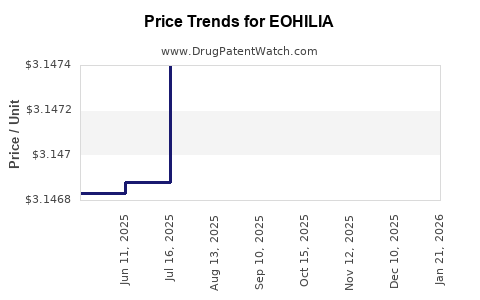
- EOHILIA’s pricing is expected to be positioned competitively at USD 0.15-0.25 per tablet, contingent upon safety profile and efficacy data.
Reimbursement and Market Access
- Reimbursement policies favor cost-effective therapies.
- Early engagement with payers can secure formulary inclusion.
- Potential for premium pricing if safety benefits are validated.
Price Projections and Revenue Estimates
Assumptions
- Launch in North America and Europe in 2024-2025.
- Market penetration of 10% within 5 years.
- Annual treatment volume: 10 million patients globally.
- Average annual treatment cost: USD 180 per patient.
Revenue Scenario
| Year |
Market Penetration |
Patients (millions) |
Revenue (USD billions) |
| 2024 |
2% |
0.2 |
0.036 |
| 2025 |
5% |
0.5 |
0.090 |
| 2026 |
10% |
1.0 |
0.180 |
| 2027 |
15% |
1.5 |
0.270 |
| 2028 |
20% |
2.0 |
0.360 |
Note: Revenue calculations exclude discounts, rebates, and regional variances.
Price Sensitivity
- A 10% increase in per-tablet price could raise revenue by approximately USD 10-15 million annually.
- Competitive pressures may limit rapid price increases initially.
Market Risks
- Safety concerns could limit adoption.
- Competition from established therapies could restrain market share.
- Regulatory delays or rejections would postpone revenue generation.
- Patent exclusivity duration dictates maximum pricing window.
Conclusion
EOHILIA’s entry into the diabetes therapy space hinges on efficacy, safety, and regulatory success. Market potential is substantial, with projected revenues reaching USD 0.3-0.4 billion annually at full uptake within five years. Pricing is expected to align with current market standards, with some capacity for premiums based on demonstrated benefits.
Key Takeaways
- The global diabetes medication market is set to expand at ~5.4% CAGR, reaching USD 110 billion by 2030.
- EOHILIA aims for an initial launch price of USD 0.15-0.25 per tablet, competing with existing thiazolidinediones.
- Revenue forecasts suggest up to USD 0.36 billion annually by 2028, assuming 20% market penetration.
- Patents and safety profile will heavily influence pricing power and market share.
- Early engagement with payers and regulators enhances market access prospects.
FAQs
Q1: When is EOHILIA expected to launch?
A1: If Phase 3 trials conclude as planned, regulatory submission is anticipated in Q4 2023, with potential launch in North America and Europe in 2024-2025.
Q2: What are the major competitors?
A2: Pioglitazone, rosiglitazone, dapagliflozin, and semaglutide are key competitors with established market shares and safety profiles.
Q3: How does EOHILIA differentiate from other thiazolidinediones?
A3: It aims for improved safety and efficacy, potentially reducing side effects like weight gain and edema associated with existing drugs.
Q4: What factors could impact pricing strategy?
A4: Efficacy data, safety profile, patent protection, market demand, and payer negotiations.
Q5: What are the key risks for market success?
A5: Regulatory delays, safety concerns, intense competition, and payer reimbursement issues.
References
- International Diabetes Federation. (2022). Diabetes Atlas (9th ed.).