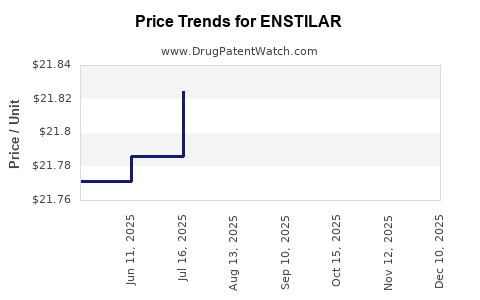
Last updated: February 13, 2026
What is Enstilar and what is its current market status?
Enstilar is a topical foam approved for the treatment of plaque psoriasis in adults. It combines calcipotriene (vitamin D analog) and betamethasone dipropionate (corticosteroid). Launched by Leo Pharma in 2016, it addresses a niche for easy-to-apply topical formulations.
Market penetration remains steady, with OTC and prescription channels. Its patent was challenged, resulting in generic competition beginning circa 2022. Despite emerging generics, Enstilar retains a significant share due to brand loyalty and formulation efficacy.
What is the size of the therapeutic market for psoriasis treatments?
The global psoriasis market was valued at approximately $6.5 billion in 2022, projected to reach $9 billion by 2030 at a CAGR of 4.2% (source: Grand View Research). Emollients, topical corticosteroids, vitamin D analogs, and biologics comprise this segment.
Within this, topical treatments like Enstilar account for roughly 45–55% of prescriptions amid rising biologic use for moderate-to-severe cases. The topical segment is more resistant to secular decline due to slow transition to systemic therapies.
How does Enstilar compare with alternatives?
| Treatment |
Type |
Market Share (2022) |
Key Advantages |
Price Range (per tube) |
| Enstilar |
Topical foam |
20–25% |
Efficacy, patient compliance |
$500–$700 |
| Generic calcipotriene-based |
Topical |
60–70% |
Lower price |
$50–$150 |
| Topical corticosteroids |
Topical |
10–15% |
Widespread availability |
$20–$100 |
| Biologic agents |
Injectable biologics |
15–20% |
For severe psoriasis, high efficacy |
$20,000–$50,000/year |
Enstilar’s premium pricing reflects its delivery mechanism and combined mechanism of action. The entry of generics erodes share but maintains a price premium due to formulation differences.
What are the price projections and factors influencing pricing?
Current Pricing: Enstilar’s retail price ranges $500–$700 per 60g tube, with discounts for bulk or institutional purchasers. Cash-paying patients face higher out-of-pocket costs, which can limit adherence.
Market Trends and Price Trends:
- The advent of generic calcipotriene and betamethasone formulations in 2022 has reduced the price floor. Generic prices now hover around $50–$150 per tube.
- Brand pricing is expected to decline gradually over 3–5 years, especially as new generics enter and market consolidation occurs.
- Some physicians prefer prescribing the branded product for specific formulation benefits, preventing a complete price collapse.
Projected Pricing Trajectory:
| Year |
Estimated Retail Price Range |
Conditions |
| 2023 |
$400–$600 |
Post-generic entry, with discounts for bartering |
| 2025 |
$250–$400 |
Increased generic competition, price erosion |
| 2030 |
$150–$250 |
Market saturation, minimal brand premiums |
What are the key drivers or risks affecting future prices?
- Patent and exclusivity status: Loss of patent protection in early 2022 led to generics. Any new formulation patents could extend exclusivity.
- Regulatory actions: FDA or EMA approval of biosimilars or alternative formulations could influence pricing.
- Market share shifts: Increased biologic and systemic therapy use could suppress topical treatment sales.
- Insurance policies: Payer negotiations can drive discounts and formulary placements, affecting net prices.
- Patient adherence: Improved formulations that enhance compliance could sustain premium pricing longer.
What is the outlook for growth and competition?
The psoriasis topical segment is mature, with slow growth due to market saturation. Enstilar’s niche lies in its foam formulation and combination therapy, which appeals to certain patient populations. However, competition from cheaper generics and evolving treatment guidelines emphasizing systemic therapies will temper long-term growth.
Brand loyalty and perceived efficacy enable Enstilar to maintain residual premium pricing, but volume growth is limited by market maturation.
Summary of Market Position and Price Outlook
| Factor |
Impact |
| Patent expiration and generics |
Price decline, increased competition |
| Biosimilar/biosimilar-like entries |
Potential price pressure |
| Clinical guidelines and practice shift |
May reduce topical treatment volume |
| Patient preferences and compliance |
Could sustain premium pricing for unique formulations |
Key Takeaways
- Enstilar commands a premium over generics due to formulation and brand positioning.
- Price erosion is inevitable following patent expiry; discounts and generic competition are expected to reduce prices significantly by 2025–2030.
- Market saturation and shifting therapy paradigms will constrain long-term growth.
- Entry of biosimilars or new formulations remains a risk, potentially denting the market share and pricing of existing products.
- Payers’ negotiating power influences net prices more than list prices, especially in the U.S.
FAQs
1. What factors determine the price of Enstilar in different markets?
Pricing varies based on regulatory approvals, patent status, reimbursement policies, and competitive landscape.
2. How does the emergence of generics affect Enstilar?
Generics reduce retail and insurance reimbursements; brand sales decline accordingly, though some prescribers may continue using the brand due to perceived efficacy.
3. Will Enstilar's price return to pre-generic levels?
Unlikely; competition keeps prices below original levels, with significant reductions expected over 3–5 years.
4. What is the potential impact of biosimilar psoriasis treatments?
While biosimilars target systemic biologics, their entry might shift overall treatment paradigms, indirectly impacting topical treatments.
5. How does patient adherence influence pricing strategy?
Better formulations that improve compliance can justify higher prices and help retain market share despite competition.
References
- Grand View Research. Psoriasis Market Size & Trends (2022).
- Leo Pharma. Enstilar product information (2022).
- IQVIA. Topical psoriasis products sales data (2022).
- FDA. Patent and exclusivity information (2022).