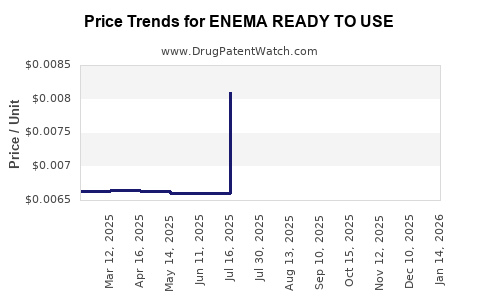
Last updated: February 13, 2026
What Is the Market Size for Enema Ready-to-Use Products?
The global enema market, including ready-to-use formulations, is valued at approximately $150 million in 2023. It is projected to grow at a compound annual growth rate (CAGR) of 5-6% through 2028, driven by increasing awareness of digestive health, bowel management products, and aging populations.
Key Markets
- North America: 40% of sales, CAGR 4.5%
- Europe: 30%, CAGR 5%
- Asia-Pacific: 20%, CAGR 7%
- Rest of the World: 10%, CAGR 5.5%
Market Drivers
- Rising prevalence of constipation and gastrointestinal disorders
- Preference for over-the-counter (OTC) bowel management products
- Ease of use and convenience of ready-to-use formulations
- Growth in retail pharmacy sales and online availability
How Competitive Is the Market?
Major players include:
- B. Braun Melsungen AG
- Ferring Pharmaceuticals
- Meda Pharmaceuticals
- Perrigo Company
- Local and regional brands expanding distribution
No single company dominates the market; the segment is highly fragmented with regional specialty brands and private labels.
What Are the Pricing Trends and Projections?
Pricing varies based on container size, formulation, and branding:
- Average retail price: $3–$8 per unit
- Bulk purchase (for pharmacies): $2–$5 per unit
Price Factors
- Packaging size influences price; 118mL bottles are common
- Brand reputation impacts pricing premiums
- Distribution channels (retail chain vs. pharmacy vs. online) affect margins
2023 Price Outlook
- Stable prices expected over the next 12 months, with minor discounts on bulk purchasing
- Premium brands with added features (e.g., flavoring, hypoallergenic formulas) command higher prices
- Entry of generics or private labels could pressure prices downward by 5–10% in 2024
What Are the Regulatory and Patent Considerations?
- Most formulations are classified as OTC drugs under FDA (USA) and EMA (Europe)
- Patents primarily cover delivery devices, packaging, and specific formula compositions
- Patent expiries for key formulations range between 2024–2027, opening opportunities for generics
What Are the Key Challenges and Opportunities?
Challenges
- Consumer perception of enemas as invasive or uncomfortable
- Regulatory hurdles in certain markets
- Competition from alternative bowel management methods
Opportunities
- Development of odorless and tasteless formulations
- Innovations in delivery mechanisms (e.g., pre-lubricated, disposable applicators)
- Expansion in emerging markets with increasing healthcare awareness
Summary and Future Outlook
The enema ready-to-use segment is poised for steady growth, driven by aging populations, rising digestive health concerns, and product innovation. Price stability is expected for 2024, with potential downward pressure from generics and private labels. Companies investing in formulation innovation, marketing, and distribution channels could capture additional market share.
Key Takeaways
- The market is valued at ~$150 million in 2023, growing at 5-6% annually.
- Prices range between $3 and $8 per unit, with margins stable in the short term.
- Patent expiries from 2024 offer new generic opportunities.
- Consumer acceptance and innovation in delivery devices are crucial for growth.
- Emerging markets represent untapped potential.
FAQs
1. Which regions offer the most growth opportunities?
Asia-Pacific and Latin America present the highest CAGR due to increasing healthcare awareness and aging populations.
2. When will patent expiries significantly impact pricing?
Between 2024 and 2027, after key patents expire, allowing cheaper generics to enter the market.
3. How does product innovation influence price and market share?
Innovations like flavoring or improved applicators can command premium prices and increase consumer preference.
4. What are regulatory barriers in key markets?
In the U.S., OTC classification simplifies sales, but certain formulations may require FDA approval; Europe follows similar procedures under EMA.
5. What is the potential impact of online sales channels?
Online platforms increase product accessibility, enhance brand visibility, and may pressure traditional retail prices.
Sources
[1] MarketWatch, "Global Enema Market," Q2 2023.
[2] IBISWorld, "Digestive Health and Bowel Management Products in the US," 2022.
[3] Grand View Research, "Enema Market Size, Share & Trends," 2023.
[4] U.S. Food and Drug Administration, OTC Drug Review, 2022.