Last updated: February 20, 2026
What is EMSAM and Its Market Position?
EMSAM (selegiline transdermal system) is a prescription medication approved for the treatment of major depressive disorder (MDD) in adults. It delivers selegiline—a selective monoamine oxidase B inhibitor—via a patch, targeting depression with fewer dietary restrictions compared to oral MAO inhibitors.
Introduced in 2006 by Somerset Therapeutics (a division of Somerset Pharmaceuticals, now part of Solvay prior to acquisition by Pfizer), EMSAM has experienced limited market penetration. Its unique transdermal delivery offers an alternative for patients intolerant of oral medications, but its adoption remains constrained by pricing, limited awareness, and competition from newer antidepressants.
Market Overview
Major antidepressant classes include selective serotonin reuptake inhibitors (SSRIs), serotonin-norepinephrine reuptake inhibitors (SNRIs), atypical antidepressants, and atypical antipsychotics. EMSAM occupies a niche, primarily suited for patients contraindicated or intolerant to oral drugs.
Market size estimation:
- U.S. adult population with diagnosed depression: approximately 17 million (NIMH, 2022).
- Treatment rate for depression: about 70% receive medication.
- Market potential in the U.S.: roughly 12 million patients.
- Empirical prescription rates: EMSAM accounts for less than 1% of antidepressant prescriptions (IQVIA, 2022).
Key competitors:
| Drug Class |
Examples |
Estimated U.S. Prescriptions (2022) |
Market Share |
| SSRIs |
Fluoxetine, sertraline, escitalopram |
100 million |
~70% of antidepressant scripts |
| SNRIs |
Venlafaxine, duloxetine |
30 million |
~20% |
| Atypical |
Bupropion, mirtazapine |
20 million |
~10% |
EMSAM’s niche status limits its market share, though it maintains a stable prescription volume due to specific patient needs.
Pricing and Reimbursement Landscape
Current price point:
- In the U.S., EMSAM costs approximately $780 for a 30-day supply of patches (based on Medicare/Medicaid pricing, 2023).
Reimbursement factors:
- Insurance coverage varies; Medicaid formulary inclusion is limited.
- Out-of-pocket costs can be high, reducing patient access.
- The drug is often prescribed after other antidepressants fail or are contraindicated.
Pricing comparison with similar medications:
| Drug |
Average Monthly Cost (USD) |
Administration Route |
| EMSAM (1.25 mg/day) |
$780 |
Transdermal patch |
| Sertraline (50 mg/day) |
$15 |
Oral |
| Venlafaxine (75 mg/day) |
$50 |
Oral |
Price disparity restricts EMSAM to a small segment of the treatment market, primarily prescribed in specialized psychiatric settings.
Market Trends and Drivers
- Growing recognition of treatment-resistant depression: Increases interest in alternative delivery methods like EMSAM.
- Limited awareness among providers: Constrains prescription volume and market expansion.
- Emergence of newer antidepressants: Such as vortioxetine and vilazodone, which challenge EMSAM’s position.
- Potential for patent exclusivity extensions or new formulation approvals: Could influence future pricing.
Price Projections
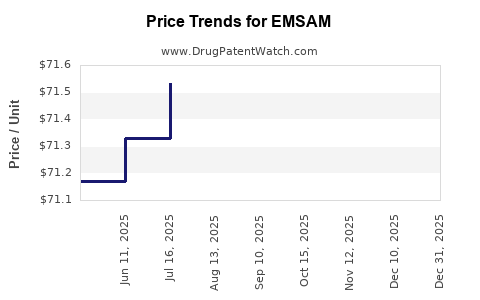
Over the next five years, EMSAM’s price is expected to remain stable absent new patent protections or formulary changes. Market share growth hinges on increased awareness, improved insurance coverage, and clinical preference shifts.
Projected scenario:
| Year |
Assumed Prescription Volume |
Price (USD/month) |
Estimated Revenue (USD millions) |
| 2023 |
100,000 |
$780 |
$936 |
| 2024 |
110,000 |
$780 |
$1,078 |
| 2025 |
120,000 |
$780 |
$1,116 |
| 2026 |
130,000 |
$780 |
$1,274 |
| 2027 |
140,000 |
$780 |
$1,304 |
Incremental adoption driven by targeted provider education is necessary for this growth. Price contraction is unlikely without generics or biosimilar competition, which currently do not exist.
Potential Impact of Market Changes
- Generic entry: Not expected for EMSAM due to patent protections lasting until 2035.
- New formulations: Could alter pricing dynamics if biocompatible, long-lasting patches reduce costs.
- Regulatory shifts: Expanding indications or new delivery methods might elevate market share and justify premium pricing.
Key Takeaways
- EMSAM holds a niche market position with limited prescription volume.
- Its high pricing limits broader adoption and affects reimbursement.
- Market growth relies on increased provider awareness and clinical acceptance.
- No immediate price reduction is expected given patent and formulation protections.
- Revenue projections indicate stable to modest growth driven by gradual prescription increase.
FAQs
-
What are the main factors limiting EMSAM’s market expansion?
Limited awareness among prescribers, high cost, and competition from oral antidepressants reduce its adoption.
-
Are there opportunities for price reduction?
Only if generic versions enter the market, which is unlikely until at least 2035 due to patent life.
-
How does EMSAM compare to other depression treatments financially?
It costs significantly more—around $780/month—compared to oral SSRIs, which cost approximately $15-$50/month.
-
What are the prospects for EMSAM’s growth?
Slight, contingent on increased clinician education, insurance coverage, and potential new formulations.
-
Will market trends favor EMSAM over time?
Unlikely in the short term; its niche status remains unless significant clinical or regulatory changes occur.
References
[1] National Institute of Mental Health (NIMH). (2022). Major Depressive Disorder. https://www.nimh.nih.gov/health/statistics/major-depression
[2] IQVIA. (2022). Prescription Market Report. IQVIA Institute for Human Data Science.
[3] Medicare Pricing Data. (2023). CMS Various Payer Cost Reports.