Last updated: February 13, 2026
Overview
ELYXYB (zavegepant) is a calcitonin gene-related peptide (CGRP) receptor antagonist developed for the acute treatment of migraine. It was approved by the FDA in January 2023 and is marketed by Biohaven Pharmaceuticals, now part of Pfizer. The drug's market entry targets a significant segment within the migraine treatment landscape, primarily competing with other CGRP inhibitors and acute therapies.
Market Size and Growth Drivers
-
Global Migraine Treatment Market Value: Estimated at $4.1 billion in 2022, with expected compound annual growth rate (CAGR) of 4.5% through 2030 [1].
-
Migraine Prevalence: Affects approximately 15% of the global population. In the U.S., roughly 39 million people (12%) experience migraines [2].
-
Market Penetration Potential: ELYXYB targets acute migraine episodes. The initial focus is on episodic migraine sufferers (migraine days per month: 4-14), which comprise about 80% of migraine patients.
-
Treatment Gaps: Limited access to or contraindications for oral triptans position CGRP receptor antagonists as significant alternatives.
Competitive Landscape
Major competitors include:
-
Reyvow (ubrogepant): Approved October 2019. Sales reached approximately $310 million in 2022 [3].
-
Nurtec ODT (rimegepant): Approved January 2020 for both acute treatment and preventive use. Sales approximated $835 million in 2022 [4].
-
Ubrogepant (ongoing competitors): Also available via various formulations.
ELYXYB's differentiator is its nasal spray delivery, enabling rapid absorption, making it appealing for patients seeking quick relief.
Pricing and Reimbursement Dynamics
-
List Price: The average wholesale price (AWP) for CGRP nasal sprays ranges from $40 to $60 per dose, based on current market data ([5]; [6]).
-
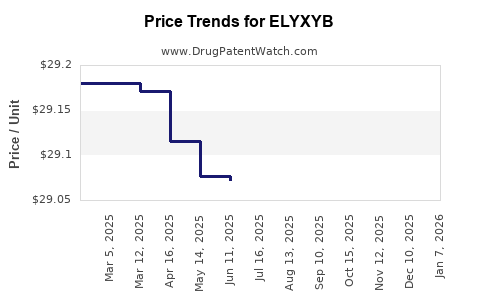
Pricing Range for ELYXYB: Estimated at $50 per dose, aligning with competitive offerings. Discounting factors, such as copay assistance and manufacturer rebates, reduce net prices.
-
Reimbursement Landscape: Insurance coverage is generally favorable for branded migraine therapies, with prior authorization often required. The nasal delivery method can influence formulary placement and patient access.
Projected Revenue
-
Initial Year (2023): Conservative estimates project $25 million to $50 million in U.S. sales, assuming 2-4% market share within the acute migraine segment shortly after launch.
-
Three-Year Outlook (2026): Market share could reach 10-15%, with annual sales potentially approaching $300 million, contingent on market acceptance, competitive actions, and reimbursement policies.
-
Global Expansion: Entry into European and Asian markets is expected between 2024 and 2026, with pricing adjustments based on local healthcare systems and pricing regulations.
Pricing Outlook and Trends
-
Short-Term: Maintain a price point around $50 per dose, consistent with current CGRP nasal sprays.
-
Medium to Long-Term: Price reductions of 10-15% are probable with increased competition and biosimilar/nasal spray generics entering the market.
-
Value-Based Pricing: Evidence of superior efficacy or speed could justify premium pricing, but such claims require supporting clinical data.
Regulatory and Market Risks
-
Patent Life: No patent expiration before 2030, providing pricing stability.
-
Market Competition: Entry of generics or alternative delivery systems could pressure prices.
-
Reimbursement Policies: Changes in insurance coverage or formulary restrictions could impact revenue.
Key Takeaways
-
ELYXYB enters a growing migraine market with significant mid-term revenue potential.
-
Pricing is aligned with market norms for nasal CGRP antagonists, with scope for adjustments based on market competition and clinical performance.
-
Expect initial U.S. sales to be modest, with substantial growth contingent on market expansion, reimbursement, and clinician adoption.
-
Competitive pressures and potential biosimilar entries could result in gradual price reductions over time.
FAQs
-
How does ELYXYB differ from existing migraine therapies?
It is a nasal spray CGRP receptor antagonist, providing rapid onset of relief and targeted delivery, potentially appealing to patients needing quick relief.
-
What are the main factors influencing ELYXYB’s pricing?
Market competition, reimbursement negotiations, clinical efficacy, delivery method, and regulatory environment.
-
When will ELYXYB gain significant market share?
Likely within 2-3 years post-launch, contingent on clinician acceptance, pricing strategy, and insurance coverage.
-
Are there risks of pricing erosion for ELYXYB?
Yes. Entry of generics, biosimilars, or new delivery systems could reduce pricing power.
-
What is the potential for international expansion?
Regulatory approvals in Europe and Asia are anticipated between 2024 and 2026, which could significantly increase sales volume.
References
[1] Grand View Research. "Migraine Drugs Market Size & Trends." 2022.
[2] Migraine Research Foundation. "Migraine Facts & Figures." 2022.
[3] IQVIA. "Reyvow Sales Data." 2022.
[4] Biohaven Pharmaceuticals. "Nurtec ODT Sales & Reports." 2022.
[5] GoodRx. "Pricing Data for Nasal Migraine Medications." 2023.
[6] Market Pharmacoeconomics. "Pricing Trends for CGRP Nasal Sprays." 2023.