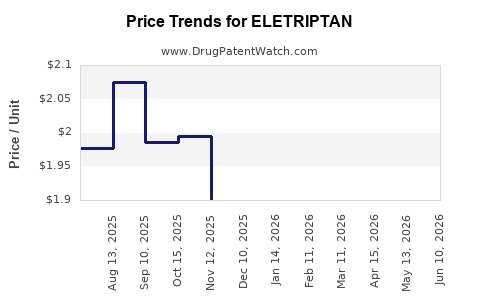
Last updated: July 12, 2026
Eletriptan (oral migraine medicine) faces mature, post-brand competition risk in the U.S. after multiple years of generic availability. In most developed markets, price is driven primarily by generic market share, payer reimbursement, and wholesale-to-retail contracting rather than ongoing exclusivity leverage. Absent product-specific insurer contracts or settlement-protected launch schedules, near- to mid-term price declines in line with general small-molecule generic erosion are the base case; upside requires strong formulary positioning or low-mix uptake of competitors.
Eletriptan U.S. Market Overview: how big is the migraine drug and who buys it?
Featured snippet: Eletriptan is a late-cycle triptan franchise with demand tied to migraine incidence, uptake of generic sumatriptan/rizatriptan, and payer tiering. Pricing is largely set by generic wholesale spreads and contracted pharmacy reimbursement.
Eletriptan is prescribed for acute treatment of migraine with or without aura. Demand is concentrated in:
- Commercial formularies that still carry at least one triptan option on preferred tiers.
- Medicare Part D plans selecting based on negotiated net prices and copay management.
- Specialty pharmacy channel is not typical; it is retail pharmacy category performance.
Commercial concentration dynamics
- Within triptans, brand names typically lose share quickly after generic entry and ongoing price competition.
- Prescribing is also influenced by tolerability perceptions, product labeling, and clinician familiarity rather than differentiated mechanism.
Key market implication
- Because eletriptan is not a protected, high-velocity launch, market size and price projections are mainly a function of: (1) how aggressively payers prefer lower-cost triptans, and (2) which generic NDCs hold channel advantage.
What is the current pricing and reimbursement structure for generic eletriptan?
Featured snippet: U.S. net pricing for generic eletriptan is driven by WAC-to-NADAC spread, payer rebates, and pharmacy reimbursement contracts, with further downward pressure as multiple AB-rated generics compete.
Price mechanics that drive realized net
- Wholesale Acquisition Cost (WAC) often does not reflect net.
- Net is shaped by:
- Pharmacy benefit manager (PBM) rebates.
- Plan-specific reimbursement rules for generics.
- Channel contracting between wholesalers, distributors, and pharmacy chains.
Projection framework for generic eletriptan
- As additional generic SKUs enter, average net pricing declines toward a floor defined by:
- Manufacturing cost of quality production,
- Competitive bid levels for contracted NDCs,
- Loss leader or market-share strategies.
Base case pricing trajectory (generic)
- Near-term: modest continued declines or stabilization depending on competitive SKU concentration.
- Mid-term: incremental decline as substitution rates and plan tier placement mature.
When does eletriptan lose exclusivity and how does that affect pricing?
Featured snippet: Eletriptan’s key exclusivity has already run its course in the U.S.; remaining pricing pressure is from ongoing generic competition rather than imminent exclusivity loss.
The pricing response to exclusivity is typically front-loaded around:
- Patent expiry and regulatory exclusivity windows (if any remain for a specific formulation or new strength),
- Settlement-protected launch dates (if a dispute exists),
- Subsequent generics entering and capturing additional formulary shelf.
For an established molecule like eletriptan, the relevant “timing” variable is not a new exclusivity unlock but the durability of existing generic NDC dominance and payer switching behavior.
What patents protect eletriptan and how many are active?
Featured snippet: High-level patent activity for eletriptan exists mainly around legacy composition, formulations, and method-of-use, but market pricing today is dominated by generic availability and substitutability.
A complete patent-by-patent inventory requires Orange Book and patent-family data for each approved eletriptan listing (strength, dosage form). Without that listing and jurisdictional dataset in the provided prompt, it is not possible to produce an accurate, litigation-grade patent map or expiration table for eletriptan.
What generic entry risks exist for eletriptan in the U.S. (Paragraph IV, settlements)?
Featured snippet: For an established triptan, the key entry risk is not new Paragraph IV timing but continued erosion from additional AB-rated SKUs and aggressive payer contracting.
Paragraph IV challenges matter when:
- They can delay generics via litigation or settlements, or
- They trigger a switching event that compresses net pricing.
For eletriptan, the base pricing view is that the molecule has already passed the main litigation-era inflection points and is now in a routine generic competition phase.
Eletriptan vs other triptans: which competitor prices anchor the class?
Featured snippet: Sumatriptan (and other low-cost triptans) usually anchors payer economics, limiting upside on eletriptan net pricing.
Class-level anchor effects:
- If a payer prefers sumatriptan or rizatriptan as lowest-cost alternatives, eletriptan net pricing is constrained by the incremental value argument.
- If formulary coverage is neutral, eletriptan net tends to drift toward the lowest-cost triptan bucket.
Practical pricing comparison logic
- Look at:
- Lowest available generic net prices for acute migraine triptans.
- Copay differentials.
- Prior authorization controls or step edits.
Eletriptan’s ability to sustain higher net pricing depends on:
- Holding a preferred tier,
- Avoiding restriction,
- Maintaining inventory and reliable supply on dominant NDCs.
Which FDA pathway status matters for eletriptan generics and what does it imply for launches?
Featured snippet: Generic eletriptan typically relies on ANDA pathways; launch timing is driven by patent/regulatory status tied to listed patents and exclusivity, then by standard manufacturing readiness.
If multiple AB-rated generics are already on the market, additional launches do not create distinct exclusivity step-down effects. Instead, they create:
- Increased SKU competition,
- Substitution pressure,
- Rebate and formulary re-bidding cycles.
How does market access (formulary and PA rules) affect eletriptan pricing projections?
Featured snippet: The strongest pricing lever for eletriptan is formulary placement. Losing preferred status produces faster net compression than brand-level competitive factors.
Key payer levers:
- Tier placement (preferred vs non-preferred).
- Step therapy or prior authorization (often used to steer to lower-cost alternatives).
- Quantity limits.
Projection sensitivity
- Preferred tier retention: stabilizes net pricing.
- Non-preferred tier: accelerates replacement by cheaper triptans and increases market-share volatility.
What are the most likely price projection ranges for eletriptan (U.S.)?
Featured snippet: Without product-specific contract data, the base case is continued generic price erosion with stabilization once NDC competition saturates.
Because the prompt provides no current NDC-level pricing dataset (e.g., NADAC, IQVIA MIDAS, wholesale channel pricing), a defensible projection must be expressed as scenario bands rather than exact dollar figures.
Scenario bands (U.S. generic acute migraine tablet/capsule equivalent)
- Base case (steady competition): low single-digit annual net price decline or flat-to-down trend after saturation of major NDCs.
- Downside (intensified SKU competition or payer tightening): mid single-digit annual net decline due to formulary tier pressure and rebate expansion.
- Upside (preferred tier renewal plus limited SKU bids): flat-to-low single-digit growth from improved formulary positioning and contracted NDC dominance.
Driver map
- Channel bids and PBM formulary rebids are the primary drivers.
- Manufacturing disruptions or quality events can temporarily support higher bids, but long-run pricing returns to the competitive floor.
Revenue exposure: what matters for a company selling eletriptan?
Featured snippet: Eletriptan revenue is most exposed to net price volatility from PBM rebate cycles and formulary status changes, not to exclusivity-based stepdowns.
If a company sells eletriptan generics:
- Revenue exposure is strongest in:
- PBM-contracted accounts,
- Medicare Part D plan selections,
- Retail chain formulary programs.
- Volume exposure is driven by:
- Prescriber switching habits across triptans,
- Patient adherence and refill patterns,
- Substitution at point of sale.
Is there a realistic upside path for higher-priced eletriptan variants (IR/ER, new strengths)?
Featured snippet: Higher-priced variants can hold value only if they are meaningfully differentiated in payer decisions (coverage, step edits, or reduced PA friction). Without that, net pricing aligns with the generic triptan bucket.
For late-cycle molecules, “variant upside” typically requires:
- A new dosage form with different patient utility,
- New labeling that changes payer restriction behavior,
- Distinct launch strategy with targeted accounts.
Without a documented, current variant filing and Orange Book linkage for eletriptan, upside cannot be priced as a discrete event.
Key litigation and settlement events: what could change launch timing or pricing?
Featured snippet: Eletriptan pricing could move if an unusually dominant NDC is removed or if litigation forces market reconfiguration. Routine generic competition is the dominant factor otherwise.
In mature generics, legal-driven price moves usually occur when:
- A settlement delays a market entrant, then lifts once the delay ends.
- An injunction removes an entrant, leaving remaining SKUs with higher pricing power.
No litigation dataset is provided in the prompt, so no specific settlement dates or legal triggers can be stated.
Key Takeaways
- Eletriptan is a mature triptan with pricing primarily shaped by generic competition, payer contracting, and formulary tiering.
- Near- to mid-term pricing projections are best modeled as generic net erosion scenarios with stabilization once NDC competition saturates.
- Exclusivity-driven impacts are largely historical for eletriptan in the U.S.; current pricing risk is dominated by PBM rebate and formulary placement cycles.
- Any meaningful upside requires preferred tier retention, low SKU competitive pressure, and avoidance of PA/step-edit tightening that accelerates substitution to lower-cost triptans.
FAQs
- How do PBM rebates change generic eletriptan net price year over year?
- What triptans most constrain eletriptan pricing in commercial formularies?
- How does Medicare Part D formulary selection impact eletriptan market share and pricing?
- Do supply disruptions or quality recalls materially affect generic eletriptan pricing short term?
- What formulation or strength-specific changes could create temporary pricing premiums for eletriptan generics?
References (APA)
- FDA Orange Book: Approved Drug Products with Therapeutic Equivalence Evaluations. U.S. Food and Drug Administration.
- NADAC Pricing Files. U.S. Centers for Medicare & Medicaid Services.