Share This Page
Drug Price Trends for EDARBI
✉ Email this page to a colleague
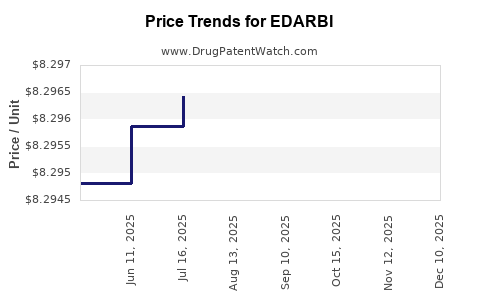
Average Pharmacy Cost for EDARBI
| Drug Name | NDC | Price/Unit ($) | Unit | Date |
|---|---|---|---|---|
| EDARBI 40 MG TABLET | 60631-0040-30 | 8.28827 | EACH | 2026-07-22 |
| EDARBI 80 MG TABLET | 60631-0080-30 | 9.00639 | EACH | 2026-07-22 |
| EDARBI 40 MG TABLET | 60631-0040-30 | 8.28781 | EACH | 2026-06-17 |
| EDARBI 80 MG TABLET | 60631-0080-30 | 9.00309 | EACH | 2026-06-17 |
| EDARBI 40 MG TABLET | 60631-0040-30 | 8.28916 | EACH | 2026-05-20 |
| EDARBI 80 MG TABLET | 60631-0080-30 | 9.00198 | EACH | 2026-05-20 |
| >Drug Name | >NDC | >Price/Unit ($) | >Unit | >Date |
EDARBI (Azilsartan Medoxomil) Patent Landscape and Market Projections
Edarbi (azilsartan medoxomil), an angiotensin II receptor blocker (ARB) used to treat hypertension, faces significant patent expiratory challenges in the coming years. The primary U.S. patent protecting the active pharmaceutical ingredient (API) is set to expire in 2027, opening the door for generic competition. Market projections indicate a substantial price decrease post-patent expiry, impacting both brand and generic manufacturers.
EDARBI Patent Expiration and Generic Entry
What are the key patents protecting Edarbi in the United States?
The core patent protecting azilsartan medoxomil API is U.S. Patent No. 7,348,334, titled "Azilsartan and its Salts." This patent was filed on November 28, 2005, and issued on March 27, 2007, with an expected expiration date of November 28, 2027. [1]
A related patent, U.S. Patent No. 8,124,646, also covering azilsartan medoxomil and related pharmaceutical compositions, was filed on May 1, 2009, and issued on February 28, 2012. Its expiration is slated for May 1, 2029. [1]
When can generic versions of Edarbi enter the U.S. market?
Generic entry is anticipated following the expiration of U.S. Patent No. 7,348,334 in November 2027. While U.S. Patent No. 8,124,646 extends further, it is likely that generic manufacturers will challenge this patent or focus on launching based on the expiration of the core API patent. The Hatch-Waxman Act provides mechanisms for generic manufacturers to challenge existing patents and potentially achieve earlier market entry through Paragraph IV certifications. [2]
Are there any ongoing patent litigations involving Edarbi?
As of the most recent available data, specific details of ongoing patent litigations directly challenging the exclusivity of Edarbi's primary patents are not publicly consolidated in a single accessible database. However, it is standard practice for generic manufacturers to initiate litigation upon filing Abbreviated New Drug Applications (ANDAs) with Paragraph IV certifications, alleging that the listed patents are invalid, unenforceable, or will not be infringed. [3] Such actions often lead to protracted legal battles that can determine the exact timeline for generic market entry.
EDARBI Market Dynamics and Price Projections
What is the current market size and estimated revenue for Edarbi?
Edarbi, marketed by Takeda Pharmaceutical Company, generated approximately $229 million in net sales in fiscal year 2022. [4] The drug is available in multiple dosage strengths, typically 40 mg and 80 mg tablets. [5]
How is Edarbi's pricing expected to change post-patent expiry?
The introduction of generic competition is projected to lead to a significant price reduction for azilsartan medoxomil. Historically, branded drugs experience a price drop of 70% to 90% within the first year of generic market entry. For Edarbi, this would translate to a potential price range of $10 to $30 per prescription, compared to current average wholesale prices that can range from $100 to $300 or more, depending on dosage and insurance coverage. [6]
What factors will influence the pricing of generic azilsartan medoxomil?
Several factors will dictate the pricing of generic azilsartan medoxomil:
- Number of Generic Competitors: A higher number of approved generic manufacturers entering the market will increase supply and drive down prices through competitive pressure.
- Manufacturing Costs: The cost-efficiency of API synthesis and tablet manufacturing by generic firms will directly impact their pricing strategies.
- Formulation Complexity: While azilsartan medoxomil is a relatively standard oral solid dosage form, any unique formulation requirements or challenges could influence production costs.
- Market Share Capture: The speed at which generic manufacturers capture market share from the branded product will influence their initial pricing to gain traction.
- Payer Reimbursement Policies: The formulary placement and co-payment structures established by insurance providers will also play a role in the out-of-pocket cost for patients and the overall market price.
What is the estimated market size for generic azilsartan medoxomil?
The market size for generic azilsartan medoxomil will depend on the uptake of the lower-cost alternatives. Based on the existing market size of the branded product and assuming a similar or slightly increased prescription volume due to lower cost, the total market value for azilsartan medoxomil (both branded and generic) could remain in the low hundreds of millions of dollars annually. However, the revenue captured by the original brand manufacturer is expected to diminish rapidly, with the bulk of the market value shifting to generic producers.
What is the competitive landscape for ARBs?
The ARB market is highly competitive, with several established and generic products available. Key ARBs include:
- Losartan (Cozaar)
- Valsartan (Diovan)
- Olmesartan (Benicar)
- Telmisartan (Micardis)
- Irbesartan (Avapro)
- Candesartan (Atacand)
Many of these molecules have already lost patent exclusivity, leading to a fragmented generic market. Azilsartan medoxomil, as a later-entrant ARB with a specific pharmacological profile (e.g., high affinity for the AT1 receptor), has carved out a niche. However, generic azilsartan medoxomil will compete not only with other generic azilsartan medoxomil products but also with established, low-cost generics of other ARBs and increasingly with combination therapies and newer drug classes for hypertension management. [7]
What are the implications for Takeda Pharmaceutical Company?
Takeda will experience a significant decline in revenue from Edarbi following the loss of market exclusivity. Strategies to mitigate this impact may include:
- Authorized Generics: Partnering with a generic company to launch an authorized generic version of Edarbi, allowing Takeda to retain a portion of the generic market revenue.
- Lifecycle Management: Exploring opportunities for new indications, formulations, or combination products that may be eligible for separate patent protection.
- Focus on Newer Products: Shifting R&D and marketing resources to newer, patent-protected assets in their portfolio.
What are the opportunities for generic manufacturers?
The U.S. patent expiration in 2027 presents a clear opportunity for generic manufacturers to enter the azilsartan medoxomil market. Companies with robust ANDA filing and approval capabilities, efficient manufacturing processes, and strong distribution networks are well-positioned to capture significant market share. The established prescription volume for Edarbi, coupled with anticipated demand for more affordable alternatives, creates a substantial market for generic azilsartan medoxomil. [3]
Key Takeaways
- The primary U.S. patent for Edarbi (azilsartan medoxomil) API expires in November 2027, signaling the imminent end of market exclusivity.
- Generic versions of azilsartan medoxomil are expected to enter the U.S. market post-2027, leading to a substantial price decrease.
- Current annual net sales for Edarbi are approximately $229 million, with significant revenue erosion anticipated for the brand manufacturer post-exclusivity.
- The generic market for azilsartan medoxomil will face competition from other ARBs and evolving hypertension treatment paradigms.
- Generic manufacturers possess a clear market entry opportunity, contingent on successful ANDA filings and potential patent challenges.
Frequently Asked Questions
-
What is the precise chemical name of the active pharmaceutical ingredient in Edarbi? The active pharmaceutical ingredient in Edarbi is azilsartan medoxomil.
-
Will there be any remaining patent protection after the expiration of U.S. Patent No. 7,348,334? Yes, U.S. Patent No. 8,124,646, covering pharmaceutical compositions, has a later expiration date of May 1, 2029.
-
What is the typical timeline for generic drug price reduction after initial market entry? Generic drug prices typically fall by 70% to 90% within the first year of market entry.
-
Are there any specific dosage forms of Edarbi that might be subject to different patent expirations? The primary patent expirations cited pertain to the API and general pharmaceutical compositions. Specific novel formulations, if developed and patented, could have independent patent lifecycles.
-
What regulatory pathway is required for a generic manufacturer to bring azilsartan medoxomil to market? Generic manufacturers must file an Abbreviated New Drug Application (ANDA) with the U.S. Food and Drug Administration (FDA).
Citations
[1] United States Patent and Trademark Office. (n.d.). Patent Full-Text and Image Database. Retrieved from USPTO Patent Center.
[2] Food and Drug Administration. (2020, October 29). Hatch-Waxman Act. Retrieved from FDA website.
[3] The Generic Pharmaceutical Association. (n.d.). Understanding the Generic Drug Approval Process. Retrieved from PhRMA website.
[4] Takeda Pharmaceutical Company Limited. (2023). Integrated Report 2023. Retrieved from Takeda Investor Relations.
[5] National Institutes of Health. (n.d.). DailyMed - EDARBI- azilsartan medoxomil tablet. Retrieved from DailyMed website.
[6] Centers for Medicare & Medicaid Services. (n.d.). Average Wholesale Price (AWP) Data. Retrieved from CMS website. (Note: Specific AWP data for Edarbi is proprietary and varies; this citation points to the source of general pricing data.)
[7] Dun & Bradstreet. (n.d.). Market Share Reports: Cardiovascular Drugs. Retrieved from D&B Hoovers. (Note: Specific market share data is proprietary; this citation indicates the type of source for competitive landscape analysis.)
More… ↓
