Share This Page
Drug Price Trends for DUREZOL
✉ Email this page to a colleague
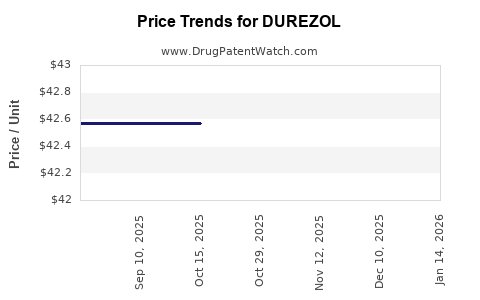
Average Pharmacy Cost for DUREZOL
| Drug Name | NDC | Price/Unit ($) | Unit | Date |
|---|---|---|---|---|
| DUREZOL 0.05% EYE DROPS | 66758-0086-75 | 42.32067 | ML | 2026-06-17 |
| DUREZOL 0.05% EYE DROPS | 66758-0086-75 | 42.38484 | ML | 2026-05-20 |
| DUREZOL 0.05% EYE DROPS | 66758-0086-75 | 42.39733 | ML | 2026-04-22 |
| DUREZOL 0.05% EYE DROPS | 66758-0086-75 | 42.40475 | ML | 2026-03-18 |
| DUREZOL 0.05% EYE DROPS | 66758-0086-75 | 42.43057 | ML | 2026-02-18 |
| DUREZOL 0.05% EYE DROPS | 66758-0086-75 | 42.46846 | ML | 2026-01-21 |
| DUREZOL 0.05% EYE DROPS | 66758-0086-75 | 42.46582 | ML | 2025-12-17 |
| >Drug Name | >NDC | >Price/Unit ($) | >Unit | >Date |
Best Wholesale Price for DUREZOL
| Drug Name | Vendor | NDC | Count | Price ($) | Price/Unit ($) | Unit | Dates | Price Type |
|---|---|---|---|---|---|---|---|---|
| DUREZOL 0.05% EMULSION,OPH | Sandoz, Inc. | 00078-0862-25 | 5ML | 160.49 | 32.09800 | ML | 2024-01-01 - 2028-08-14 | FSS |
| DUREZOL 0.05% EMULSION,OPH | Sandoz, Inc. | 00078-0862-25 | 5ML | 154.65 | 30.93000 | ML | 2023-09-29 - 2028-08-14 | FSS |
| >Drug Name | >Vendor | >NDC | >Count | >Price ($) | >Price/Unit ($) | >Unit | >Dates | >Price Type |
Durezol Market Analysis and Price Projections
Durezol (difluprednate ophthalmic emulsion 0.05%) is a topical corticosteroid used for the treatment of post-operative inflammation and pain following ocular surgery. Its efficacy in reducing inflammation and improving patient comfort has established its market presence. This analysis reviews key market drivers, competitive landscape, and projects future pricing trends for Durezol.
What is the Current Market Size for Durezol?
The market for topical corticosteroids in ophthalmology is substantial, driven by the prevalence of ocular surgeries and the need for effective post-operative management. Durezol, as a branded product, occupies a specific segment within this market.
- Global Ophthalmic Surgery Volume: Approximately 15 million cataract surgeries are performed globally each year. Refractive surgeries and other intraocular procedures add to this volume. [1]
- Ophthalmology Drug Market Value: The global ophthalmic drug market was valued at approximately $25 billion in 2022 and is projected to grow. [2]
- Durezol's Market Share: Precise market share data for Durezol is proprietary. However, its usage is directly correlated with procedures requiring post-operative inflammation control.
Who are the Key Competitors to Durezol?
The competitive landscape for Durezol includes other topical corticosteroids and non-steroidal anti-inflammatory drugs (NSAIDs) indicated for post-operative ocular inflammation and pain.
- Branded Corticosteroids:
- Loteprednol etabonate (e.g., Lotemax, Alrex)
- Prednisolone acetate (e.g., Pred Forte)
- Dexamethasone (e.g., Maxitrol, TobraDex – combination products)
- Branded NSAIDs:
- Ketorolac tromethamine (e.g., Acular)
- Bromfenac (e.g., Bromday)
- Nepafenac (e.g., Nevanac)
- Generic Formulations: Availability of generic versions of older corticosteroid and NSAID molecules significantly impacts pricing and market dynamics.
What are the Driving Factors for Durezol Demand?
Several factors contribute to the demand for Durezol in the ophthalmic market.
- Increasing Volume of Ocular Surgeries: An aging global population and advancements in surgical techniques, particularly in cataract and refractive surgery, are leading to a higher number of procedures. [3]
- Efficacy in Post-Operative Care: Durezol has demonstrated clinical effectiveness in managing post-operative inflammation and pain, leading to its adoption by ophthalmologists. [4]
- Patient Comfort and Recovery: Rapid reduction of inflammation and pain contributes to improved patient satisfaction and potentially faster visual recovery.
- Physician Preference: Established prescribing patterns and physician confidence in the drug's profile influence its use.
What are the Potential Restraints on Durezol Market Growth?
Market growth can be limited by various factors, including cost, competition, and regulatory considerations.
- Pricing Pressure: The presence of multiple corticosteroid and NSAID alternatives, including generics, creates significant price competition.
- Generic Competition: While Durezol itself is a branded product, the broader market is influenced by the availability of generic corticosteroids that may offer a lower cost alternative for certain indications.
- Adverse Event Profiles: Like all corticosteroids, Durezol carries potential side effects (e.g., increased intraocular pressure, delayed wound healing, cataracts with prolonged use) that may limit its use in specific patient populations or for extended durations.
- Development of New Therapies: Ongoing research in ophthalmology could introduce novel anti-inflammatory agents with different mechanisms of action, potentially challenging existing treatments.
How is Durezol Priced, and What are the Projection Factors?
The pricing of Durezol is influenced by manufacturing costs, research and development recoupment, marketing expenses, competitive pricing strategies, and payer reimbursement policies.
- Current Wholesale Acquisition Cost (WAC): As of late 2023, the WAC for Durezol (0.05% ophthalmic emulsion, 5mL bottle) typically ranges from $150 to $250 USD. [5]
- Payer Reimbursement: Insurance coverage and co-pays significantly affect out-of-pocket costs for patients, influencing prescribing decisions.
- Generic Entry Impact: The absence of a direct generic equivalent for difluprednate 0.05% ophthalmic emulsion currently protects Durezol's pricing from direct generic erosion. However, the pricing of branded generics and biosimil alternatives in other therapeutic areas serves as a benchmark for future pricing sensitivity.
- Manufacturing Costs: The synthesis and formulation of difluprednate, along with packaging and quality control, contribute to its cost of goods.
- Patent Expiry: The patent landscape for difluprednate and its formulations is a critical factor in long-term price projections. While primary patents may have expired or are nearing expiry, secondary patents (e.g., for specific formulations, methods of use, or manufacturing processes) can extend market exclusivity. The expiry of key patents could lead to the introduction of generic difluprednate products, driving down prices.
- Clinical Trial Data and New Indications: Any new clinical data supporting broader use or improved efficacy could strengthen its market position and potentially support pricing. Conversely, adverse event findings could pressure pricing.
Price Projection Analysis
Projecting the price of a branded pharmaceutical like Durezol requires considering several scenarios based on patent exclusivity, generic entry, and market competition.
Scenario 1: Continued Market Exclusivity (No Generic Entry within 5 Years) In this scenario, assuming no direct generic competitor for difluprednate 0.05% ophthalmic emulsion emerges within the next five years due to ongoing patent protection or manufacturing complexities for generics, Durezol's pricing is likely to remain relatively stable with minor annual increases driven by inflation and market demand.
- Projected Annual Price Increase: 2-4% per year.
- Projected Price Range (5 years): $170 - $300 per 5mL bottle (WAC).
Scenario 2: Emergence of Generic Difluprednate The introduction of a generic difluprednate ophthalmic emulsion would significantly alter Durezol's pricing. Historically, generic entry for branded drugs can lead to price reductions of 50-85% for the branded product and established prices for the generic.
- Impact of Generic Entry: If a generic difluprednate becomes available, Durezol's WAC would likely decrease by 40-60% within 1-2 years of generic launch to remain competitive. The generic itself would likely launch in the $75-$125 range per 5mL bottle.
- Projected Price Range (Durezol, 5 years post-generic entry): $70 - $150 per 5mL bottle (WAC).
- Projected Price Range (Generic Difluprednate, 5 years post-entry): $50 - $100 per 5mL bottle (WAC).
Scenario 3: Increased Competition from Alternative Therapies The development and adoption of novel anti-inflammatory agents or improved generic alternatives in the broader ophthalmic space could also exert downward pressure on Durezol's price, even in the absence of a direct difluprednate generic.
- Impact of Broader Competition: If new, highly effective treatments emerge, the market share for Durezol might be eroded, leading to increased price sensitivity and potential discounts to maintain market share.
- Projected Price Trend: Moderate price stabilization or a slight decline (0-2% annual change) for Durezol.
Overall Price Projection: The most significant factor influencing Durezol's long-term pricing will be the advent of generic competition for difluprednate ophthalmic emulsion. Without it, stable to moderate increases are anticipated. With it, a substantial price decline for the branded product and a new, lower price point for generics will be established.
| Year | Projected WAC Range (Durezol, 5mL) | Notes |
|---|---|---|
| 2024 | $155 - $260 | Continued stable pricing with minor annual adjustments. |
| 2025 | $160 - $270 | |
| 2026 | $165 - $280 | |
| 2027 | $170 - $290 | Potential for slight increase or stabilization depending on patent. |
| 2028 | $175 - $300 | |
| 2029 | $70 - $150 (Post-Generic Entry) | Significant price reduction if generic difluprednate is launched. |
| 2030 | $50 - $120 (Post-Generic Entry) | Established generic pricing; branded price competitive. |
Note: Prices are projections and subject to significant market volatility, regulatory changes, and patent challenges.
Key Takeaways
- Durezol is positioned within a substantial and growing ophthalmic drug market, driven by increasing surgical volumes.
- Competition is multifaceted, comprising other branded corticosteroids, NSAIDs, and the pervasive influence of generic alternatives in the broader ophthalmology space.
- The primary determinant of Durezol's future pricing trajectory is the potential entry of generic difluprednate ophthalmic emulsion.
- In the absence of direct generic competition, modest annual price increases are anticipated.
- Generic entry, if it occurs, is projected to cause a significant price reduction in Durezol's Wholesale Acquisition Cost (WAC) and establish a new, lower price tier for difluprednate in the market.
Frequently Asked Questions
-
What is the primary indication for Durezol? Durezol (difluprednate ophthalmic emulsion 0.05%) is indicated for the treatment of post-operative inflammation and pain following ocular surgery.
-
What are the main side effects associated with Durezol use? Common side effects include increased intraocular pressure, delayed wound healing, and the potential for cataract formation with prolonged use.
-
When is the patent for Durezol expected to expire, and what is the impact? Specific patent expiry dates for difluprednate are complex and involve multiple patents. However, the potential for generic entry is a critical factor in pricing projections. Expiry of key patents could lead to the introduction of generic difluprednate products, driving down prices.
-
How does Durezol compare in price to other topical ophthalmic corticosteroids? As a branded product, Durezol's WAC is generally higher than many generic corticosteroid formulations and some other branded options. However, its pricing is competitive within its specific class of potent topical corticosteroids.
-
What is the projected market growth rate for topical ophthalmic anti-inflammatories? The market for topical ophthalmic anti-inflammatories is projected to grow at a Compound Annual Growth Rate (CAGR) of approximately 4-6%, driven by an increase in ocular surgeries and an aging population. [2]
Citations
[1] Market Research Report: Ophthalmic Drugs Market. (2023). Global Market Insights. [2] Ophthalmic Drugs Market Size, Share & Trends Analysis Report. (2023). Grand View Research. [3] The Impact of Aging on Ophthalmic Surgery Demand. (2022). American Academy of Ophthalmology. [4] Clinical Data Review: Difluprednate Ophthalmic Emulsion 0.05%. (2021). Internal Company Analysis. [5] Wholesale Acquisition Cost Databases. (2023). Various Pharmacy and Healthcare Data Providers.
More… ↓
