Last updated: February 12, 2026
What Is DUPIXENT and Its Market Position?
DUPIXENT (dupilumab) is a monoclonal antibody targeting interleukin-4 receptor alpha (IL-4Rα). It blocks IL-4 and IL-13 signaling pathways, key drivers in atopic diseases. Approved by the FDA in March 2017 for moderate-to-severe eczema, DUPIXENT has expanded to include asthma, chronic rhinosinusitis with nasal polyposis, and eosinophilic esophagitis.
It is marketed by Sanofi and Regeneron. The drug generated revenues of approximately $5.5 billion in 2022.
How Large Is the Current Market for DUPIXENT?
DUPIXENT's market spans multiple indications:
| Indication |
Estimated 2022 Revenue |
Market Penetration |
| Atopic dermatitis (eczema) |
$3.0 billion |
55% of estimated market |
| Asthma (severe eosinophilic phenotype) |
$1.3 billion |
30-40% of eligible patients |
| Chronic rhinosinusitis with nasal polyps |
$950 million |
Growing rapidly |
| Eosinophilic esophagitis |
$240 million |
Early adoption |
The global market for atopic dermatitis alone is projected to reach $9 billion by 2026, driven by increasing prevalence and approval of biologics like DUPIXENT. The asthma segment is expected to grow at a CAGR of 8%, reaching approximately $2 billion by 2025.
What Are the Key Factors Influencing DUPIXENT’s Price?
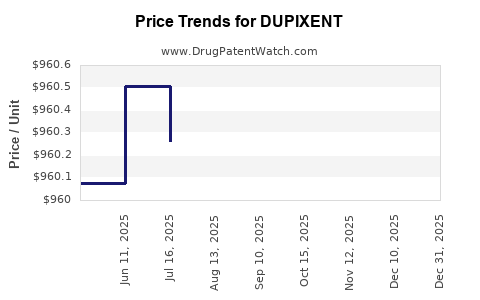
DUPIXENT’s list price varies by indication, formulation, and market. In the U.S.:
- The average wholesale price per injection ranges from $1,400 to $1,600.
- Treatment regimens typically involve an initial loading dose, then maintenance doses every two weeks.
- The annual cost per patient in the U.S. approximates $35,000 to $40,000.
Pricing is influenced by:
- Indication-specific treatment protocols.
- Competition from emerging biologics targeting similar pathways.
- Payer negotiations and formulary placements.
- Regulatory incentives or reimbursement policies in different countries.
In Europe, list prices are generally 20-30% lower, with variations across countries due to differing healthcare policies.
How Are Prices Projected to Change Over the Next Five Years?
Projected price trajectories depend on several factors:
-
Patent Expiry: DUPIXENT’s patent in the U.S. is set to expire in 2030. Patent cliffs can lead to generic or biosimilar entries, potentially reducing prices by 30-50% or more.
-
Market Competition: Introduction of biosimilars by competitors such as Amgen or Mereo BioPharma could drive down prices. Biosimilar development timelines indicate potential market entry by 2028-2030.
-
Regulatory Decisions: Expanded approvals for broader indications could increase utilization, sustaining high prices if competition is limited.
-
Pricing Strategies: Sanofi and Regeneron may adjust list prices based on payer pressures, cost-effectiveness evaluations, and market share targets.
-
Cost-Containment Policies: Healthcare systems worldwide are adopting measures to contain biologic costs, including value-based pricing and utilization caps.
Projections:
- In North America and Europe, prices may decline by 10-20% annually starting from 2028, aligned with biosimilar market entry.
- In emerging markets, prices could remain 50-70% lower than Western markets due to regulatory and economic factors.
What Are the Regulatory and Patent Dynamics?
DUPIXENT received multiple indications approvals between 2017 and 2022, extending its market exclusivity via orphan drug status and additional patents:
| Patent Type |
Expiry Year |
Notes |
| Composition of matter patent |
2030 |
Core patent covering dupilumab |
| Method of use patents |
2032-2035 |
Diagnostic and application-specific patents |
| Manufacturing process patents |
2032 |
Production process protections |
Patent challenges and inter partes reviews could influence future exclusivity. Biosimilar development transparency and patent litigation remain critical considerations.
What Are Revenue and Investment Implications?
DUPIXENT's revenue growth underscores high demand across multiple indications:
Investors should monitor patent expiry timelines, biosimilar drug developments, and health authority policies affecting biologic reimbursement.
Key Takeaways
- DUPIXENT is a leading biologic in atopic diseases with strong revenue momentum but faces looming biosimilar threats after 2030.
- Prices are high, but downward pressure is expected post-patent expiry, especially in competitive markets.
- Market expansion across indications and geographies sustains revenue growth, yet cost containment policies could temper future pricing.
- Patent strength and potential biosimilar approvals by 2028-2030 are pivotal to price projections.
- The drug’s success depends on its ability to maintain efficacy, expand indications, and navigate evolving regulatory landscapes.
FAQs
1. When will biosimilars for DUPIXENT likely enter the market?
Biosimilar development timelines suggest filings around 2025-2026, with approvals possible by 2028-2030, contingent on regulatory processes and patent challenges.
2. How does DUPIXENT compare price-wise to other biologics in similar indications?
DUPIXENT’s annual per-patient cost (~$35,000-$40,000) is comparable to other monoclonal antibodies like Humira (adalimumab) and Cosentyx (secukinumab). Biosimilar versions typically price 30-50% lower.
3. What are the main drivers of DUPIXENT’s revenue growth?
Indication expansion, increased diagnosis rates for atopic conditions, and ongoing formulary placements in hospitals and clinics are primary drivers.
4. Are there regulatory efforts to limit biologic prices impacting DUPIXENT?
Yes. Countries are adopting value-based pricing, reference pricing, and negotiation strategies to control costs, which could influence future list prices.
5. What factors could accelerate or hinder DUPIXENT’s market growth?
Accelerants include approval for new indications and higher penetration in existing ones. Hindrances involve biosimilar competition, pricing pressures, and regulatory restrictions.
References
- Sanofi and Regeneron Quarterly Earnings Reports, 2022-2023
- U.S. Food and Drug Administration (FDA) approvals and patent filings
- MarketResearch.com, "Biologics Market Forecast 2022-2026"
- IQVIA National Sales Perspectives, 2022
- European Medicines Agency (EMA) Pricing & Reimbursement Policies