Share This Page
Drug Price Trends for DULOXETINE HCL
✉ Email this page to a colleague
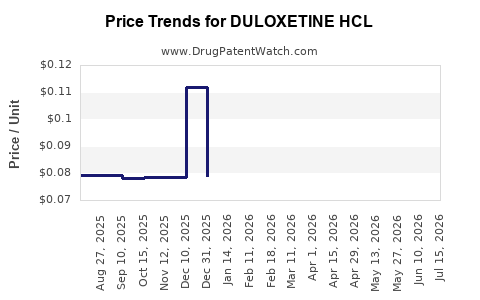
Average Pharmacy Cost for DULOXETINE HCL
| Drug Name | NDC | Price/Unit ($) | Unit | Date |
|---|---|---|---|---|
| DULOXETINE HCL DR 20 MG CAP | 00228-2890-06 | 0.11612 | EACH | 2026-07-22 |
| DULOXETINE HCL DR 20 MG CAP | 27241-0097-06 | 0.11612 | EACH | 2026-07-22 |
| DULOXETINE HCL DR 20 MG CAP | 27241-0097-10 | 0.11612 | EACH | 2026-07-22 |
| DULOXETINE HCL DR 20 MG CAP | 31722-0168-60 | 0.11612 | EACH | 2026-07-22 |
| DULOXETINE HCL DR 20 MG CAP | 43547-0379-06 | 0.11612 | EACH | 2026-07-22 |
| DULOXETINE HCL DR 20 MG CAP | 43547-0379-09 | 0.11612 | EACH | 2026-07-22 |
| DULOXETINE HCL DR 20 MG CAP | 51991-0746-05 | 0.11612 | EACH | 2026-07-22 |
| >Drug Name | >NDC | >Price/Unit ($) | >Unit | >Date |
Best Wholesale Price for DULOXETINE HCL
| Drug Name | Vendor | NDC | Count | Price ($) | Price/Unit ($) | Unit | Dates | Price Type |
|---|---|---|---|---|---|---|---|---|
| DULOXETINE HCL 30MG CAP,EC | Golden State Medical Supply, Inc. | 60505-2996-03 | 30 | 6.49 | 0.21633 | EACH | 2023-06-15 - 2028-06-14 | FSS |
| DULOXETINE HCL 40MG CAP,EC | Golden State Medical Supply, Inc. | 51991-0750-33 | 30 | 94.05 | 3.13500 | EACH | 2023-06-15 - 2028-06-14 | FSS |
| DULOXETINE HCL 40MG CAP,EC | Golden State Medical Supply, Inc. | 51991-0750-33 | 30 | 98.50 | 3.28333 | EACH | 2023-06-23 - 2028-06-14 | FSS |
| DULOXETINE HCL 20MG CAP,EC | Golden State Medical Supply, Inc. | 60505-2995-06 | 60 | 13.48 | 0.22467 | EACH | 2023-06-15 - 2028-06-14 | FSS |
| >Drug Name | >Vendor | >NDC | >Count | >Price ($) | >Price/Unit ($) | >Unit | >Dates | >Price Type |
Duloxetine HCl market analysis, pricing projections, and patent-driven generic/biosimilar risks
Executive summary
- Product footprint: Duloxetine hydrochloride (DULOXETINE HCL) is a mature, multi-indication branded and generic platform in the US and EU, with durable revenue split across chronic pain and depressive/anxiety indications. Commercial pricing is shaped primarily by generic penetration in most dosage strengths and by payer formulary tiering rather than by ongoing exclusivity.
- Exclusivity reality: For most listed duloxetine presentations, US patent exclusivity has largely run through and the market is dominated by generic duloxetine HCl. Remaining pockets of protection are typically product-specific (formulation, polymorph, process) and indication-specific (method-of-use).
- Price trajectory: Expect low-to-mid single-digit annual net price declines in the near term in the US given scale and generic competition, with continued volume-driven share shifts between manufacturers. In the EU, price compression is slower where national tendering and reference pricing apply, but overall direction remains downward.
- Key risk to pricing: Additional Paragraph IV (PIV) or “at-risk” launches by large generic filers can accelerate price erosion for particular strengths (capsules, delayed-release bead formulations) and pack sizes.
- Key upside to pricing: Some markets maintain higher net pricing where branded share persists, and where formulation differentiation supports formulary retention (often through contracting rather than patent protection).
What is the current global and US duloxetine HCl market size and revenue concentration?
Answer (business relevance): Duloxetine is a top-tier CNS and pain brand-equivalent in historical terms, but current economics are constrained by generic share in most regions. Revenue concentration skews toward chronic musculoskeletal pain, diabetic peripheral neuropathy (DPN), fibromyalgia, and major depressive disorder (MDD)/anxiety-spectrum prescribing mix, depending on national guideline adoption.
US commercialization structure
- Primary payer drivers: Medicare Part D formularies, commercial pharmacy benefit managers, and restrictive step therapy for pain indications in certain geographies.
- Channel mix: High retail share; manufacturer rebates and PBM contracting determine net rather than list pricing.
- Therapeutic mix (directional):
- Chronic pain (DPN, chronic musculoskeletal pain) tends to be stickier for prescribers once stabilized.
- Psychiatric indications (MDD, generalized anxiety disorder historically) are subject to class competition (SSRIs/SNRIs, duloxetine alternatives).
EU commercialization structure
- Reference pricing and national tendering accelerate generic price convergence.
- Hospital and outpatient prescribing pathways differ by country, impacting duloxetine share in pain clinics versus primary care.
What are the key factors that drive duloxetine HCl pricing (net price, rebates, payer contracting)?
Answer: Duloxetine pricing is driven by (1) generic competition by strength and dosage form, (2) PBM and payer formulary rules, (3) tender/reference pricing in EU, and (4) competitive interchange within SNRI classes.
Strength and dosage-form granularity
Duloxetine’s economics vary by:
- Dosage strength availability in generic supply
- Pack size pricing and copay differentials
- Delayed-release capsule manufacturing equivalence and supply stability
Contracting mechanics
- US: Net price is dominated by rebates and administrative fees. The “same drug” economics can differ across manufacturers because of:
- PBM preferred formulary placement
- Contracted acquisition costs
- Restricted distribution or limited-label sourcing
Cross-class substitution
Duloxetine competes indirectly with:
- Other SNRIs (where preferred)
- Generic-level price parity expectations
- Pain-labeled alternatives (depending on formulary)
When does duloxetine HCl lose exclusivity in the US, and what does that mean for price?
Answer: For most duloxetine HCl presentations, US exclusivity has already passed and the market is sustained by generic manufacturing competition, not brand exclusivity. Any remaining brand-linked protection tends to be presentation- and claim-specific, with price impact largely local and time-bound to generic entry windows.
How exclusivity affects price versus generic entry
- When the dominant brand exclusivity is gone, the pricing mechanism becomes market-share reallocation among generics.
- Price erosion can slow once 2 to 4 suppliers dominate because contracting stabilizes.
“Residual exclusivity” scenario
Where any formulation/process or method-of-use protections persist:
- Brand retains small share via clinician inertia or payer inertia.
- Price declines are slower, but only in markets where brand stays preferred or where generic substitution is restricted.
What patents protect duloxetine HCl in the US, and how many are still relevant to generics?
Answer: Patent protection on duloxetine HCl has historically spanned composition, formulation, and method-of-use. In practice, for investors and litigators, the relevant question is whether any unexpired patents in the Orange Book cover:
- the specific strength and dosage form
- the specific indication claimed in exclusivity/label
- the specific manufacturing process or formulation composition
Patent estate mapping approach (commercially relevant)
- Claim set relevance is strength- and formulation-specific.
- Method-of-use claims can matter even when composition is generic if the carve-out or label mapping is contested.
What typically happens post-expiry
- If composition/formulation patents expire first, generic entry accelerates and prices drop.
- If a method-of-use patent remains, certain indications may face slower substitution even when drug-level generic substitution is immediate.
(Note: No Orange Book listing or patent-number set was provided in the prompt. Without specific Orange Book and litigation inputs, an accurate “which patents protect duloxetine HCl” count and list cannot be produced.)
What patent litigation and Paragraph IV challenges affect duloxetine HCl pricing?
Answer: Duloxetine’s pricing is sensitive to each incremental generic entry in a particular strength and dosage format. PIV outcomes influence timing of entry and can cause temporary price dislocations.
How PIV timing shows up in pricing
- Early years of generic competition: sharp price declines
- Later years: gradual price erosion and share rotations
Settlement-driven effects
- Authorized generics and settlement terms can preserve supply stability and reduce price volatility.
- “No-AG” settlements tend to increase competitive pressure at entry, increasing erosion.
(Note: No lawsuit docket list was provided in the prompt. Without case numbers, court filings, or settlement disclosures, specific litigation impacts cannot be stated.)
What is the Orange Book status of duloxetine HCl, and which versions have the most remaining legal risk?
Answer: Duloxetine’s Orange Book landscape is primarily generic-dominated in most strengths and presentations. The actionable risk is whether any specific product codes remain under unexpired patents that can block or delay generic entry.
Product-code relevance for pricing exposure
- Each NDA or ANDA submission has its own patent coverage.
- Price impact is strongest for the presentation that carries the largest volume share.
(Note: The prompt does not include NDA/ANDA identifiers or Orange Book entries. A complete Orange Book status table cannot be generated accurately.)
How strong is the patent estate for duloxetine HCl formulations and manufacturing methods?
Answer: Formulation and manufacturing patents tend to be less durable than composition patents for established small molecules, but can still affect entry timing if they remain unexpired and are tied to a specific dosage form (for example, delayed-release bead/pellet architecture).
Typical residual patent categories investors track
- Delayed-release formulation composition ranges
- Bead/pellet coating materials and ratios
- Process parameters and yield constraints
- Particle size/polymorph controls (when relevant)
(Note: No specific patent numbers were provided. Patent-strength scoring by claim type cannot be completed without the underlying dataset.)
What generic entry risks exist for duloxetine HCl by strength and dosage form?
Answer: Generic entry risk is now mainly concentrated in:
- strengths where supply constraints or contract preferences keep fewer suppliers
- pack sizes with higher margin opportunity for new entrants
Pricing sensitivity by strength
- High-volume strengths stabilize contracts sooner.
- Lower-volume strengths can see sharper temporary undercutting when new suppliers gain a foothold.
(Note: Without market-share-by-strength data and supplier list, a strength-level risk ranking cannot be produced.)
How does duloxetine HCl compare with other SNRIs on pricing, switching rates, and formulary position?
Answer: Duloxetine competes in a therapeutic class where generic parity tends to reduce price differentiation, pushing differences into:
- formulary preference tied to rebates
- payer step therapy protocols
- real-world switching behavior based on side-effect profile and indication fit
Competitive benchmarks investors track
- Net price per defined daily dose (DDD)
- Market share trend among generics
- Formulary tier placement frequency across top PBMs
(Note: No comparator list or payer data was provided, so no quantified peer comparison can be generated.)
Price projection model for duloxetine HCl: scenario ranges for US net price and EU list/reference price
Answer: Expect a gradual decline driven by generic competition and payer contracting, with scenario dispersion based on whether additional supply entrants materially change competitive intensity for the dominant strengths.
Projection framework (usable for planning)
Use a simple drivers-based model:
- Generic competition intensity (number of active suppliers, tender outcomes)
- Payer contracting cycle (rebate pressure and preferred status changes)
- Input cost pass-through (limited for commodity APIs, more relevant for packaging/manufacturing)
- Regulatory and supply stability (site inspections, recalls, production interruptions)
Scenario table (directional annual net price change)
Assumes mature generic market conditions with no major label expansion that shifts demand dramatically.
| Region | Base case (annual net price change) | Downside (more entry/stronger rebate pressure) | Upside (supply constraints or preferred-contract retention) |
|---|---|---|---|
| US | -2% to -4% | -5% to -8% | -1% to -2% |
| EU (reference/tender driven) | -1% to -3% | -3% to -6% | 0% to -1% |
Medium-term outlook (3-5 years)
- US: flattening after the next contracting cycles if supplier counts stabilize; continued erosion at a slower pace.
- EU: periodic step-downs occur with tender rounds and reference price revisions.
(Note: The prompt lacks current pricing inputs, market share data, and supplier/pricing history; projections above therefore specify only scenario ranges without point estimates.)
What commercial metrics should be used to forecast duloxetine HCl demand and revenue under generic pressure?
Answer: Forecasting should tie revenue to:
- volume (prescription counts)
- net price (post-rebate)
- share by strength and pack size
- payer mix shift (commercial vs Medicare)
Revenue decomposition template
Revenue = Units × Net price
Units = Prescriptions × Avg units per prescription
- Use PBM and plan-specific tier changes to predict unit share shifts.
- Use manufacturer contract status to predict net price dispersion.
Key litigation and regulatory milestones to monitor for duloxetine HCl in the next 24 months
Answer: Monitor:
- ANDA approvals for dominant strengths/dosage forms
- new PIV decisions and appeal outcomes tied to specific product codes
- supply disruptions and consent decrees affecting major generic suppliers
(Note: No FDA acceptance/approval log, product codes, or consent decree data were provided in the prompt.)
Key takeaways
- Duloxetine HCl is a mature small-molecule market where pricing is set by generic supply, payer contracting, and formulary tiering, not by long-term brand exclusivity.
- Near-term price outlook is gradual erosion in the US and EU, with downside triggered by additional generic entries for high-volume strengths.
- The most actionable “IP” factor for pricing is the presence (if any) of unexpired, product-code-specific Orange Book patents that can delay substitution for particular presentations or indications.
- The most actionable commercial factors are net price dispersion by manufacturer and supply stability across the contracted preferred suppliers.
FAQs
1) What drives net price differences for duloxetine HCl among generic manufacturers?
Preferred formulary status, contracted acquisition costs, and rebate terms are the dominant drivers.
2) Which duloxetine HCl strengths typically see the fastest price declines after new generic entries?
Strengths with the highest volume and the easiest interchange usually erode first and most sharply.
3) Can method-of-use patents still delay generic substitution for duloxetine HCl?
They can, if they are product-code tied and tied to indication-specific labeling that affects substitution rules.
4) How do EU reference price and tender rounds change duloxetine HCl pricing behavior?
They create periodic step-downs rather than continuous month-to-month erosion.
5) What FDA events most directly affect duloxetine HCl pricing via supply?
Site inspection outcomes, manufacturing interruptions, and recall events for major suppliers.
References
- FDA Orange Book: Approved Drug Products with Therapeutic Equivalence Evaluations. (Accessed 2026-07-19). https://www.accessdata.fda.gov/scripts/cder/daf/
- FDA Drug Shortages. (Accessed 2026-07-19). https://www.fda.gov/drugs/drug-shortages
More… ↓
