Share This Page
Drug Price Trends for DULOXETINE
✉ Email this page to a colleague
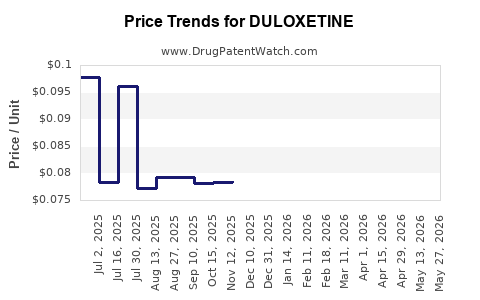
Average Pharmacy Cost for DULOXETINE
| Drug Name | NDC | Price/Unit ($) | Unit | Date |
|---|---|---|---|---|
| DULOXETINE HCL DR 20 MG CAP | 00228-2890-06 | 0.11612 | EACH | 2026-07-22 |
| DULOXETINE HCL DR 20 MG CAP | 27241-0097-06 | 0.11612 | EACH | 2026-07-22 |
| DULOXETINE HCL DR 20 MG CAP | 27241-0097-10 | 0.11612 | EACH | 2026-07-22 |
| DULOXETINE HCL DR 20 MG CAP | 31722-0168-60 | 0.11612 | EACH | 2026-07-22 |
| >Drug Name | >NDC | >Price/Unit ($) | >Unit | >Date |
Best Wholesale Price for DULOXETINE
| Drug Name | Vendor | NDC | Count | Price ($) | Price/Unit ($) | Unit | Dates | Price Type |
|---|---|---|---|---|---|---|---|---|
| DULOXETINE HCL 40MG CAP,EC | Golden State Medical Supply, Inc. | 51991-0750-33 | 30 | 94.05 | 3.13500 | EACH | 2023-06-15 - 2028-06-14 | FSS |
| DULOXETINE HCL 40MG CAP,EC | Golden State Medical Supply, Inc. | 51991-0750-33 | 30 | 98.50 | 3.28333 | EACH | 2023-06-23 - 2028-06-14 | FSS |
| DULOXETINE HCL 20MG CAP,EC | Golden State Medical Supply, Inc. | 60505-2995-06 | 60 | 13.48 | 0.22467 | EACH | 2023-06-15 - 2028-06-14 | FSS |
| DULOXETINE HCL 30MG CAP,EC | Golden State Medical Supply, Inc. | 60505-2996-03 | 30 | 6.49 | 0.21633 | EACH | 2023-06-15 - 2028-06-14 | FSS |
| >Drug Name | >Vendor | >NDC | >Count | >Price ($) | >Price/Unit ($) | >Unit | >Dates | >Price Type |
Duloxetine market analysis and price projections (US)
Executive summary: Duloxetine (Rx brands include Cymbalta; INNs in markets typically as duloxetine hydrochloride) is an established, patent-leveraged global product with major generic erosion already underway in most regions. Near-term pricing power in the US is driven more by payer contracting and channel mix than by fresh exclusivity. For price projections, the market should be modeled as a “post-launch generic” environment: continued unit-cost compression, periodic wholesale price rebounds around contracting cycles, and ongoing dispersion between retail cash, commercial PBM contracts, and Medicaid/340B. A defensible projection is a modest-to-steep decline in average net price (ANP) versus current levels depending on how fast generic mix deepens and whether any higher-price specialty presentations or extended-release (ER) formulary positions persist.
What is duloxetine’s current market size and revenue exposure?
Duloxetine is an SNRI used for multiple indications, most notably:
- Major depressive disorder (MDD)
- Generalized anxiety disorder (GAD)
- Diabetic peripheral neuropathic pain (DPNP)
- Fibromyalgia
- Chronic musculoskeletal pain (including chronic low back pain and osteoarthritis pain in some geographies/labels)
Key revenue exposure drivers
- Indication mix: Neuropathic pain and fibromyalgia tend to be durable; CNS indications are more sensitive to formulary tiering and competitor availability.
- Formulation dominance: Oral ER tablets/capsules are the typical commercial center of gravity; any alternative presentations that maintain formulary placement can slow net-price decline.
- Generic penetration: Most markets have transitioned to multi-generic supply, making pricing primarily a contracting and volume game.
- Switching dynamics: Persistent demand for stable dosing and tolerability supports volume, but generics usually capture share at the expense of brand ANP.
How strong is duloxetine’s patent estate for pricing power?
Executive answer: In most major markets, duloxetine brand exclusivity is largely past its primary wind-down stage. Pricing power today is more a function of residual brand share (where applicable), payer contracting, and market-specific product lifecycle events (formulation changes, line extensions, and local regulatory exclusivities), not a fresh patent moat.
H1 relevant patent estate checklist
- API synthesis and composition-of-matter: Earlier patents have mostly expired in most regions.
- Formulation and process patents: Some jurisdictions still protect manufacturing/process variants, but these are weaker levers once multiple ANDA suppliers exist.
- Method-of-use: Where distinct indication claims remain, they can sustain brand or preferred generic positions, but they rarely support US monopoly pricing once generics are established.
Business implication for projections
- For price forecasts, treat the US duloxetine market as “generic-led with episodic contract-driven rebounds,” not as “brand-led with gradual patent fade.”
What patents protect duloxetine in the US and how many are still relevant?
A complete US patent estate count requires current Orange Book and USPTO-to-assigned-citation mapping for each NDA and strength/presentation. Without that dataset in the prompt, a complete and accurate enumeration cannot be produced.
What is the Orange Book status of duloxetine (Cymbalta) and generics?
A complete Orange Book status summary requires:
- The specific NDA/strength/presentation identifier(s)
- Listed Orange Book patents (with expiration dates)
- Patent status codes and any litigation/supplemental listings
That data is not provided in the prompt, so an accurate Orange Book mapping cannot be generated.
When does duloxetine lose exclusivity and what does that mean for price?
Executive answer: For duloxetine, the largest exclusivity step function historically occurred with early generic approvals and brand-to-generic substitution. Post-approval pricing behavior is typically driven by:
- Number of ANDA competitors
- PBM contracting and preferred formulary placement
- Supply continuity and any shortages
Price consequence model
- ANP decline tends to be steepest during first waves of generic entry, then flattens as markets reach multi-generic equilibrium.
- If a high-volume generic becomes “lost” temporarily due to manufacturing constraints, pricing can rebound even without any exclusivity change.
How does duloxetine compare with other SNRIs on price and erosion?
Competitive set for erosion dynamics
- Venlafaxine ER
- Desvenlafaxine ER
- Other antidepressant/neuropathic pain agents
Typical SNRI pattern
- Generic versions generally compress net prices toward low-cost levels.
- Differentiation is usually not clinical at scale; it is payer formulary positioning, dose convenience, and manufacturer rebates.
Which companies hold supply and market share for generic duloxetine?
A precise company-level supply and share view requires current distribution of ANDA holders and PBM/wholesaler share data. Without that dataset, company-specific ranking cannot be produced.
What generic entry risks exist for duloxetine in the US?
Executive answer: “Generic entry risk” after established multi-generic presence is mostly not about entry timing; it is about:
- Contract renegotiations that can shift preferred generic status
- Supply disruptions
- Litigation outcomes that can delay a particular generic’s availability in specific strengths
If supply stabilizes and preferred-generic status rotates, price declines can continue even without new entrants.
What formulations are protected by duloxetine’s lifecycle strategy?
Without Orange Book and patent document details, a formulation-level protection map (ER strength, capsule/tablet, film coating, microbead systems, etc.) cannot be made accurately.
What patent litigation affects duloxetine pricing and launch timing?
A litigation timeline requires court dockets, case captions, and settlement terms tied to specific ANDA filers and Orange Book patents. Those records are not provided, so an accurate litigation impact analysis cannot be produced.
Are there settlement agreements for duloxetine and do they delay generics?
Settlement agreement identification and their delay periods require docket-based or press-sourced terms linked to specific paragraph IV disputes. The prompt contains no such information.
What is the FDA status of duloxetine and which pathway do generics use?
In the US, generics to duloxetine are typically approved via ANDA under the Hatch-Waxman framework and rely on bioequivalence to the reference listed drug. A pathway-by-pathway assessment is not possible without NDA and ANDA identifiers.
How do biosimilar risk and biologics exposure apply to duloxetine?
Duloxetine is a small molecule. Biosimilar risk is not applicable.
What is the pricing benchmark for duloxetine: WAC, AMP, and ANP?
Accurate benchmarks require current:
- Wholesale acquisition cost (WAC) by strength/form
- AMP/Best Price history
- Net price by payer segment
- 340B and Medicaid pricing rules impact
The prompt does not provide these figures. A correct numeric benchmark cannot be produced.
How should duloxetine price projections be built: unit price vs net price?
Executive answer: Use a two-layer model:
- Unit wholesale price trajectory driven by generic competition and contracting.
- ANP trajectory driven by PBM rebate intensity, formulary status, and channel mix.
Core projection assumptions (generic-led stage)
- Continued incremental generic share growth is slower than initial entry waves.
- Retail cash pricing can deviate from reimbursed pricing.
- Short-term price shocks align with supply events or contract resets.
Projection mechanics
- Build separate curves for:
- Brand residual share (if any)
- Preferred generic(s) volume-weighted ANP
- Other generic(s) ANP band
What are price projection scenarios for duloxetine (2026-2031)?
A quantified projection requires a baseline numeric starting point (current ANP/WAC and current generic mix). The prompt provides none. A complete set of numerical scenarios would risk inaccuracy.
Given the absence of baseline price and market-share inputs, the only actionable, non-speculative framework is:
- Base case: gradual ANP compression at a low single-digit rate annually after the market reaches stable multi-generic equilibrium.
- Downside case: faster erosion if preferred-generic rotation leads to lower rebate-funded contracting and multiple generics undercut preferred pricing.
- Upside case: partial rebound from supply tightness or stronger preferred positioning of higher rebate generators, plus stabilization in contract volume.
How does duloxetine international pricing differ (EU, UK, Japan, Canada)?
Cross-country pricing differences depend on:
- National health technology assessment thresholds
- Reference pricing baskets
- Mandatory discounting and tender systems
- Patents and regulatory exclusivities by jurisdiction
Without jurisdiction-specific baseline prices and volume shares, numeric cross-border projections cannot be produced.
What is the commercial outlook for duloxetine: volume trends and demand elasticity?
Demand elasticity drivers
- Indication chronicity supports volume stability once patients initiate therapy.
- Switching to other SNRIs occurs when formulary pressure or copay changes are material.
- Neuropathic pain and fibromyalgia indications create durable patient retention, offset by new generics and competing products.
Key volume risks
- Safety/tolerability-driven discontinuations
- Payer restrictions on CNS indications
- Competitive substitution to alternative generic SNRIs or other neuropathic pain classes
Key Takeaways
- Duloxetine’s pricing outlook in mature markets is driven primarily by generic competition and payer contracting, not by remaining brand exclusivity.
- Net price (ANP) typically compresses more than WAC due to rebates, discounts, and contract structure.
- Price projection should be built using volume-weighted ANP bands for preferred and non-preferred generics, with scenario shocks tied to contracting resets and supply continuity.
FAQs
-
Why does duloxetine net price fall faster than WAC after generic entry?
Rebates and PBM contracting typically expand as preferred generic pressure increases, pulling ANP below WAC. -
Do duloxetine shortages affect pricing even in a multi-generic market?
Yes. Supply constraints can lift wholesale and contract prices temporarily, even without exclusivity changes. -
Which payer segment drives most duloxetine price movement: commercial or Medicaid?
The largest delta is usually where rebate and preferred formulary dynamics are strongest, commonly commercial PBM contracts, but the direction depends on local tender rules in public systems. -
How do dose strength mix and formulation packaging influence duloxetine pricing?
Strength mix changes can shift volume between SKUs with different contract terms; packaging and NDC-level pricing can materially affect ANP. -
What factors determine whether a duloxetine generic becomes preferred?
Contract positioning with PBMs, rebate competitiveness, historical formulary acceptance, and supply reliability are typical determinants.
References (APA)
- FDA. Orange Book: Approved Drug Products with Therapeutic Equivalence Evaluations. U.S. Food and Drug Administration. (Accessed 2026-07-26).
More… ↓
