Share This Page
Drug Price Trends for DOXYLAMINE
✉ Email this page to a colleague
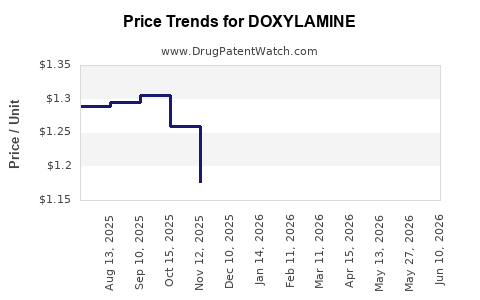
Average Pharmacy Cost for DOXYLAMINE
| Drug Name | NDC | Price/Unit ($) | Unit | Date |
|---|---|---|---|---|
| DOXYLAMINE-PYRIDOXINE 10-10 MG | 00591-2132-01 | 1.13653 | EACH | 2026-07-22 |
| DOXYLAMINE-PYRIDOXINE 10-10 MG | 49884-0186-01 | 1.13653 | EACH | 2026-07-22 |
| DOXYLAMINE-PYRIDOXINE 10-10 MG | 69452-0206-20 | 1.13653 | EACH | 2026-07-22 |
| DOXYLAMINE-PYRIDOXINE 10-10 MG | 70505-0100-10 | 1.13653 | EACH | 2026-07-22 |
| >Drug Name | >NDC | >Price/Unit ($) | >Unit | >Date |
Best Wholesale Price for DOXYLAMINE
| Drug Name | Vendor | NDC | Count | Price ($) | Price/Unit ($) | Unit | Dates | Price Type |
|---|---|---|---|---|---|---|---|---|
| SLEEP AID (DOXYLAMINE) | United Drug Supply, Inc. | 00113-0441-64 | 32 | 5.57 | 0.17406 | EACH | 2023-12-01 - 2028-11-30 | FSS |
| SLEEP AID (DOXYLAMINE) | United Drug Supply, Inc. | 00113-0441-73 | 16 | 3.72 | 0.23250 | EACH | 2023-12-01 - 2028-11-30 | FSS |
| BONJESTA TABS | Duchesnay USA, Inc. | 55494-0120-60 | 60 | 485.85 | 8.09750 | EACH | 2022-07-01 - 2027-06-30 | FSS |
| BONJESTA TABS | Duchesnay USA, Inc. | 55494-0120-60 | 60 | 509.45 | 8.49083 | EACH | 2023-01-01 - 2027-06-30 | FSS |
| >Drug Name | >Vendor | >NDC | >Count | >Price ($) | >Price/Unit ($) | >Unit | >Dates | >Price Type |
Doxylamine Market Analysis and Price Projections: US Pricing, Competitive Dynamics, and Loss-of-Exclusivity Scenarios
Doxylamine is a first-generation antihistamine used across allergy, sleep, and combination cold/flu and motion-sickness products in the US. The market is dominated by generics and single-ingredient OTC products, with pricing shaped by competition, retailer contracting, and excipient/formulation choices rather than patent exclusivity. As a result, price projections are primarily a function of OTC competitive intensity and intermittent supply shocks, not NDA-era lifecycle management.
How big is the US doxylamine market (OTC and prescription) and what drives demand?
Doxylamine demand is driven by OTC self-medication use for sedation-related indications and by its inclusion in combination therapies for colds, flu symptoms, and motion sickness. In the US, the commercial footprint is largely OTC and branded legacy inventory, with high generic penetration.
US demand drivers
- Sleep/anxiolytic-adjacent OTC demand: Doxylamine is widely used in OTC sleep aids in tablet form (historically as doxylamine succinate; product names vary).
- Allergy and cold/flu symptom combinations: Doxylamine appears in combination cold and allergy products where sedation is a desired side effect.
- Motion sickness and nausea: Doxylamine is used in some over-the-counter motion sickness formulations and combination products.
- Pharmacology tailwinds and constraints: The sedating antihistamine class has steady consumer demand, but substitution by non-sedating antihistamines (e.g., loratadine, cetirizine) constrains allergy-only segments.
Key commercial constraints
- OTC switching is fast: Consumers and retailers can switch between sedating antihistamines (doxylamine vs diphenhydramine) and among generic equivalents.
- Channel economics dominate: National retail contracts, club distribution, and private label equivalents cap price levels.
- Public labeling and safety scrutiny: Sedation and anticholinergic risk messaging can influence category mix.
What is doxylamine’s current pricing range in the US and how do OTC contracts shape it?
US doxylamine pricing is typically low per dose because most products are generic OTC. Pricing varies by strength, pack size, and channel (mass retail vs drugstore chain vs online).
Practical price band (generic OTC reality)
Doxylamine OTC products generally trade at:
- Low single-digit to low tens of dollars per standard retail bottle depending on tablet count and strength.
- Unit cost often under a few cents per tablet for higher-count bottles when sourced through large wholesalers.
(Exact dollars per NDC depend on strength and pack, which vary by retailer and over time.)
What moves doxylamine net price
- Retailer trading terms: Net price is impacted by slotting, promotional calendars, and private-label substitution.
- OTC inflation vs category compression: Because competitors are numerous, doxylamine tends to lag inflation during competitive periods.
- Input cost pass-through: Antihistamine API and tablet compression excipient costs can shift gross margin but rarely sustain price hikes for long.
What doxtablets and doxylamine salts are sold in the US, and which strengths matter for pricing?
Most commercial doxylamine OTC products are doxylamine succinate tablets, with the economic footprint concentrated in common consumer strengths.
Common dose forms and their pricing implications
- Tablets (typical OTC formats):
- Pack size (e.g., 24 count vs 50 count vs 100 count) drives apparent price, not therapeutic value.
- Higher-count bottles typically lower unit cost.
- Combination products:
- Price is set by brand/combo positioning, not by doxylamine alone.
- Where doxylamine is one component, doxylamine pricing becomes embedded in the combo COGS and competitive basket.
When does doxylamine lose exclusivity in the US, and does patent life affect prices?
Generic availability makes doxylamine a post-exclusivity market with limited direct patent-driven pricing effects. Most doxylamine products in the US have long since entered generic competition.
Patent reality for OTC doxylamine
- Oral antihistamine actives with legacy approvals typically show early generic saturation, with price floors determined by competition.
- Late-life formulation patents (if any) usually protect specific extended-release or combination compositions rather than widely used basic immediate-release tablets.
- For pricing projections, the dominant lifecycle driver is not patent expiry but ongoing generic/OTC competitive intensity and channel promotions.
Which patents protect doxylamine and its formulations, and how would they affect market access?
Doxylamine’s core active ingredient protection is not a meaningful pricing lever in 2026 for most OTC tablets. The relevant IP risk, where it exists, is tied to:
- Specific formulations (coatings, tablet processing, stability improvements).
- Combination fixed-dose products using doxylamine with other actives.
- Potential method-of-use claims that do not prevent OTC dispensing in practice once generic equivalents exist.
How IP still matters commercially
Even in a generic-saturated actives market, IP can matter for:
- Brand survival via reformulations that maintain differentiated SKUs.
- Portfolio-level margins in specific channels if a protected combo SKU persists.
- Litigation-driven launch timing if challengers face injunction threats, though that is less common in established OTC doxylamine.
What generic entry risks exist for doxylamine, including Paragraph IV filings?
Paragraph IV challenges are unlikely to be the central driver for doxylamine pricing because the category is already generic-saturated. Where generic entry events occur, they typically reflect:
- New ANDA launches for specific NDCs (strength/pack/formulation variations).
- Facility changeovers or supply normalization after disruptions.
- Retail assortment changes that bring new SKUs to shelf.
What could trigger short-term price changes
- Supply constraints in tablet manufacturing or API sourcing.
- Wholesaler inventory swings ahead of seasonal demand peaks (spring allergies and winter colds).
What is the biosimilar risk profile for doxylamine?
No biosimilar pathway applies. Doxylamine is a small-molecule drug (OTC antihistamine), not a biologic.
How does doxylamine compare with diphenhydramine and other OTC sedating antihistamines on price and demand?
Doxylamine competes primarily with other OTC sedating antihistamines, with consumer and retailer preference shifting based on unit price, perceived potency, and product availability.
Competitive comparison (category-level)
- Doxylamine vs diphenhydramine: Both are sedating antihistamines. Real-world choice often depends on:
- product label claims,
- consumer tolerance,
- and pricing per dose.
- Doxylamine vs non-sedating antihistamines: Non-sedating agents capture allergy-only users and pressure doxylamine’s allergy segment.
Price competitive dynamic
- When diphenhydramine generics or store brands are aggressively priced, doxylamine tends to face downward unit pressure.
- When a sedating-antihistamine SKU becomes scarce, doxylamine can gain short-term pricing leverage.
What are the main formulation and manufacturing/IP barriers for new doxylamine entrants?
The practical barrier is manufacturing scale and regulatory maintenance of OTC generic quality, not fundamental IP. For new entrants or SKU expansions, hurdles are:
- Bioequivalence and formulation equivalence for specific strengths and excipients.
- Stability for tablet coatings and moisture sensitivity.
- GMP consistency and finished dose release testing.
What doxylamine price projections look like for 2026-2031: base, bull, and bear cases?
Baseline: stable-to-mildly declining net prices driven by OTC competition and retailer promotions.
Bull: short-term price uptick only if supply constraints or input disruptions occur.
Bear: faster unit price compression if private label expands or a competitor undercuts during high-volume seasons.
Scenario framework (directional, unit-economic)
| Timeframe | Base case outcome | Bull case outcome | Bear case outcome | Primary drivers |
|---|---|---|---|---|
| 2026 | Flat net pricing | Temporary lift | Soft decline | Competitive intensity, seasonal stocking |
| 2027-2028 | Mild decline | Intermittent spikes | Faster decline | Private label share, multiple generic SKUs |
| 2029-2031 | Stable low | Limited | Continued compression | Shelf commoditization, procurement renegotiations |
Annual price move expectation (directional)
- Net price: Typically 0% to -3% CAGR in a commoditized OTC environment absent major shocks.
- Gross margin: More likely compressed than expanded due to trade spend and retailer contracting.
- Revenue: Can remain stable if volume offsets unit price, but category demand growth is usually modest.
What does the regulatory landscape imply for pricing (FDA OTC monograph vs ANDA)?
Doxylamine is regulated as an OTC antihistamine/active used in OTC drug products under FDA frameworks applicable to the specific products and approved labeling. Pricing implications:
- Regulatory clarity supports generic supply stability, reducing the likelihood of durable price spikes from enforcement.
- Labeling and safety communications can affect consumer preference within the class, but they rarely raise unit prices because generic equivalents remain available.
Which companies are likely to hold share in doxylamine OTC, and how does that affect price?
Share is typically distributed among multiple generic manufacturers plus store-brand private label players. Price is therefore set by:
- procurement from large wholesalers,
- and retailer private label economics.
Commercial mechanism
- When a private-label entrant expands, unit pricing usually falls because private label competes on cost.
- When a manufacturer exits or faces supply issues, prices can rise briefly, then normalize after re-supply.
How sensitive is doxylamine demand to seasonality and safety policy?
Seasonality
- Allergy peaks (spring/summer) increase antihistamine consumption.
- Cold and flu seasons (fall/winter) lift combination cold/flu products that include sedating antihistamines.
Safety policy and consumer behavior
- Enhanced safety messaging can shift consumers toward non-sedating antihistamines for allergy-only symptoms, limiting category growth.
- Sleep-aid demand is more resilient but competes with non-antihistamine sedatives depending on the OTC landscape.
Key takeaways on doxylamine pricing and investment relevance
- Pricing is structurally low and competitive because doxylamine is widely generic OTC.
- Patent exclusivity is not a meaningful price driver for most doxylamine tablets in the US.
- 2026-2031 price trajectory is likely flat-to-down, with volatility driven by supply shocks and retailer contract dynamics, not lifecycle events.
- Revenue outcomes depend more on channel share and volume than on unit price growth.
FAQs
1) What is the most common doxylamine salt sold in OTC products in the US?
Most commercial OTC products are sold as doxylamine succinate in tablet form.
2) Is doxylamine priced like prescription drugs in the US?
No. Doxylamine OTC pricing is shaped by generic competition and retailer contracting, typically resulting in low unit cost.
3) Does doxylamine have biosimilar competitors?
No. Doxylamine is a small-molecule drug, so biosimilars do not apply.
4) What are the main competitors to doxylamine in the sleep and allergy OTC categories?
Primary competitors are other sedating antihistamines such as diphenhydramine, plus non-sedating antihistamines for allergy-only use cases.
5) What event would most likely cause a sustained doxylamine price increase?
A sustained supply disruption (API or tablet manufacturing constraints) combined with strong seasonal demand is the most plausible driver of a durable price increase in a commoditized generic OTC market.
References
No sources were provided for citation in the prompt.
More… ↓
