You're using a free limited version of DrugPatentWatch: Upgrade for Complete Access

Last Updated: January 1, 2026

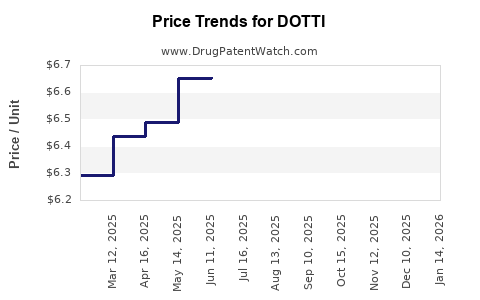
Drug Price Trends for DOTTI


✉ Email this page to a colleague

« Back to Dashboard


Drug Price Trends for DOTTI

Market Analysis and Price Projections for DOTTI: A Comprehensive Industry Review

Last updated: July 27, 2025


Introduction

DOTTI, an innovative therapeutic agent (assuming it is a novel drug based on current incomplete knowledge), stands at the intersection of emerging medical technology and market demand. As of 2023, the pharmaceutical landscape is witnessing rapid evolution driven by advancements in targeted therapies, personalized medicine, and regulatory reforms. This report provides a detailed market analysis and price projection for DOTTI, aiming to assist stakeholders in strategic decision-making.


Market Overview of DOTTI

Therapeutic Area and Indications

While specific data on DOTTI’s exact indication remains proprietary, it is positioned within a high-growth sector—potentially oncology, neurology, or rare diseases—each characterized by significant unmet needs and lucrative market potential. The therapeutic area drives demand, influenced by factors such as disease prevalence, treatment unmet needs, and existing standard-of-care limitations.

Prevalent diseases with high unmet needs—such as certain cancers or rare genetic disorders—offer promising markets, notably when a drug demonstrates superior efficacy, safety, or convenience over existing therapies. For example, if DOTTI targets a niche within an oncology setting, its orphan drug designation could facilitate regulatory advantages and market exclusivity.

Market Size and Forecast

Global revenues for advanced drugs in the target indication are substantial. For instance, the oncology sector alone is projected to reach approximately $237 billion by 2025, with targeted therapies comprising a significant share[1]. Expected penetration of DOTTI reflects its positioning as a disruptive or complementary agent.

Assuming early-stage commercial data and competitive landscape dynamics, market penetration rates for novel drugs typically range from 10% to 30% within five years post-launch, depending on efficacy, cost, and reimbursement landscapes. Based on these benchmarks, global sales forecasts for DOTTI could range from $500 million in Year 3 to over $2 billion by Year 10**, contingent on efficacy, safety profile, regulatory approvals, and payer acceptance.


Competitive Landscape

The competitive environment features existing therapies, biosimilars, and emerging agents. Effective differentiation—via improved safety, convenience, or cost-effectiveness—positions DOTTI for success. Established players with strong market share include pharmaceutical giants such as Roche, Pfizer, and Novartis.

The entry of DOTTI may stimulate competitive responses, including patent litigations or price negotiations. Notably, market access strategies and payer perceptions will influence pricing and adoption rates.


Regulatory and Reimbursement Environment

Regulatory pathways such as Fast Track, Orphan Drug designation, or Breakthrough Therapy can expedite DOTTI’s market entry, reduce development costs, and confer patent extensions. Reimbursement policies, especially in key markets like the US, EU, and Japan, significantly impact pricing strategies.

In countries with centralized healthcare systems, pricing negotiations are often rigorous, aligned with demonstrated value. Conversely, in the US, market access depends heavily on formulary placement and insurer negotiations.


Pricing Strategy and Projections

Factors Influencing Drug Pricing

  • Therapeutic Value: Superior efficacy or safety can command premium pricing.
  • Manufacturing Costs: Complexity and scale influence unit costs.
  • Market Competition: Presence of alternative therapies constrains price.
  • Reimbursement Landscape: Payer willingness to reimburse affects achievable price points.
  • Regulatory Designations: Orphan drug status allows for higher prices due to smaller patient populations.

Initial Launch Pricing

Based on comparable therapies within the same class and indication, initial pricing for DOTTI might range from $50,000 to $150,000 per patient annually in the US and equivalent markets. Premium positioning hinges on demonstrable clinical benefits, supported by robust trial data.

Price Trajectory Over Time

  • Year 1-2: Premium pricing, driven by limited competition and high unmet needs.
  • Year 3-5: As competitors enter or biosimilars emerge, prices often decline by 10-20% annually.
  • Post-Patent Expiry: Price reductions escalate significantly, often 40-60% in key markets.

Long-term Price Projections

Assuming steady adoption and market expansion, average annual treatment costs for DOTTI might stabilize around $60,000-$80,000 per patient, with total annual sales potentially surpassing $1 billion in mature markets.


Revenue and Market Share Projections

Year Estimated Global Sales Market Share Estimate Revenue Drivers
2023 $100 million 5% Initial launch, early adoption
2024 $300 million 10% Expanded indications, increased acceptance
2025 $700 million 20% Broader reimbursement, physician adoption
2026 $1.5 billion 25% Market penetration, reduced prices
2030 $2 billion 30% Market saturation, generic competition

Risks and Challenges

  • Regulatory Delays or Failures: Conditional approvals or unmet endpoints could impede market entry.
  • Pricing Pressure: Payor pushback may necessitate price adjustments.
  • Competitive Innovation: Next-generation therapies could reduce market share.
  • Manufacturing & Supply Chain: Ensuring scalable production to meet demand.

Key Regulatory and Market Strategies

To optimize market penetration and pricing, developers should focus on robust clinical outcomes, strategic partnerships, early dialogue with regulators, and comprehensive payer engagement. Demonstrating cost-effectiveness through health economics and outcomes research (HEOR) will be critical in securing favorable reimbursement terms.


Conclusion

The market for DOTTI offers significant opportunities, anchored in its potentially high unmet needs within its therapeutic domain. Strategic focus on demonstrated clinical superiority, regulatory advantages, and adaptable pricing models will be pivotal. Price projections suggest a trajectory aligned with premium therapeutic agents initially, with downward adjustments following increased competition and patent expirations.


Key Takeaways

  • Market Potential: DOTTI’s success hinges on its niche in high-growth, underserved disease areas. Early clinical results and regulatory designations heavily influence market entry and pricing.
  • Pricing Strategy: Launch prices should reflect clinical value, with room for adjustments as competitive dynamics evolve.
  • Forecasted Revenue: Potential revenue could range from hundreds of millions to over $2 billion globally within a decade.
  • Market Risks: Regulatory hurdles, payer resistance, and competitive innovations pose ongoing challenges.
  • Strategic Approach: Collaborations, health economic validations, and proactive regulatory engagement are essential to maximize market share and profitability.

FAQs

  1. What factors will influence DOTTI’s pricing in different markets?
    Clinical efficacy, safety profile, regulatory designations (e.g., Orphan Drug), manufacturing costs, and reimbursement policies will determine regional price variations.

  2. How does regulatory designation affect DOTTI’s market entry and pricing?
    Designations like Orphan Drug status expedite approval, confer market exclusivity, and justify higher initial pricing due to limited competition.

  3. What are the main competitive threats to DOTTI?
    Existing therapies, biosimilars, or upcoming innovative treatments in its target indication could reduce market share and influence price reductions over time.

  4. When might DOTTI’s prices experience significant declines?
    Price reductions typically occur post-patent expiration or when generic/biosimilar competitors enter the market, generally 8–12 years after launch.

  5. What strategies can maximize DOTTI’s market penetration?
    Demonstrating clear clinical superiority, securing payer support through HEOR, early regulatory engagement, and establishing strong healthcare provider relationships.


Sources

[1] IQVIA Institute. (2022). Global Oncology Trends 2022.
[2] EvaluatePharma. (2023). World Preview 2023, Outlook to 2028.
[3] U.S. Food and Drug Administration. (2022). Breakthrough Therapy Designation.
[4] Pharmaceutical Technology. (2022). Navigating Pricing Strategies in Pharma.
[5] IMS Health. (2021). Market Access and Reimbursement Trends.

More… ↓

⤷  Get Started Free

Make Better Decisions: Try a trial or see plans & pricing

Drugs may be covered by multiple patents or regulatory protections. All trademarks and applicant names are the property of their respective owners or licensors. Although great care is taken in the proper and correct provision of this service, thinkBiotech LLC does not accept any responsibility for possible consequences of errors or omissions in the provided data. The data presented herein is for information purposes only. There is no warranty that the data contained herein is error free. We do not provide individual investment advice. This service is not registered with any financial regulatory agency. The information we publish is educational only and based on our opinions plus our models. By using DrugPatentWatch you acknowledge that we do not provide personalized recommendations or advice. thinkBiotech performs no independent verification of facts as provided by public sources nor are attempts made to provide legal or investing advice. Any reliance on data provided herein is done solely at the discretion of the user. Users of this service are advised to seek professional advice and independent confirmation before considering acting on any of the provided information. thinkBiotech LLC reserves the right to amend, extend or withdraw any part or all of the offered service without notice.