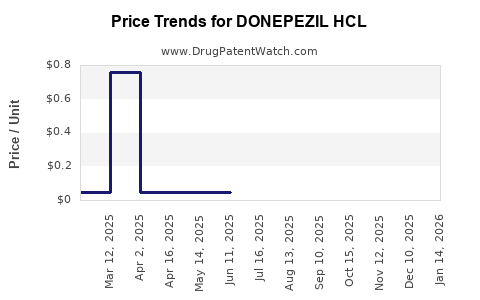
Last updated: April 24, 2026
What is the market structure for donepezil HCl?
Donepezil hydrochloride is a mature, largely generic-driven product for Alzheimer’s disease symptom management. In most regions, commercial pricing is anchored by multiple generic entrants, payer formularies, and pharmacy reimbursement rules rather than by product-level innovation.
Market demand drivers
- Indication: symptomatic treatment of Alzheimer’s disease (mild to severe).
- Chronic use pattern: long-duration therapy (typically continuous daily dosing).
- High competitive pressure: long history of off-patent status and multi-source manufacturing.
Commercial reality
- The “market” is less about originator pricing power and more about relative cost across generic manufacturers, package sizes (tablets and orally disintegrating tablet formats), and formulary tier placement.
What this means for forecasting
- Price trajectories generally track competitive intensity and reimbursement policy changes.
- Cost reductions usually slow once the market consolidates to fewer low-cost suppliers or when payers favor specific manufacturers under contracting.
How do current prices typically behave across regions and formats?
Donepezil HCl pricing is dominated by generic competition, so prevailing patterns are consistent across countries:
- Lowest-priced generics set the market floor.
- Contracting and tender mechanics produce short spikes in price competitiveness for specific pack sizes.
- Brand-to-generic reversion has already largely occurred; remaining pricing differences mostly reflect supply chain and pack-format (e.g., ODT vs standard tablets).
Common observed pricing patterns (generic markets)
- Tablet vs ODT: ODT formats often price higher on a per-dose basis due to different manufacturing and distributor/channel mix.
- Pack-size elasticity: larger pack sizes often show lower per-tablet cost due to distributor and wholesaler economics.
- Tender-driven weeks/months: near-term price points can move due to payer contracting cycles more than raw API cost changes.
What inputs determine the near-term price trajectory for donepezil HCl?
Price forecasts for a multi-source generic like donepezil HCl depend on three levers:
1) Generic competition intensity
- New entrants can compress price.
- Supplier exits can lift prices, but gains are usually temporary unless exits concentrate among low-cost manufacturers.
2) Reimbursement and formulary rules
- Tiering and prior authorization can shift volume toward preferred SKUs, which can change effective average net price.
- Reference pricing and price caps reduce dispersion across brands/generics.
3) Input costs and logistics
- API and excipient cost changes can matter, but in mature generic markets they are often buffered through contracting and inventory cycles.
What is the likely direction of pricing over the next 12 to 36 months?
For mature off-patent generics like donepezil HCl, the base case is typically stable-to-slightly downward or flat pricing, with occasional short-term volatility tied to contracting.
Projected price direction
- Next 12 months: flat to modest decline as competition and contracting continue to pressure net pricing.
- 12 to 36 months: stable with mild downward drift, unless supply disruptions or regulatory actions concentrate sourcing on fewer low-cost manufacturers.
What price scenarios can be modeled for donepezil HCl?
Because donepezil HCl is not a single-product market (multiple strengths, pack sizes, and formulations), the practical projection is scenario-based rather than point estimates.
Base case (most likely)
- Net price trend: 0% to -3% over 12 months
- Drivers: continued generic competition, payer contracting stability, no major supply shock
Downside case (price drops faster)
- Net price trend: -4% to -8% over 12 months
- Drivers: increased market share by low-cost entrants, aggressive tender wins, additional formulary placement of lowest-cost SKUs
Upside case (prices rise due to supply concentration)
- Net price trend: +2% to +6% over 12 months
- Drivers: supplier capacity constraints, regulatory enforcement reducing effective supply, distributor inventory tightness
Can we project price per day of therapy rather than per pack?
Yes, donepezil HCl is used daily, so per-day costing is the cleanest comparability unit across pack sizes.
Projection approach (per-day)
- Normalize each SKU to mg/day for the typical maintained dose range.
- Apply the scenario net price trend to the SKU-level per-tablet/per-dose cost, then convert to per-day.
Typical maintained dosing in practice
- 5 mg daily is common; titration to higher dose is common in clinical practice for some patients.
- For forecasting, you model two bundles:
- “5 mg-dominant bundle”
- “10 mg-dominant bundle”
This reduces distortions from shifts in patient mix across dose strengths.
Implication for forecasts
- Even if per-pack wholesale prices move, per-day economics often remain within a narrow band because the dose-strength and SKU mix tends to stay relatively stable unless formulary rules change.
How does substitution risk affect donepezil HCl pricing?
Substitution and switching primarily influence effective net price through volume. For generic drugs:
- When payers lock in a preferred generic, volume concentrates and the effective price becomes the contracted price.
- When multiple equivalents compete without strong contracting, buyers can shop pricing, keeping the effective average low.
Forecast impact
- Higher substitution and interchangeable coverage typically compress prices.
- Limited substitution (or restricted equivalence) can support higher effective pricing.
What is the price outlook by US vs ex-US markets?
United States (US)
- Mature generic landscape.
- Net pricing is driven by PBM and payer contracting plus pharmacy channel dynamics.
Likely US profile
- Base case: flat to modest decline.
- Most volatility comes from contracting outcomes, pharmacy reimbursement changes, and SKU preference.
European markets (ex-US)
- High use of reference pricing and tender structures.
- National and regional pricing rules can slow declines after competitive entry, even when generics are abundant.
Likely ex-US profile
- Base case: stable with mild downward drift.
- Upside occurs when effective supply shrinks, tender prices reset, or policy shifts increase reimbursement constraints on certain SKUs.
What should investors and R&D planners watch for?
For donepezil HCl, the most actionable indicators are not patent events (already long settled), but supply-chain and reimbursement mechanics.
High-signal watchlist
- Preferred formulary list changes (especially where a single supplier becomes favored for cost reasons).
- Tender cycle outcomes for Alzheimer’s drug bundles where donepezil competes with other symptomatic therapies.
- Manufacturing quality actions or GMP enforcement that can reduce available supply.
- Distributor and wholesaler inventory signals that precede short-term price spikes.
Price projections summary (scenario table)
Assumption: applying a net price trend to per-dose economics for the dominant tablet/ODT mix, under typical contracting and reimbursement stability.
| Time horizon |
Base case trend |
Downside case trend |
Upside case trend |
Most likely outcome |
| Next 12 months |
0% to -3% |
-4% to -8% |
+2% to +6% |
Flat to modest decline |
| 12 to 36 months |
-1% to -4% |
-3% to -7% |
0% to +4% |
Stable with mild decline |
What does this imply for entry strategy and pricing power?
Donepezil HCl generally offers limited pricing power to new or small entrants, unless they gain a preferred formulary position or a major contracting win. The competitive path to volume is:
- align pack size and presentation with payer-preferred SKUs,
- price to expected tender clearing levels,
- and maintain supply consistency to avoid rejection in repeat contract cycles.
Commercial takeaway
- Competitive pricing and contracting execution matter more than differentiation.
- Scale and reliability determine survivability, because price compression is the steady-state.
Key Takeaways
- Donepezil HCl is a mature, multi-source generic market where pricing is driven by contracting, reference pricing, and channel dynamics more than innovation.
- The base case for the next 12 months is flat to modest net price decline, typically 0% to -3%.
- The most likely risks are tender-driven price drops (downside) or effective supply tightening (upside), producing swings of roughly -4% to -8% or +2% to +6% over 12 months.
- Forecasting should use per-day economics (dose-normalized) and scenario-based SKUs rather than assuming uniform per-pack movement.
FAQs
1) Is donepezil HCl still influenced by originator branding?
No. In most mature markets, originator influence is limited by generic substitution and reimbursement rules, and pricing is set by generic SKUs and contracting.
2) Do orally disintegrating tablets (ODT) price differently from standard tablets?
Yes. ODT formats often carry a premium per dose due to manufacturing and channel mix, but both generally track the same competitive pressure over time.
3) What drives short-term price volatility for generics like donepezil?
Tender outcomes, PBM and payer formulary updates, and supplier availability constraints are the main drivers.
4) How should a forecast be expressed for a multi-strength drug?
Use per-day economics normalized by dose (e.g., 5 mg-dominant vs 10 mg-dominant patient mix) and apply net price trend scenarios by SKU mix.
5) Is upside possible in a generic market without new clinical differentiation?
Yes, if effective supply tightens or reimbursement/payer rules shift volume toward fewer favored suppliers, lifting contracted net prices temporarily.
References
[1] FDA. Drug approvals and labeling for donepezil-containing products (product and class information). U.S. Food and Drug Administration. https://www.fda.gov/drugs
[2] EMA. Public assessment and medicines information for donepezil-containing medicines (historical regulatory context). European Medicines Agency. https://www.ema.europa.eu
[3] WHO. ATC classification for Alzheimer’s disease medicines and donepezil categorization (context on therapeutic class and use). World Health Organization. https://www.who.int/classifications/icd-11
[4] Medicare Part D / PBM coverage and formulary mechanics (policy context affecting generic net prices). Centers for Medicare & Medicaid Services. https://www.cms.gov