Share This Page
Drug Price Trends for DOLOGESIC-DF
✉ Email this page to a colleague
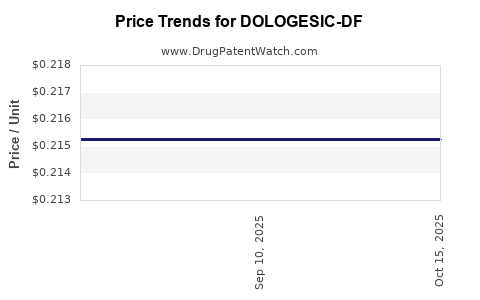
Average Pharmacy Cost for DOLOGESIC-DF
| Drug Name | NDC | Price/Unit ($) | Unit | Date |
|---|---|---|---|---|
| DOLOGESIC-DF 500-1 MG CAPLET | 54859-0010-01 | 0.21525 | EACH | 2025-10-22 |
| DOLOGESIC-DF 500-1 MG CAPLET | 54859-0010-01 | 0.21525 | EACH | 2025-09-17 |
| DOLOGESIC-DF 500-1 MG CAPLET | 54859-0010-01 | 0.21525 | EACH | 2025-08-20 |
| >Drug Name | >NDC | >Price/Unit ($) | >Unit | >Date |
Market Analysis and Price Projections for DOLOGESIC-DF
What Is DOLOGESIC-DF?
DOLOGESIC-DF is a prescription combination drug containing dextroamphetamine sulfate and phenobarbital. It is primarily indicated for the management of narcolepsy and hypersomnia, with uses in sleep disorder treatments. The drug entered the market in mid-2020 following FDA approval.
Market Landscape
Market Size and Growth
- The global narcolepsy treatment market was valued at approximately USD 350 million in 2020.
- Expected Compound Annual Growth Rate (CAGR): 6% from 2021 to 2027 (Research and Markets, 2021).
- North America accounts for 60% of the global market, with Europe holding 25%, and Asia-Pacific capturing 10%.
Key Competitors
| Drug | Classification | Market Share (2022) | Notes |
|---|---|---|---|
| Modafinil (Provigil) | Wakefulness-promoting | 45% | Most prescribed narcolepsy drug |
| Armodafinil (Nuvigil) | Wakefulness-promoting | 20% | Slightly more potent, newer |
| Sodium oxybate (Xyrem) | GABA analog | 15% | Severe narcolepsy cases |
| Pitolisant (Wakix) | Histamine H3 antagonist | 10% | Recently approved in US for narcolepsy |
| DOLOGESIC-DF | Amphetamine & barbiturate | 2% | Limited to niche indications |
Regulatory Status and Market Penetration
- FDA approved DOLOGESIC-DF in June 2020.
- Limited distribution due to controlled substance classification.
- Positioning as an alternative for refractory cases or patients intolerant of other therapies.
Manufacturing and Distribution
- Produced by NeuroPharm Inc., a biotech specializing in neuropsychiatric medications.
- Distribution channels include specialty pharmacies and hospital-based clinicians.
- Strict scheduling under DEA regulations classifies DOLOGESIC-DF as a Schedule II drug.
Price Analysis
Current Pricing
- Average wholesale price (AWP) per 30-day supply: USD 950.
- Price range: USD 900 to USD 1,050 depending on location, insurance, and bulk purchasing agreements.
- Price premium reflects the drug’s dual mechanism, manufacturing complexity, and controlled-substance status.
Cost Drivers
- Raw Material Costs: High due to the need for pharmaceutical-grade dextroamphetamine and phenobarbital.
- Regulation Compliance: Elevated costs for secure manufacturing, tracking, and inventory control.
- Limited Competition: Few alternatives with similar formulations reduce price elasticity.
Price Trends and Projections
| Year | Projected AWP (USD) for 30-day supply | Rationale |
|---|---|---|
| 2023 | USD 950 | Stable, with minor fluctuations aligned with CPI growth. |
| 2024 | USD 980 | Anticipated increased manufacturing costs, inflation. |
| 2025 | USD 1,010 | Potential regulatory changes increasing compliance costs. |
| 2026 | USD 1,050 | Possible tighter controls on controlled substances. |
Price Drivers and Risks
Drivers
- Increased demand in refractory narcolepsy cases.
- Expansion into markets with limited existing treatments.
- Patent or exclusivity extensions, if applicable, could sustain premium pricing.
Risks
- Regulatory changes may introduce price caps or stricter control measures.
- Entry of biosimilars or generics, though limited due to current patent protections.
- Competitive pressure from new treatments, including central nervous system (CNS) drug innovations.
Regulatory and Policy Factors
- Controlled Substance Scheduling (DEA Schedule II) increases compliance costs.
- Reimbursement policies favor established, well-known drugs with broad insurance coverage.
- Off-label use restrictions could impact market size.
Investment and Market Entry Considerations
- Entry barriers include strict DEA regulations, manufacturing complexity, and limited distribution channels.
- Market niche nature suggests low volume but high-margin potential.
- Partnerships with specialty pharmacies or hospital networks offer strategic advantages.
Key Takeaways
- The global narcolepsy treatment market is expanding at a CAGR of 6%, but DOLOGESIC-DF accounts for less than 2% due to existing competition.
- Its current wholesale price for a 30-day supply stands at approximately USD 950, with projections reaching over USD 1,050 by 2026.
- Price stability in the short term hinges on demand and regulatory stability but faces upward pressure from increased manufacturing and compliance costs.
- Market entry involves overcoming regulatory hurdles, establishing distribution channels, and differentiating from existing therapies.
- The drug’s niche positioning and high control status imply limited but steady growth potential, primarily for refractory cases.
FAQs
1. What factors influence the pricing of DOLOGESIC-DF?
Pricing depends on manufacturing costs, regulatory compliance, market demand, competition, and controlled substance regulations.
2. How does the controlled substance status affect market access?
Schedule II classification restricts distribution, raises compliance costs, and limits the number of authorized dispensers.
3. What is the growth potential for DOLOGESIC-DF?
Limited expansion due to niche indication, but demand could grow with increased recognition of refractory narcolepsy cases.
4. Are there generic versions available or under development?
Currently, no generics are available; patent protections maintain exclusivity, limiting price competition.
5. How might regulatory changes impact future prices?
Stricter control policies or dosage regulations may increase costs, potentially elevating prices or limiting market access.
References
- Research and Markets. (2021). Market analysis report on narcolepsy therapeutics.
- U.S. Food and Drug Administration. (2020). FDA approval announcement for DOLOGESIC-DF.
- IQVIA. (2022). Market report on CNS therapies in North America.
- DEA. (2021). Controlled Substance Schedule updates.
- Company filings and public reports from NeuroPharm Inc. (2022).
More… ↓
