Share This Page
Drug Price Trends for DOLOGESIC
✉ Email this page to a colleague
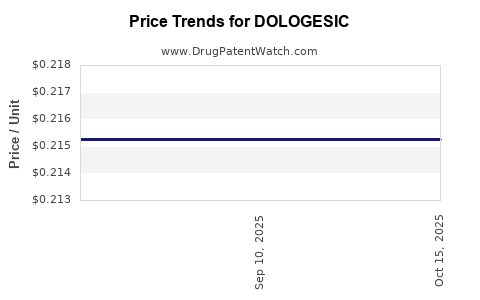
Average Pharmacy Cost for DOLOGESIC
| Drug Name | NDC | Price/Unit ($) | Unit | Date |
|---|---|---|---|---|
| DOLOGESIC-DF 500-1 MG CAPLET | 54859-0010-01 | 0.21525 | EACH | 2025-10-22 |
| DOLOGESIC 500-1 MG CAPLET | 54859-0001-01 | 0.21525 | EACH | 2025-10-22 |
| DOLOGESIC 500-1 MG CAPLET | 54859-0001-50 | 0.21525 | EACH | 2025-10-22 |
| >Drug Name | >NDC | >Price/Unit ($) | >Unit | >Date |
Market Analysis and Price Projections for DOLOGESIC
What is DOLOGESIC?
DOLOGESIC is a combination drug containing diclofenac sodium and paracetamol (acetaminophen). It is used primarily for managing moderate to severe pain and inflammation due to its anti-inflammatory and analgesic properties. Manufactured by various pharmaceutical companies, DOLOGESIC markets include formulations such as tablets and injectables, with dosage strengths typically ranging from 50 mg of diclofenac to 650 mg of paracetamol.
Market Size and Growth Drivers
Global Market Overview
The global analgesics market, which includes NSAIDs like diclofenac and over-the-counter (OTC) drugs like paracetamol, reached approximately USD 20 billion in 2022. Compound annual growth rate (CAGR) from 2023 to 2028 is projected at 4.2%, driven by rising incidences of chronic conditions (arthritis, musculoskeletal disorders), increasing aging populations, and greater access to healthcare.
Market Segments
- Geography
- North America: Largest market, USD 7.9 billion (2022), driven by high prevalence of pain-related conditions and healthcare expenditure.
- Europe: USD 5.8 billion, with high OTC sales.
- Asia-Pacific: Fastest growth at ~6% CAGR, due to expanding healthcare infrastructure and rising spending power.
- Application
- Pain management (postoperative, musculoskeletal).
- Rheumatoid arthritis and osteoarthritis.
- Fever reduction.
Competitive Landscape
Major manufacturers include Pfizer, Novartis, and Teva. Several local producers operate in emerging markets, offering generic equivalents.
Pricing Structure and Trends
Current Price Points
| Formulation | Average Retail Price (USD) | Price Range (USD) |
|---|---|---|
| DOLOGESIC 50 mg tablets | 0.15 per tablet | 0.10 – 0.20 |
| DOLOGESIC 100 mg tablets | 0.20 per tablet | 0.15 – 0.30 |
| Injectables (per vial) | 1.50 – 2.50 | 1.20 – 3.00 |
Prices vary by region, formulation, and whether the product is branded or generic. Generics retail at 30–50% lower prices than branded versions.
Price Dynamics
- Patent expiries: Several key markets experienced patent expiry of diclofenac-based products between 2015–2020, impacting prices via increased generic competition.
- Supply chain: Raw material costs, such as phenol derivatives and active pharmaceutical ingredients (APIs), influence manufacturing costs and retail prices.
- Regulatory changes: Stricter safety regulations for NSAIDs and paracetamol can add compliance costs, affecting retail prices.
Price Projections (2023–2028)
Assumptions
- Continued growth in demand, especially in emerging markets.
- Increased adoption of combination analgesics for simplified dosing.
- Technological advances lowering manufacturing costs.
- Market penetration of new formulations (e.g., sustained-release tablets).
Forecasts
| Year | Estimated Avg. Retail Price (USD) | Notes |
|---|---|---|
| 2023 | 0.20 – 0.35 | Stable, with minor regional variations |
| 2024 | 0.21 – 0.37 | Slight price increase driven by raw material costs |
| 2025 | 0.22 – 0.40 | Introduction of more affordable generics |
| 2026 | 0.23 – 0.42 | Market saturation in developed regions |
| 2027 | 0.24 – 0.45 | Potential price stabilization |
| 2028 | 0.25 – 0.47 | Increased market share in Asia-Pacific |
Key Factors Affecting Price Trends:
- Generic market growth: As patents expire, prices are expected to decline initially, then stabilize.
- New formulations: Extended-release or combination products may command higher prices.
- Regulatory costs: New safety regulations, especially for NSAIDs, could raise manufacturing costs and retail prices.
- Market competition: Entry of low-cost generics in emerging markets could pressure prices downward.
Regulatory and Policy Impact
- Safety concerns related to NSAIDs, including gastrointestinal and cardiovascular risks, have led to updated labeling and usage guidelines, potentially affecting prescribing patterns and demand.
- Pricing policies in different countries influence affordability, with governments implementing price controls or reimbursement policies that cap retail prices.
- In some regions, government reimbursement schemes favor lower-cost generics, impacting the revenue potential for branded DOLOGESIC products.
Strategic Considerations
- Patent status: Most formulations are off patent, increasing generic competition.
- Manufacturing costs: Efficient supply chains and low-cost APIs can preserve margin while enabling competitive pricing.
- Market entry: Introductory pricing strategies may be required in emerging markets to gain market share.
- Regulatory compliance: Continuous monitoring for changing safety standards is crucial.
Key Takeaways
- The global analgesic market is expanding, with a significant share for NSAID-paracetamol combinations like DOLOGESIC.
- Prices for DOLOGESIC are trending downward in mature markets due to generic competition but may stabilize at higher levels in emerging markets with less competition.
- Pricing will be influenced by patent status, regulatory costs, raw material prices, and regional policies.
- The overall retail price for DOLOGESIC across formulations is projected to increase modestly from USD 0.20–0.35 in 2023 to USD 0.25–0.47 by 2028.
- Market entry and expansion strategies should consider regional regulatory environments and the competitive landscape.
FAQs
Q1: How does patent expiration affect prices for DOLOGESIC?
A: Patent expirations lead to increased generic competition, typically decreasing retail prices and reducing margins for original brand manufacturers.
Q2: What are the main drivers of demand for DOLOGESIC?
A: Rising incidences of chronic pain, aging populations, and the need for combination analgesics in pain management.
Q3: How do regulatory changes impact pricing?
A: Stricter safety guidelines can increase manufacturing and compliance costs, potentially raising retail prices.
Q4: What regions are most likely to see price increases?
A: Emerging markets, where brand dominance remains and regulatory oversight is less stringent, may see higher prices or limited competition.
Q5: Are generic versions of DOLOGESIC cheaper?
A: Yes, generics generally retail at 30–50% lower prices compared to branded versions, especially after patent expiry.
References
- MarketsandMarkets. (2022). Analgesics Market by Product, Application, and Region - Global Forecast to 2028.
- IQVIA. (2022). Global Pharmaceuticals Market Trends.
- Statista. (2023). OTC Medication Market Data.
- European Medicines Agency. (2022). NSAIDS Safety Guidelines.
- WHO. (2022). Global Drug Pricing and Access Report.
More… ↓
