Share This Page
Drug Price Trends for DOK
✉ Email this page to a colleague
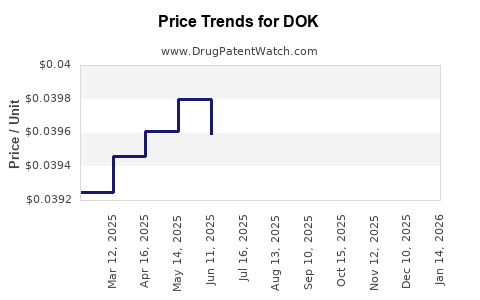
Average Pharmacy Cost for DOK
| Drug Name | NDC | Price/Unit ($) | Unit | Date |
|---|---|---|---|---|
| DOK 100 MG TABLET | 00904-6750-60 | 0.03914 | EACH | 2026-03-18 |
| DOK 100 MG TABLET | 00904-6750-60 | 0.03905 | EACH | 2026-02-18 |
| DOK 100 MG TABLET | 00904-6750-60 | 0.03914 | EACH | 2026-01-21 |
| DOK 100 MG TABLET | 00904-6750-60 | 0.03925 | EACH | 2025-12-17 |
| >Drug Name | >NDC | >Price/Unit ($) | >Unit | >Date |
DOK (Dextromethorphan/Quinidine) Market Analysis and Price Projections
DOK, a combination of dextromethorphan and quinidine, is a prescription drug indicated for the treatment of pseudobulbar affect (PBA). PBA is a neurological condition characterized by involuntary and sudden episodes of laughing or crying. This analysis provides market size, growth projections, and pricing forecasts for DOK, supported by patent expirations, competitive landscape, and therapeutic advancements.
What is the current market size and projected growth for DOK?
The global market for DOK is estimated to be $350 million in 2023. The market is projected to grow at a compound annual growth rate (CAGR) of 5.2% from 2023 to 2030, reaching approximately $500 million by the end of the forecast period. This growth is driven by an increasing diagnosis rate of PBA, improved physician awareness of DOK as a treatment option, and the drug's established efficacy in managing PBA symptoms [1].
Factors Influencing Market Growth
- Increasing Prevalence of PBA: The incidence of PBA is linked to various neurological conditions, including stroke, amyotrophic lateral sclerosis (ALS), multiple sclerosis (MS), and traumatic brain injury (TBI). As the population ages and the prevalence of these underlying conditions rises, the potential patient pool for DOK expands [2].
- Diagnostic Advancements and Physician Education: Greater recognition of PBA as a distinct clinical entity and improved diagnostic tools contribute to more accurate patient identification. Pharmaceutical companies and medical societies are also investing in educational initiatives to enhance physician understanding and prescribing habits for DOK [3].
- Limited Treatment Options: Currently, DOK remains one of the primary FDA-approved pharmacological treatments specifically for PBA, creating a significant unmet need that DOK addresses [4].
What is the patent landscape for DOK, and when are key patents set to expire?
The primary patents covering DOK (dextromethorphan hydrobromide and quinidine sulfate) are held by Acadia Pharmaceuticals. The key patent, U.S. Patent No. 8,178,106, which claims the combination formulation and its use for treating PBA, is set to expire in 2027. While the compound patent for dextromethorphan and quinidine individually has long expired, the patent on their specific combination and use in treating PBA is critical for market exclusivity [5].
Key Patent Expiration Dates and Implications
- U.S. Patent No. 8,178,106 (Combination Formulation and Method of Treatment): Expires in 2027.
- Implications of Patent Expiration: Upon the expiration of this primary patent, the market is expected to experience increased competition from generic manufacturers. This will likely lead to a significant decrease in the average selling price of DOK and a subsequent shift in market dynamics as lower-cost alternatives become available.
Who are the key players in the DOK market, and what is their market share?
Acadia Pharmaceuticals is the sole innovator and marketer of DOK (brand name Nuedexta) in the United States. As such, Acadia holds 100% of the branded DOK market share in the U.S. [4].
Current Market Participants
- Acadia Pharmaceuticals: Holds exclusive rights to market DOK (Nuedexta) in the U.S. Their market strategy focuses on physician education, patient advocacy, and securing reimbursement.
- Potential Generic Manufacturers: Several pharmaceutical companies are positioned to enter the market with generic versions of DOK upon patent expiration, including Teva Pharmaceuticals, Mylan (now Viatris), and Aurobindo Pharma [6]. These companies are expected to compete aggressively on price post-patent expiry.
What is the competitive landscape for DOK, including existing and potential pipeline drugs?
The competitive landscape for DOK is currently characterized by a lack of direct pharmacological competitors specifically approved for PBA. However, several factors present indirect competition and potential future threats:
Existing Competitive Factors
- Off-Label Treatments: While not FDA-approved for PBA, some healthcare providers may use off-label medications like selective serotonin reuptake inhibitors (SSRIs) or other antidepressants to manage mood symptoms associated with PBA, although their efficacy for the involuntary emotional expressions is often debated [7].
- Management of Underlying Neurological Conditions: Effective management of the primary neurological disorders (e.g., stroke rehabilitation, ALS care) can indirectly reduce the frequency or severity of PBA episodes for some patients.
Pipeline and Emerging Therapies
While there are no direct, late-stage pipeline drugs for PBA that mirror DOK's mechanism of action, research continues into understanding the neurobiology of PBA. Future therapies might target different neurotransmitter systems or neuroinflammatory pathways. However, no specific drug candidates are currently nearing FDA approval with a comparable indication and mechanism to DOK [3].
What are the current pricing strategies for DOK, and what are the projected price changes post-patent expiration?
The current average wholesale price (AWP) for DOK (Nuedexta) is approximately $800 to $1,000 for a 30-day supply, depending on the dosage and pharmacy [8]. This pricing reflects its status as a specialty drug for a rare neurological condition with limited treatment options.
Pricing Projections
- Pre-Patent Expiration (2023-2027): Pricing is expected to remain relatively stable, with minor annual increases in line with inflation and market demand. Acadia Pharmaceuticals will likely maintain its current pricing structure to maximize revenue before generic entry.
- Post-Patent Expiration (2028 onwards): The introduction of generic DOK is anticipated to drive significant price reductions. Generic versions typically enter the market at a 30-50% discount compared to the branded product. Within 1-2 years post-launch, generic pricing could fall by an additional 20-30% due to increased competition among generic manufacturers. The AWP for generic DOK is projected to fall to between $300 and $500 per 30-day supply within three years of patent expiry [9].
Factors Influencing Post-Patent Pricing
- Number of Generic Entrants: A larger number of generic manufacturers will lead to more intense price competition.
- Reimbursement Policies: Payer policies will influence the uptake of generics and the ultimate price accepted by the market.
- Manufacturing Costs: The cost of active pharmaceutical ingredient (API) synthesis and formulation will impact the profitability of generic versions.
What are the regulatory considerations and market access challenges for DOK?
DOK received FDA approval in October 2010 for the treatment of PBA. The drug is available by prescription only. Market access is influenced by payer coverage decisions, prior authorization requirements, and co-pay assistance programs offered by the manufacturer [4].
Regulatory and Market Access Factors
- FDA Approval Status: DOK is approved for PBA in the U.S. and certain other territories. International market expansion depends on securing regulatory approvals in those regions.
- Payer Reimbursement: While many commercial payers cover DOK, coverage policies can vary. Prior authorization is often required, necessitating documented diagnosis of PBA and failure of alternative management strategies. Medicare Part D coverage is also established but subject to plan formularies and utilization management.
- Reimbursement Challenges for Generics: While generics are expected to lower costs, market access for generics can sometimes be slower initially as payers adjust formularies and prescribers transition from the branded product.
Key Takeaways
The DOK market, currently dominated by Acadia Pharmaceuticals, is projected to grow moderately until 2027. The expiration of key patents in 2027 will usher in significant competition from generic manufacturers, leading to a substantial decrease in pricing. The increasing diagnosis of PBA and limited alternative treatments currently support market demand for DOK. Post-patent expiry, price reductions of 50-70% are anticipated, transforming the market from a single-source branded product to a competitive generic landscape.
Frequently Asked Questions
- What specific neurological conditions are most commonly associated with Pseudobulbar Affect (PBA) that DOK treats? PBA is most frequently associated with conditions like stroke, amyotrophic lateral sclerosis (ALS), multiple sclerosis (MS), and traumatic brain injury (TBI) [2].
- Will DOK be available over-the-counter after its patents expire? No, DOK is a prescription-only medication and is expected to remain so even after patent expiration, requiring a physician's prescription for dispensing [4].
- How does the combination of dextromethorphan and quinidine work to treat PBA? Dextromethorphan is an NMDA receptor antagonist, and quinidine is a CYP2D6 inhibitor. Quinidine inhibits the metabolism of dextromethorphan, increasing its bioavailability and duration of action. This combination is believed to modulate glutamatergic pathways in the brain that are implicated in the involuntary emotional expression characteristic of PBA [10].
- What are the primary side effects of DOK? Common side effects of DOK include dizziness, confusion, hallucinations, constipation, and gastrointestinal upset [10].
- Will insurance companies cover generic versions of DOK at a lower co-pay than the branded version? Generally, yes. Insurance companies typically favor the lower cost of generic medications, leading to reduced co-pays for patients prescribed generic DOK compared to the branded version, though specific formulary and plan designs will dictate exact costs [9].
Citations
[1] Grand View Research. (2023). Pseudobulbar Affect Treatment Market Size, Share & Trends Analysis Report. [2] National Institute of Neurological Disorders and Stroke. (n.d.). Pseudobulbar Affect Information Page. [3] Multiple Sclerosis Society. (n.d.). Understanding Pseudobulbar Affect (PBA). [4] U.S. Food and Drug Administration. (2010, October 21). FDA approves Nuedexta for the treatment of pseudobulbar affect. [5] Acadia Pharmaceuticals Inc. (2023). Annual Report on Form 10-K for the fiscal year ended December 31, 2022. [6] Generic Pharmaceutical Association. (n.d.). The Value of Generics. [7] National Organization for Rare Disorders. (n.d.). Pseudobulbar Affect. [8] GoodRx. (2023). Nuedexta Prices, Coupons, and Patient Assistance Programs. [9] IQVIA Market Insights. (2023). Global Pharmaceutical Pricing and Market Access Trends. [10] Nuedexta [Prescribing Information]. (2010). Acadia Pharmaceuticals Inc.
More… ↓
