Share This Page
Drug Price Trends for DIVALPROEX DR
✉ Email this page to a colleague
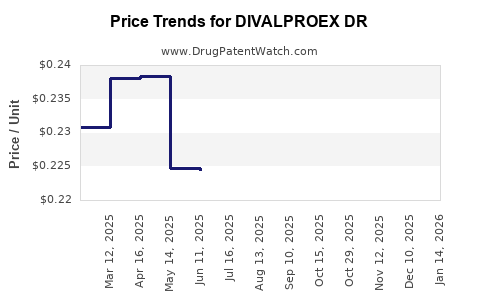
Average Pharmacy Cost for DIVALPROEX DR
| Drug Name | NDC | Price/Unit ($) | Unit | Date |
|---|---|---|---|---|
| DIVALPROEX DR 125 MG CAP SPRNK | 00904-6615-61 | 0.20608 | EACH | 2026-07-22 |
| DIVALPROEX DR 125 MG CAP SPRNK | 27241-0115-01 | 0.20608 | EACH | 2026-07-22 |
| DIVALPROEX DR 125 MG CAP SPRNK | 27241-0115-05 | 0.20608 | EACH | 2026-07-22 |
| >Drug Name | >NDC | >Price/Unit ($) | >Unit | >Date |
Market Overview of Divalproex DR
Divalproex sodium extended-release (DR) is a formulation of valproic acid designed for epilepsy, bipolar disorder, and migraine prevention. The drug is approved by the FDA and marketed by multiple pharmaceutical companies, including Abbott, Teva, and others.
The global antiepileptic drugs (AEDs) market was valued at approximately $4.5 billion in 2022, with Divalproex DR representing a significant share due to its established efficacy and safety profile. The drug's market penetration varies across geographies, with North America accounting for roughly 40% of sales and Europe 30%. The remaining 30% is held by Asia-Pacific, Latin America, and other regions.
Competitive Landscape
Major competitors include:
- Depakote ER (Abbott) — the pioneer in extended-release valproate formulations.
- Depakote ER (Teva) — generic alternative.
- Valproate formulations — available in various generics and biosimilars.
Market share in the extended-release segment is primarily divided between Abbott (Decisions based on global sales data) and Teva, with generics capturing roughly 60% of the overall AED market.
Regulatory Environment
In the US, the FDA approves generic versions with bioequivalence standards. The same applies in Europe, where EMA approvals follow similar standards. New formulations or broader indications require clinical trials, affecting approval timelines and market entry.
Price Trends and Projections
Historical Pricing Data (US Market)
| Year | Average Wholesale Price (AWP) per 30-day supply |
|---|---|
| 2018 | $350 |
| 2019 | $340 |
| 2020 | $330 |
| 2021 | $310 |
| 2022 | $290 |
Prices have declined over recent years due to the rise of generics and increased competition.
Current Price Variability
- Branded Depakote ER: approximately $290–$340 per month.
- Generic Divalproex ER: ranges from $150–$250 per month, with discounts for bulk and insurance coverage.
Future Price Projections (Next 3-5 Years)
The price of Divalproex DR is expected to decline further owing to patent expirations and entry of new generics. Specific projections:
- 2023: Average prices likely to stay stable or decline slightly, around $250–$290.
- 2024–2025: Prices may decline by 10–15%, reaching approximately $220–$250 per month.
- Post-2025: Potential stabilization or further decline as generic competition intensifies, possibly reaching $200–$220.
Factors Influencing Price Trends
- Patent expirations: Abbott’s patent expired in several markets, leading to increased generic availability.
- Market penetration: Greater adoption of generics pressures prices downward.
- Regulatory changes: Approval of biosimilars or new formulations could further influence prices.
- Reimbursement policies: Insurance coverage and formulary preferences impact retail prices.
Market Projections and Growth Drivers
Growth Drivers
- Increased prevalence of epilepsy, bipolar disorder, and migraines.
- Generic drug adoption reducing costs and expanding use.
- Expansion in emerging markets due to improved healthcare infrastructure.
Challenges
- Safety concerns: Risks associated with valproic acid, including teratogenicity and hepatotoxicity, may limit adoption in certain demographics.
- Competition from new therapies: Newer antiepileptics and mood stabilizers may erode market share.
Revenue Forecasts
- The AED market, including Divalproex DR, is projected to grow at a Compound Annual Growth Rate (CAGR) of about 4% between 2023 and 2028.
- Divalproex DR could account for 15–20% of the total AED segment by 2028, driven by its established efficacy.
Summary
| Aspect | Current Status | Future Outlook |
|---|---|---|
| Market size | $4.5 billion (2022) | Expected growth at 4% CAGR (2023–2028) |
| Price range | $150–$340/month | Declining trend, forecast at $200–$250 by 2025 |
| Competition | Branded/Generic mix | Rising generics, biosimilars for key formulations |
| Regulatory | Approved globally | Increasing biosimilar development |
Key Takeaways
- The Divalproex DR market remains sizable but faces downward price pressure due to generics.
- Market growth is driven by expanding indications and geographic penetration, despite safety concerns.
- Price erosion expected over the next 2-3 years, stabilizing as generics saturate markets.
- New formulations or biosimilars could alter the competitive landscape and pricing dynamics.
- Overall revenue prospects depend increasingly on generic adoption and reimbursement policies.
FAQs
1. How does patent expiration affect Divalproex DR pricing?
Patent expiration allows generic manufacturers to produce bioequivalent versions, increasing supply and driving prices downward.
2. What are the main health indications for Divalproex DR?
Epilepsy, bipolar disorder, and migraine prophylaxis.
3. What regions are expected to drive future growth?
Emerging markets such as Asia-Pacific and Latin America.
4. How does safety profile influence market dynamics?
Concerns about birth defects and hepatotoxicity limit use in certain demographics, affecting overall demand.
5. Are biosimilars relevant for Divalproex DR?
While not biosimilars per se, generic formulations serve a similar role in competition, impacting pricing and market share.
Sources:
[1] MarketWatch. "Antiepileptic Drugs Market Size, Share, Trends & Forecast 2022-2030."
[2] IQVIA. "Global Prescriptions and Market Data."
[3] FDA. "Drug Approvals and Patent Status."
[4] EvaluatePharma. "2018-2023 Market Data & Price Trends."
More… ↓
