Share This Page
Drug Price Trends for DIFLUNISAL
✉ Email this page to a colleague
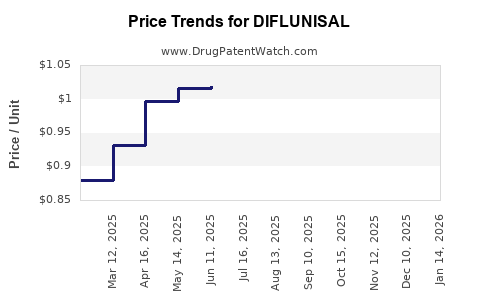
Average Pharmacy Cost for DIFLUNISAL
| Drug Name | NDC | Price/Unit ($) | Unit | Date |
|---|---|---|---|---|
| DIFLUNISAL 500 MG TABLET | 00093-9222-01 | 1.03803 | EACH | 2026-07-22 |
| DIFLUNISAL 500 MG TABLET | 00093-9222-05 | 1.03803 | EACH | 2026-07-22 |
| DIFLUNISAL 500 MG TABLET | 00093-9222-06 | 1.03803 | EACH | 2026-07-22 |
| DIFLUNISAL 500 MG TABLET | 14539-0673-01 | 1.03803 | EACH | 2026-07-22 |
| DIFLUNISAL 500 MG TABLET | 14539-0673-06 | 1.03803 | EACH | 2026-07-22 |
| >Drug Name | >NDC | >Price/Unit ($) | >Unit | >Date |
Market Analysis and Price Projections for Diflunisal
What Is Diflunisal?
Diflunisal is a non-steroidal anti-inflammatory drug (NSAID) used primarily for managing pain, arthritis-related inflammation, and familial amyloid polyneuropathy (FAP). It is available both as a branded product and a generic.
Patent Status and Market Exclusivity
The original patent for Diflunisal expired in the early 2000s. Post-expiration, the drug faced generic competition, significantly reducing its market price. Currently, only select formulations are under patent protection, and many markets have high generic penetration.
Current Market Dynamics
Market Size and Sales
- The global NSAID market was valued at approximately USD 15 billion in 2022, with Diflunisal representing a small segment within this.
- Diflunisal's market share is limited compared to NSAID giants like ibuprofen and naproxen but remains relevant for specific patient populations, such as those with FAP.
Key Players
- Generic pharmaceutical companies dominate Diflunisal production.
- Limited branded competition exists, mainly in niche indications.
Regulatory Environment
- Diflunisal achieves regulatory approval in the US (FDA), Europe (EMA), and other major markets.
- No recent patent approvals or exclusivity extensions are active in major markets, pressuring prices downward.
Pricing Landscape
Current Pricing
- Branded Diflunisal (e.g., Dolobid): USD 10–15 per tablet (strength varies).
- Generics: USD 4–8 per tablet, depending on the region and supplier.
Price Trends
- Prices have stabilized after patent expiration, with some decline in generic pricing due to increased competition.
- Average retail prices in the US tend to decline by approximately 10–15% annually, consistent with typical generic drug trends.
Forecasting Price Trends (Next 5 Years)
| Year | Estimated Average Price (USD per tablet) | Notes |
|---|---|---|
| 2023 | 4–8 | Current range, high generic competition |
| 2024 | 3.5–7 | Slight decline expected, broader generic penetration |
| 2025 | 3–6.5 | Stabilization as new generics enter markets |
| 2026 | 2.8–6 | Further price erosion, potential market consolidation |
| 2027 | 2.5–5.5 | Approaching low-cost generic thresholds, minimal branded sales |
Market Growth Drivers and Constraints
Drivers
- Growing prevalence of arthritis and FAP, leading to niche demand.
- Emerging markets with expanding healthcare infrastructure.
- Potential repositioning for new indications or formulations.
Constraints
- High availability of over-the-counter NSAIDs reduces prescription demand.
- Price elasticity in primary markets limits revenue growth.
- Patent and exclusivity periods are over, dampening innovation incentives.
Potential Market Opportunities
- Development of improved formulations (e.g., extended-release).
- New indications or combination therapies.
- Geographic expansion, especially into emerging markets.
Summary of Investment Implications
- Diflunisal remains a low-price, established product with limited growth potential.
- Market entry barriers are minimal due to generic availability.
- Pricing trends suggest a gradual decline over the coming years, with little prospect for significant price increases.
- Companies seeking to capitalize on Diflunisal should focus on niche markets or formulation innovations rather than volume growth.
Key Takeaways
- Diflunisal's patent expiration led to significant price erosion, with current prices stabilized by generic competition.
- The global market is small within the larger NSAID landscape, with slow growth driven by niche applications.
- Price projections indicate modest decreases through 2027, influenced by generic market dynamics.
- Opportunities include developing new formulations or expanding into underserved geographic regions.
- Overall, Diflunisal presents limited upside for investors but remains relevant in specific therapeutic contexts.
FAQs
1. How does Diflunisal compare to other NSAIDs in terms of price?
Diflunisal tends to be slightly more expensive than common OTC NSAIDs like ibuprofen or naproxen but more affordable than brand-name NSAIDs, largely due to generic competition.
2. Is there potential for patent protection renewal or new exclusivity?
No indication exists of recent patent extensions or new rights, limiting exclusivity-driven price increases.
3. Are there significant regional differences in Diflunisal pricing?
Yes. Prices are generally higher in the US and Western Europe due to regulatory and market factors; emerging markets often have lower prices.
4. What is the primary driver for future market demand?
Demand is driven by niche indications like FAP and arthritis management, with growth limited by over-the-counter alternatives.
5. Could formulation innovations impact the market?
Yes. Extended-release or combination formulations could fetch premium pricing but require investment and regulatory approvals.
References
[1] MarketWatch. NSAID Market Size, Share & Trends Analysis, 2023.
[2] U.S. Food and Drug Administration. Diflunisal Drug Label.
[3] IQVIA. Global Pharmaceutical Market Trends, 2022.
[4] EvaluatePharma. Generic Drug Pricing Data, 2023.
[5] ClinicalTrials.gov. Diflunisal Indications and Trials Summary, 2023.
More… ↓
