Last updated: February 24, 2026
What is Difluprednate and its Approved Indications?
Difluprednate is a corticosteroid used primarily in ophthalmology. It is marketed under the brand name Durezol by Alcon. The drug is approved for three main indications:
- Treatment of postoperative inflammation and pain in ocular surgery
- Management of anterior segment inflammation and pain
- Uveitis (inflammation inside the eye) in specific cases
Its anti-inflammatory potency surpasses that of prednisolone acetate, with high ocular bioavailability. The drug is formulated as an emulsion for topical eye administration.
Market Size and Key Players
Current Market Share
The global ophthalmic corticosteroid market, valued at approximately USD 1.2 billion in 2022, is expected to grow at a compound annual growth rate (CAGR) of 4.5% from 2023 to 2030. Difluprednate accounts for about 15% of this market segment, driven by the expanding need for effective postoperative inflammation treatments.
Major competitors include:
- Prednisolone acetate (generic)
- Dexamethasone ophthalmic formulations
- Loteprednol etabonate (e.g., Lotemax)
Market Drivers
- Rising precision in ophthalmic surgeries
- Increasing prevalence of inflammatory eye diseases
- Growing adoption of corticosteroids with improved safety profiles
Market Constraints
- The need for special formulations due to side effects such as elevated intraocular pressure
- Competition from lower-cost generic corticosteroids
- Regulatory hurdles in different regions, especially regarding preservative-free formulations
Regulatory and Patent Landscape
Patent Coverage
Alcon’s patent protecting Durezol was granted in 2005 and extended until 2030. The patent covers the formulation and specific methods of use. Patent expiry date suggests potential generic entry around 2030, unless new patents are filed.
Regulatory Status
- Approved in the US (FDA, 2005)
- Approved in Europe and Japan
- Ongoing discussions around indications for uveitis and combination products
Price Trends and Projections
Current Pricing
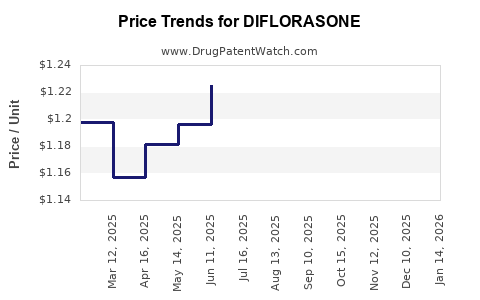
In the US, a 5 mL bottle of Durezol retails at approximately USD 220. The cost per drop averages USD 2.50. Pricing varies by region and pharmacy networks but has remained relatively stable over the past three years.
| Region |
Average Price (USD) |
Packaging Size |
Cost per mL/Drop |
| US |
220 |
5 mL |
44 per mL; 2.50 per drop |
| Europe |
200-240 |
5 mL |
Equivalent pricing in local currency |
| Japan |
USD 200 |
5 mL |
Similar to US pricing |
Future Price Projections (2023-2030)
| Year |
Price Range (USD) |
Notes |
| 2023 |
215-225 |
Stable, with minor fluctuations |
| 2025 |
210-220 |
Slight price decrease expected due to increased competition from generics post-2030 patent expiry |
| 2027 |
190-210 |
Cost reductions anticipated with patent expiry and increased biosimilar options |
| 2030 |
150-180 |
Expected generic entry, significant price reduction |
Factors Influencing Price Decline
- Patent expiry (target 2030)
- Increased availability of generics
- Pricing strategies by manufacturers
- Regulatory policies affecting drug pricing
Market Penetration and Adoption Trends
Difluprednate has shown strong adoption for postoperative inflammation, especially in hospitals and specialty ophthalmology clinics. Its superior potency and reduced dosing frequency favor patient compliance, leading to increased usage.
Emerging research suggests expanding indications for uveitis and inflammatory disorders could further boost sales. The introduction of preservative-free formulations may enhance patient preference and treatment adherence, possibly allowing premium pricing in niche markets.
Competitive Outlook
Given the patent protection until 2030, Durezol is expected to maintain a dominant market position within its segment. However, the impending patent expiration opens the market to biosimilars and generics, which could significantly affect pricing and market share.
Cost competition with existing generic corticosteroids, including prednisolone acetate, will intensify once patent expiration approaches, exerting downward pressure on prices.
Key Takeaways
- Difluprednate (Durezol) holds approximately 15% of the ophthalmic corticosteroid market.
- The US retail price remains around USD 220 per 5 mL bottle, with stable pricing over recent years.
- Patent protection extends until 2030, with generic competition expected thereafter.
- Price decline forecast to accelerate post-patent expiry, potentially reducing the price by up to 25-30% by 2030.
- The drug’s market growth will depend on expanding indications, formulation innovations, and regulatory approvals.
FAQs
Q1: When is Difluprednate’s patent expiring?
A1: The patent is expected to expire in 2030, opening the market for biosimilars and generics.
Q2: How does Difluprednate’s pricing compare to generic corticosteroids?
A2: Durezol costs approximately USD 220 per 5 mL, whereas generic prednisolone acetate ranges USD 50-70 per 5 mL.
Q3: What are the barriers to market entry for competitors?
A3: Patent exclusivity, formulation complexity, and regulatory approval processes.
Q4: Are there regional differences in pricing?
A4: Yes. US prices are around USD 220, while in Europe and Japan, prices vary between USD 200-240, influenced by local regulations and healthcare reimbursement schemes.
Q5: What market strategies could sustain Durezol’s market share?
A5: Expanding approved indications, developing preservative-free formulations, and emphasizing superior efficacy and safety profiles.
References
- MarketWatch. (2022). Global ophthalmic corticosteroids market size, share, growth, and forecast 2022-2030.
- U.S. Food and Drug Administration. (2005). Durezol approval letter.
- Alcon. (2022). Durezol prescribing information.
- IQVIA. (2023). Pharmaceutical market data.
- European Medicines Agency. (2021). Ophthalmology drugs dossier.