Last updated: February 19, 2026
Dicyclomine is an anticholinergic agent primarily prescribed for the treatment of irritable bowel syndrome (IBS). It has been on the market since the 1960s, with a well-established patent and manufacturing footprint. The following analysis covers current market dynamics, competitive landscape, regulatory environment, and future price projections.
Current Market Landscape
Market Size and Sales
The global IBS treatment market, where dicyclomine is used, was valued at approximately $1.2 billion in 2022. Dicyclomine ranks among the established drugs for symptomatic relief, though it has faced competition from newer therapies.
Major Manufacturers
- Sanofi: Historically a leading producer, with sales mainly in North America and Europe.
- Teva Pharmaceuticals: Generic manufacturer with extensive production capabilities.
- Sandoz (Novartis) and other generics suppliers: Cover a significant share of the market due to lower pricing.
Patent Status and Generics
Dicyclomine's original patent expired in the early 2000s. Currently, only generics are available, which puts downward pressure on prices. Limited brand-name availability persists mostly in certain regions due to manufacturing or regulatory considerations.
Regulatory Environment
Approvals and Patent Status
- Approved by FDA since 1964 for IBS.
- No new patent protection; ongoing patent expirations have led to widespread generic entry.
- Some regional variations exist in regulatory approvals and formulations.
Pricing Regulations
- Price controls in countries like Canada, parts of the EU, and some Asian markets influence native pricing strategies.
- In the U.S., prices are market-driven, with significant discounts on generics.
Competitive Landscape
Alternatives to Dicyclomine
- Hyoscyamine: Similar anticholinergic with broader indications.
- Peppermint oil: OTC alternative.
- Rifaximin: Approved for IBS, particularly for bloating.
- Eluxadoline: For diarrhea-predominant IBS, under patent protection until 2035.
Market Trends
- Growth driven by increasing IBS prevalence, projected at a CAGR of 3% over the next five years.
- Shift toward newer therapies with better safety profiles is moderating dicyclomine's market share.
- Rising preference for OTC and natural remedies in some regions.
Price Trends and Projections
Historical Pricing
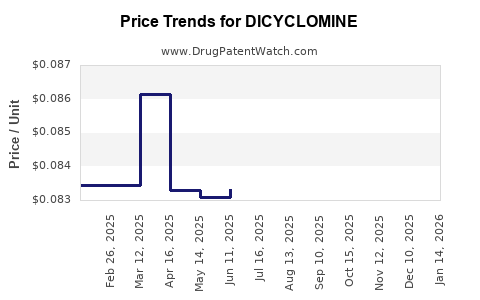
- Average wholesale price (AWP) for oral dicyclomine 10 mg tablets in the U.S. was approximately $0.50 per pill in 2010.
- Prices declined to roughly $0.20 per pill by 2022 due to generic competition.
- The average retail price for a 30-day supply (30 pills) is circa $6 to $9, depending on pharmacy discounts.
Forecasting Future Prices
- In the next 5 years, prices are expected to stabilize or decline marginally, barring manufacturer exit or new patent protections.
- Any entry of bioequivalent reformulations or combination products could influence prices upward.
Projected Price Range for 2028:
| Year |
Estimated Average Wholesale Price per Pill |
Notes |
| 2023 |
$0.20 – $0.22 |
Current levels, stable market |
| 2025 |
$0.20 – $0.23 |
Slight increase possible with inflation |
| 2028 |
$0.22 – $0.25 |
Market saturation limits price increases |
Factors Affecting Prices
- Regulatory changes facilitating or restricting generic entry.
- Impact of health insurance policies on drug reimbursement.
- Development of superior or combination therapies reducing demand.
Market Outlook and Strategic Considerations
- Continued generic competition suggests limited upward pricing potential.
- Manufacturers should monitor biosimilar or new formulations that could impact market share.
- Investors may find limited growth opportunities in mature markets unless new indications or formulations are developed.
Key Takeaways
- Dicyclomine's market is mature with extensive generic competition, constraining price growth.
- Current average wholesale prices hover around $0.20 per pill, with minor fluctuations expected.
- The total global market for IBS treatments is about $1.2 billion, with dicyclomine comprising a small but steady segment.
- Future pricing will likely remain stable, barring regulatory or strategic market shifts.
- Industry focus shifts toward newer agents with better safety or efficacy profiles.
5 FAQs
1. What is the primary use of dicyclomine?
It treats irritable bowel syndrome by reducing intestinal spasms.
2. What is the patent status of dicyclomine?
The original patent expired in the early 2000s; no new patent protections exist.
3. How competitive is the market for dicyclomine?
Highly competitive with multiple generic manufacturers; this limits price increases.
4. What factors could influence future drug prices?
Regulatory changes, market entry of biosimilars, or new treatment guidelines could impact prices.
5. Are there significant regional price differences for dicyclomine?
Yes. Price controls in Europe and Asia make it generally cheaper outside the U.S., where prices are market-driven.
References
- Grand View Research. (2022). Irritable Bowel Syndrome (IBS) Treatment Market Analysis.
- IQVIA. (2022). U.S. Prescription Drug Price Trends.
- U.S. Food and Drug Administration. (2023). Drug Approvals and Patent Statuses.
- Statista. (2022). Global IBS Treatment Market Revenue.
- NICE. (2021). Health Technology Assessment of Generic IBS Drugs.