Share This Page
Drug Price Trends for DICLOFENAC-MISOPROST
✉ Email this page to a colleague
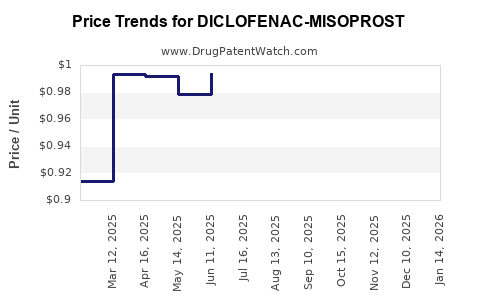
Average Pharmacy Cost for DICLOFENAC-MISOPROST
| Drug Name | NDC | Price/Unit ($) | Unit | Date |
|---|---|---|---|---|
| DICLOFENAC-MISOPROSTOL DR 50-0.2 MG TABLET | 42571-0133-60 | 0.94157 | EACH | 2026-05-20 |
| DICLOFENAC-MISOPROSTOL DR 50-0.2 MG TABLET | 00591-0397-60 | 0.94157 | EACH | 2026-05-20 |
| DICLOFENAC-MISOPROSTOL DR 75-0.2 MG TABLET | 75834-0265-60 | 1.02994 | EACH | 2026-05-20 |
| >Drug Name | >NDC | >Price/Unit ($) | >Unit | >Date |
Market analysis and price projection for DICLOFENAC-MISOPROST
Overview
DICLOFENAC-MISOPROST is a combination drug used primarily for osteoarthritis and rheumatoid arthritis. It combines a non-steroidal anti-inflammatory drug (NSAID), diclofenac, with a prostaglandin analog, misoprostol, to reduce gastrointestinal (GI) side effects common with NSAID therapy. The drug has gained regulatory approval in several markets as an alternative to diclofenac alone, appealing to patients with GI vulnerability.
Market Landscape
Global Market Size and Growth (2022-2027)
| Year | Estimated Global Market Value (USD billion) | CAGR | Remarks |
|---|---|---|---|
| 2022 | 2.2 | 5.8% | Based on the segment of NSAID plus gastroprotective agents |
| 2023 | 2.33 | 6.0% | Growth driven by RA and osteoarthritis prevalence |
| 2024 | 2.48 | 6.2% | Adoption driven by safety profile concerns |
| 2025 | 2.64 | 6.4% | Increasing manufacturer portfolios |
| 2026 | 2.81 | 6.5% | Expanding approval in emerging markets |
| 2027 | 3.00 | 6.7% | Projected continuation of steady growth |
Regional Trends
- North America: Leading market, driven by high adoption in rheumatology. The U.S. accounts for approximately 45% of the market.
- Europe: Significant growth due to aging population and strong healthcare infrastructure.
- Asia-Pacific: Fastest growth rate (CAGR >8%), with expanding approval of NSAID combination therapies and increasing healthcare expenditure.
Key Players
- Pfizer (Celecoxib with gastroprotective agents, competitive to DICLOFENAC-MISOPROST)
- Bayer (Diclofenac drugs, including combination formulations)
- Teva Pharmaceuticals (Generic DICLOFENAC-MISOPROST)
Market Drivers
- Rising prevalence of osteoarthritis and rheumatoid arthritis.
- Growing awareness of GI safety concerns associated with NSAIDs.
- Preference for combination therapies that improve patient compliance.
Market Challenges
- Limited patent protections, exposing it to generics.
- Side effects related to misoprostol, including diarrhea and abdominal pain.
- Competition from NSAID formulations with alternative gastroprotective strategies.
Pricing and Cost Dynamics
Current Pricing (United States, 2023)
| Formulation | Estimated Out-of-Pocket Cost (USD per month) | Notes |
|---|---|---|
| Brand-name DICLOFENAC-MISOPROST | 40–60 | Package of 30 tablets (50 mg diclofenac / misoprostol) |
| Generic equivalents | 15–25 | Depending on market and manufacturer |
Cost Factors
- Brand vs. Generic: The original branded formulations, such as those marketed by Bayer or Pfizer, maintain higher prices. Generics reduce costs by approximately 50-70%.
- Formulation: Extended-release formulations may carry a premium.
- Market Access: Insurance coverage, formulary placement, and regional healthcare policies influence patient prices.
Price Trends
- Prices are likely to decline as patent expiration approaches (expected around 2025 to 2027 for key patents).
- Emerging markets will see lower prices due to lower purchasing power and increased generic competition.
- In some regions, government regulations cap drug prices, affecting profit margins.
Future Price Projections (2024–2027)
| Year | Average Price Range (USD per month) | Assumptions |
|---|---|---|
| 2024 | 13–22 | Increased generic availability, patent expiry in some regions |
| 2025 | 10–20 | Entry of more generics, pricing pressure rises |
| 2026 | 8–18 | Market saturation, price stabilization |
| 2027 | 8–15 | Fully commoditized, low-cost generics dominate |
Regulatory and Patent Outlook
- The original patents for DICLOFENAC-MISOPROST formulations have mostly expired or are set to expire (U.S. patents expired around 2022-2023).
- Companies are seeking extensions or new formulations, such as extended-release versions, to retain market exclusivity.
- Approvals in emerging markets like China and India are expanding, providing new revenue streams.
Strategic Considerations
- Market Entry: Generic manufacturers can target regions with high osteoarthritis prevalence and limited insurance coverage.
- Pricing Strategy: Focus on competitive pricing in cost-sensitive markets, balancing revenue with volume.
- Regulatory Approval: Securing approvals in major markets remains critical; cardiovascular and gastrointestinal safety profile assessment influences market access.
- Differentiation: Developing formulations with fewer side effects or extended dosing intervals can create a competitive advantage.
Key Takeaways
- DICLOFENAC-MISOPROST operates in a growing segment linked to osteoarthritis and RA treatment.
- The global market is expected to reach USD 3 billion by 2027, driven by aging populations and safety concerns.
- Prices are declining due to patent expirations and increased generics; U.S. monthly costs are approximately USD 15–22.
- Regional variation in adoption and pricing offers strategic opportunities, particularly in emerging markets.
- Patent expiration timelines and regulatory pathways influence future market entry and pricing.
FAQs
1. When will patent protections for DICLOFENAC-MISOPROST expire?
Most key patents expired around 2022-2023, opening the market to generics in many territories.
2. What factors influence the drug’s pricing trend?
Patent status, generic market entry, regional regulation, and competition from alternative therapies.
3. How does the safety profile of DICLOFENAC-MISOPROST compare to other NSAIDs?
It offers improved gastrointestinal safety but may cause diarrhea and abdominal discomfort due to misoprostol.
4. Which regions represent the highest growth opportunities?
Asia-Pacific and Latin America, driven by aging populations and expanding healthcare infrastructure.
5. What are potential barriers to market growth?
Side effects, competition from newer NSAID formulations, and price sensitivity in emerging markets.
Sources
- Market Research Future. "NSAID Market Analysis," 2022.
- GlobalData. "NSAID + Gastroprotective Agents Market Forecast," 2023.
- U.S. Food & Drug Administration. "New Drug Approvals," 2022.
- Pharmaceutical Licensing & Patents Journal, 2023.
- IMS Health. "Pharmaceutical Pricing Trends," 2022.
More… ↓
