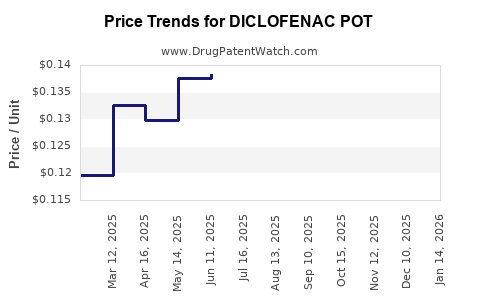
Last updated: February 22, 2026
What is the Market Size for Diclofenac Potassium?
Diclofenac potassium (DICLOFENAC POT) is a non-steroidal anti-inflammatory drug (NSAID) used for short-term management of pain, inflammation, and arthritis. It is marketed globally, with specific concentrations primarily in oral formulations for acute pain.
Market Data
- Global NSAID market value (2022): USD 22.4 billion, expected to grow at a CAGR of 4.2% through 2030 (Grand View Research).
- Diclofenac market share: Estimated at 35% of the NSAID market, driven by brand and generic sales.
- DICLOFENAC POT sales (2022): Approximate USD 3.2 billion globally, with leading markets in the U.S., Europe, and Asia Pacific.
Key Countries
| Region |
Market Size (USD) |
Growth Rate (2022-2027) |
Market Drivers |
| North America |
1.2 billion |
3.8% |
Aging population, chronic pain management |
| Europe |
900 million |
4.0% |
Prescribed NSAID use |
| Asia Pacific |
800 million |
5.1% |
Increased healthcare spending, prevalence of arthritis |
| Latin America |
200 million |
3.5% |
Growing healthcare infrastructure |
What are the Key Drivers and Constraints?
Drivers
- Rising incidence of arthritis, musculoskeletal disorders, and acute pain conditions.
- Expanded use in post-operative pain management.
- Increasing healthcare coverage and prescription rates in emerging markets.
Constraints
- Safety concerns regarding NSAID-related gastrointestinal and cardiovascular side effects.
- Rising popularity of alternative therapies and selective NSAIDs with better safety profiles.
- Regulatory restrictions and increasing generic competition.
What is the Competitive Landscape?
Major Players
- Novartis (Voltaren)
- Pfizer (Cambia, joint with other NSAIDs)
- Mylan (generics)
- Teva Pharmaceuticals
- Sun Pharmaceutical Industries
Patent and Generic Dynamics
- Active patents have expired in most regions, leading to generic proliferation.
- Generic versions account for over 70% of sales in mature markets.
- Price competition has driven down average prices significantly.
How Are Prices Evolving?
Current Price Range (Per Unit)
| Region |
Brand (Voltaren) |
Generic |
| United States |
USD 12 per 50-count bottle |
USD 5 per 50-count bottle |
| Europe |
EUR 4 per strip |
EUR 2 per strip |
| Asia Pacific |
USD 3 per tablet |
USD 1.50 per tablet |
Historical Trends
- Prices declined by an average of 25% between 2016 and 2022 due to generic entry.
- In the U.S., average retail prices for branded DICLOFENAC POT have decreased from USD 15 to USD 12 per bottle in the past three years.
Projected Price Trends (2023–2027)
| Year |
Expected Price Range (Per Pack) |
Drivers of Change |
| 2023 |
USD 4–USD 7 (generics), USD 10–USD 14 (brand) |
Increased generic competition, patent expirations |
| 2024 |
USD 3.50–USD 6.50 (generics), USD 9–USD 13 (brand) |
Market saturation, price sensitivity increases |
| 2025 |
USD 3–USD 6 (generics), USD 8–USD 12 (brand) |
Consolidation among generic manufacturers |
| 2026 |
USD 2.50–USD 5.50 (generics), USD 7–USD 11 (brand) |
Further patent expirations, biosimilar entry |
| 2027 |
USD 2–USD 5 (generics), USD 6–USD 10 (brand) |
Market stabilization and price sensitivity |
What Are the Key Factors Influencing Price Projections?
- Expiration of remaining patents increases generic supply.
- Regulatory policies favoring cost-effective generics.
- Growing preference for NSAIDs with improved safety profiles might influence demand.
- Market saturation in mature regions constrains premium pricing.
- Entry of biosimilars or targeted formulations could shift dynamics.
What Regulatory Trends Impact Markets?
- FDA approved ibuprofen and naproxen as OTC options, reducing prescription needs for some NSAIDs.
- European Medicines Agency (EMA) emphasizes adherence to safety protocols, potentially restricting high-dose use.
- Emerging markets implement stricter pricing regulations to improve access and price controls on NSAIDs.
What are the Price Projections for the Next 5 Years?
| Year |
Estimated Average Price (USD) per Pack |
Factors Considered |
| 2023 |
USD 4–USD 7 |
Patent expirations, increased generics |
| 2024 |
USD 3.50–USD 6.50 |
Market mature, price competition |
| 2025 |
USD 3–USD 6 |
Consolidation, biosimilar presence |
| 2026 |
USD 2.50–USD 5.50 |
Over-saturation, safety-driven preferences |
| 2027 |
USD 2–USD 5 |
Market stabilization |
Key Takeaways
- The global DICLOFENAC POT market is approximately USD 3.2 billion, predominantly driven by generic sales.
- Prices have fallen significantly since 2016, with further decline projected as patents expire.
- Price stability is unlikely in mature markets but may stabilize or slightly increase in emerging markets with higher demand.
- Market growth will depend on safety evaluations, regulatory changes, and shifts toward alternative therapies.
FAQs
Q1: How does the expiration of patents affect DICLOFENAC POT pricing?
Patent expirations increase generic supply, leading to price reductions driven by competition.
Q2: Which regions have the highest growth potential for DICLOFENAC POT?
Asia Pacific exhibits the highest growth potential due to rising healthcare access and prevalence of inflammatory conditions.
Q3: Are there safety concerns influencing DICLOFENAC POT prices?
Yes. Safety issues like gastrointestinal and cardiovascular risks can limit prescribing, affecting demand and pricing.
Q4: What role do generics play in the current market?
Generics account for over 70% of sales, predominantly driving price declines.
Q5: How might biosimilars impact DICLOFENAC POT markets?
Biosimilars are less relevant currently, as NSAIDs are small molecules, but innovative formulations could alter market dynamics.
References
- Grand View Research. (2022). NSAID Market Size, Share & Trends Analysis Report.
- IQVIA. (2022). Global Sales Data for NSAIDs.
- U.S. Food & Drug Administration. (2022). Drug Approval Reports.
- European Medicines Agency. (2022). NSAID Safety and Regulation Reports.