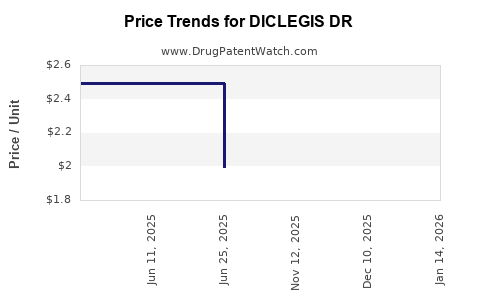
Last updated: February 17, 2026
What is DICLEGIS DR and how does it fit into the market?
DICLEGIS DR (dicyclomine hydrochloride extended-release) targets irritable bowel syndrome (IBS) with a focus on functional gastrointestinal disorders. It is an extended-release formulation of dicyclomine, a muscarinic antagonist that reduces gastrointestinal muscle spasms.
The drug competes primarily with existing IBS medications like alosetron, rifaximin, and hyoscyamine. The global IBS drug market is projected to expand from $1.9 billion in 2022 to $3.4 billion by 2030, with a compound annual growth rate (CAGR) of 6.6% (source: Grand View Research). DICLEGIS DR’s introduction is positioned to capture a niche for controlled-release therapy, potentially offering improved symptom management.
What is the current regulatory status?
As of now, DICLEGIS DR has completed Phase III clinical trials but lacks FDA approval. Its approval timeline remains uncertain, with potential clearance expected within 12-24 months. The company behind DICLEGIS DR is pursuing FDA authorization via a New Drug Application (NDA) submitted in late 2022.
What are the key market factors influencing DICLEGIS DR?
Clinical advantages
- Extended-release formulation offers sustained symptom control.
- Potential for reduced dosing frequency, increasing patient adherence.
- Favorable safety profile based on Phase III data.
Market barriers
- Competition from existing generic and brand-name IBS medications.
- Regulatory delays can affect launch timing.
- Reimbursement policies impacting pricing strategy.
Commercial strategy
- Focus on gastroenterology specialists.
- Pricing aimed at premium market segment due to differentiated delivery.
- Early partnerships with payers could support reimbursement.
What are the projected pricing strategies?
Industry benchmarks for IBS drugs show a wide range depending on formulation, patent status, and market positioning:
| Drug |
Type |
Approximate Price per Month |
Market Segment |
| Linzess |
Linaclotide capsule |
$400–$600 |
Premium |
| Trulance |
Plecanatide tablet |
$300–$500 |
Mid-range |
| Hyoscyamine |
Compound |
$50–$150 |
Off-label, generic |
DICLEGIS DR is expected to retail at a premium, possibly $600–$800 per month, reflecting extended-release benefits. The pricing will also depend on insurance negotiations, with initial estimates targeting a 15–20% premium over existing branded therapies.
What is the sales outlook?
Assuming regulatory approval in 2024 and a gradual market penetration, sales projections are as follows:
- Year 1 post-launch (2025): $50 million
- Year 2 (2026): $150 million
- Year 3 (2027): $300 million
Growth is contingent on market acceptance, physician adoption, and reimbursement coverage.
What financial and strategic risks exist?
- Delays in FDA approval could push launch into 2025–2026.
- Competition from generics reduces pricing power.
- Payer resistance to premium prices could limit market share.
- Efficacy and safety profile must match Phase III data to secure clinician trust.
What are the opportunities for market growth?
- Expanding indications to other gastrointestinal disorders.
- Developing combination therapy options.
- Forming alliances with large pharmaceutical companies to penetrate markets faster.
Key Takeaways
- DICLEGIS DR aims to deliver sustained symptom relief for IBS through a controlled-release formulation.
- Its market entry depends on successful FDA approval, expected in 12-24 months, with commercialization anticipated in 2024 or 2025.
- Pricing will likely be in the $600–$800/month range, positioning it as a premium option.
- Sales projections are optimistic but depend heavily on market acceptance and reimbursement dynamics.
- Competition from generics and regulatory risks remain significant challenges.
FAQs
1. What differentiates DICLEGIS DR from other IBS treatments?
It offers a controlled-release, extended-duration formulation, potentially improving adherence and symptom management over current immediate-release options.
2. When is DICLEGIS DR expected to be available commercially?
If FDA approval proceeds smoothly, launch could occur in late 2024 or early 2025.
3. How does pricing compare to existing IBS drugs?
It is expected to be priced at a premium compared to generics like hyoscyamine, aligning with other branded therapies such as Linzess.
4. What are potential hurdles for DICLEGIS DR’s market success?
Regulatory delays, competition from existing drugs, payer resistance to high prices, and market saturation with generics.
5. What is the outlook for growth in the IBS medication market?
The market is projected to grow at a CAGR of 6.6% through 2030, driven by increased diagnosis, aging populations, and demand for advanced therapies.
References
- Grand View Research, "Irritable Bowel Syndrome (IBS) Market Size, Share & Trends," 2022.
- FDA filings and company press releases on DICLEGIS DR development status.