Share This Page
Drug Price Trends for DIAPER RASH
✉ Email this page to a colleague
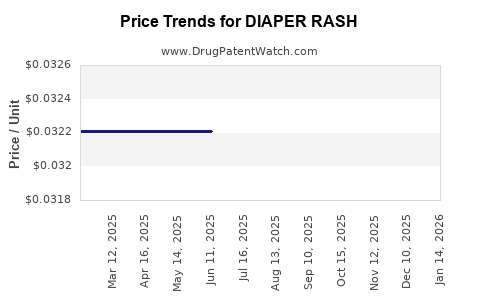
Average Pharmacy Cost for DIAPER RASH
| Drug Name | NDC | Price/Unit ($) | Unit | Date |
|---|---|---|---|---|
| DIAPER RASH 40% OINTMENT | 70000-0469-01 | 0.03356 | GM | 2026-05-20 |
| DIAPER RASH 40% OINTMENT | 70000-0469-01 | 0.03371 | GM | 2026-04-22 |
| DIAPER RASH 40% OINTMENT | 70000-0469-01 | 0.03358 | GM | 2026-03-18 |
| DIAPER RASH 40% OINTMENT | 70000-0469-01 | 0.03319 | GM | 2026-02-18 |
| >Drug Name | >NDC | >Price/Unit ($) | >Unit | >Date |
Market Analysis and Price Projections for Diaper Rash Treatments
What is the current market size for diaper rash treatments?
The global diaper rash treatment market was valued at approximately USD 1.2 billion in 2022. The market is projected to grow at a compound annual growth rate (CAGR) of 4.5% through 2028, reaching an estimated USD 1.74 billion.
Primary drivers include rising birth rates in emerging markets, increased awareness about infant skin health, and demand for OTC products. North America accounts for nearly 40% of the market, with Asia-Pacific showing rapid growth due to rising urbanization and disposable income.
What are the key product types within the diaper rash treatment market?
The market largely consists of:
- Ointments and creams: 65% market share, including zinc oxide-based formulations and petroleum jelly.
- Powders: 20%, mainly talc or cornstarch-based.
- Wipes and cleansers: 10%, often containing soothing agents like aloe or calendula.
- Other formulations: 5%, including ointment sticks and sprays.
Ointments dominate due to higher efficacy in barrier protection, while powders have declining use owing to safety concerns related to inhalation risks.
Who are the key players and their market share?
Major players include:
| Company | Market Share (2022) | Key Products |
|---|---|---|
| Johnson & Johnson | 30% | Desitin, Johnson’s Baby Zinc Oxide |
| P&G | 20% | Pampers Diaper Rash Cream |
| Aveeno (Johnson & Johnson) | 10% | Aveeno Baby Healing Oat Soothing Diaper Rash Cream |
| Chirayu Healthcare | 5% | CHIRAYU Diaper Rash Ointment |
| Others | 35% | Various regional brands |
Market shares are based on retail sales data and reports from industry analysts.
How do regulatory environments affect pricing?
Regulatory bodies such as the FDA (U.S.) and EMA (Europe) regulate diaper rash treatments as OTC drugs or cosmetics. Approval standards influence formulation, labeling, and marketing, impacting manufacturing costs and retail prices.
In regulated markets, formulations with active ingredients like zinc oxide and petrolatum may face testing requirements that add costs. Ingredient safety assessments and efficacy claims also influence pricing strategies.
What are the typical price ranges for diaper rash products?
Price ranges vary by formulation and brand:
- Generic zinc oxide ointments: USD 2–4 per 100g tube.
- Brand-name products (e.g., Desitin, Bepanthen): USD 4–8 per 100g tube.
- Powders (cornstarch-based): USD 3–5 per 100g container.
- Wipes and cleansers: USD 5–10 per pack.
Private label brands often offer products at lower prices, intensifying market competition.
What are projected price trends through 2028?
Price erosion is expected due to increased competition and shifts toward generic formulations. Price premiums for branded products may reduce by approximately 10% over five years.
In emerging markets, prices tend to remain stable or rise slightly due to import tariffs and distribution costs. Conversely, mature markets see downward pressure because of supermarket retail chains' focus on low-cost brand offerings.
How will innovation influence future market dynamics?
Concerns about ingredient safety, such as the inhalation risk linked to powders, push companies toward safer, more skin-friendly formulations. Products with added soothing agents or probiotic components command higher prices, potentially increasing retail costs by 15–20%.
Innovations that enhance efficacy or deliver faster relief may command higher prices initially, but volume-driven sales will likely offset price increases over time.
What are the key challenges and opportunities?
Challenges:
- Regulatory scrutiny increasing for powders and sprays.
- Market saturation in developed countries.
- Growing consumer preference for natural and organic products.
Opportunities:
- Expansion in emerging markets.
- Development of safer, innovative formulations.
- Private label brands capturing more retail shelf space.
Summary: Market outlook and pricing implications
The diaper rash treatment market maintains steady growth fueled by demographic trends and product diversification. Average retail prices are stable but face downward pressure from generic products and private labels. Innovations regarding safety and formulation efficacy could allow premium pricing in niche segments initially, but overall, price decreases are expected in mature markets.
Key Takeaways
- The 2022 global market was USD 1.2 billion; projected to reach USD 1.74 billion by 2028.
- Market share dominance is held by Johnson & Johnson (30%) and P&G (20%).
- Price points vary: USD 2–8 per 100g, depending on formulation and brand.
- Regulatory environments influence product development costs and retail pricing.
- Price erosion is likely, with potential increases for innovative, safer formulations.
FAQs
-
How does regulatory approval impact diaper rash product pricing?
Regulatory approval increases manufacturing costs and can delay product launches, which influences retail pricing, especially for new formulations requiring efficacy and safety testing. -
What factors contribute to price differentiation among brands?
Brand recognition, formulation ingredients, safety profile, and product innovation determine price variations. Premium brands often incorporate natural or organic ingredients. -
Which emerging markets present the best growth opportunities?
Markets in India, China, Brazil, and parts of Southeast Asia hold rapid growth potential due to increasing birth rates and rising disposable incomes. -
Are there any notable new product trends?
Yes, formulations with added probiotics, natural ingredients, and better safety profiles are gaining market traction. -
How will consumer preferences influence future product development?
Demand for natural, chemical-free, and hypoallergenic formulations will drive innovation, potentially enabling premium pricing for safer, more effective products.
References
[1] Markets and Markets. (2023). Diaper Rash (Diaper Dermatitis) Treatment Market.
[2] Grand View Research. (2023). Baby Care Products Market Size, Share & Trends.
[3] U.S. Food and Drug Administration. (2022). OTC Monographs for Diaper Rash Products.
[4] Statista. (2022). Baby Care Market Revenue Forecasts.
[5] Euromonitor International. (2023). Baby and Child-Specific Products Industry Reports.
More… ↓
