Share This Page
Drug Price Trends for DEXTROAMPHETAMINE ER
✉ Email this page to a colleague
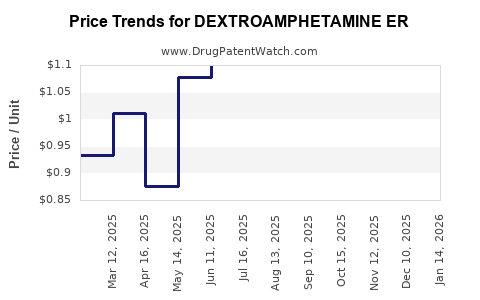
Average Pharmacy Cost for DEXTROAMPHETAMINE ER
| Drug Name | NDC | Price/Unit ($) | Unit | Date |
|---|---|---|---|---|
| DEXTROAMPHETAMINE ER 10 MG CAP | 00406-8961-01 | 0.99493 | EACH | 2026-07-22 |
| DEXTROAMPHETAMINE ER 15 MG CAP | 00406-8962-01 | 1.33115 | EACH | 2026-07-22 |
| DEXTROAMPHETAMINE ER 5 MG CAP | 45963-0303-09 | 1.10914 | EACH | 2026-07-22 |
| >Drug Name | >NDC | >Price/Unit ($) | >Unit | >Date |
Market Analysis and Price Projections for Dextroamphetamine ER
What Is the Current Market for Dextroamphetamine ER?
Dextroamphetamine extended-release (ER) is a prescription stimulant primarily used for attention deficit hyperactivity disorder (ADHD) and narcolepsy. It is a branded product, commonly marketed as Adderall XR, alongside generic formulations. The global demand for ADHD medications has grown steadily, driven by increased awareness and diagnosis rates.
In 2022, the global ADHD medication market was valued at approximately USD 13.5 billion. Dextroamphetamine ER accounts for a significant share, considering its status as an FDA-approved generic and branded product. The U.S. accounts for over 85% of global revenue, reflecting high prescription rates and insurance coverage.
Market Demographics:
- North America: 70-75% market share, driven by high diagnosis rates and insurance accessibility.
- Europe: Growing demand, with sales driven by increasing awareness.
- Asia-Pacific: Emerging market with expanding healthcare infrastructure.
Competitive Landscape:
- It is dominated by the branded drug Adderall XR (produced by Shire and now part of Takeda) and multiple generic manufacturers.
- Generics account for approximately 60-70% of prescriptions in the U.S.
- Patent protections for original formulations expired in the early 2010s, increasing generic penetration.
What Are Current Pricing Trends?
Pricing varies by formulation, manufacturer, and region:
| Formulation | Brand Name | Approximate Average Wholesale Price (AWP) per 30-day supply | Cost Range (Generic) |
|---|---|---|---|
| Dextroamphetamine ER | Adderall XR | USD 250–USD 350 | USD 80–USD 150 |
| Generic Dextroamphetamine ER | Multiple manufacturers | USD 80–USD 150 | USD 50–USD 100 |
In the U.S., insurance coverage reduces the out-of-pocket costs but varies by plan. The wholesale acquisition cost (WAC) typically remains 20-30% lower than AWP.
What Are Key Drivers and Constraints?
Drivers:
- Shift in diagnosis rates for ADHD across age groups.
- Insurance reimbursement encouraging broad access.
- Wider acceptance of stimulant medications over alternatives.
- Ongoing patent expirations increasing generic competition.
Constraints:
- Regulatory pressures to limit misuse and diversion.
- Increasing scrutiny over stimulant abuse potential.
- Price sensitivity among payers and consumers.
- Potential shifts towards non-stimulant treatments.
How Will Pricing Evolve?
Analysts project moderate pricing declines for generic Dextroamphetamine ER through 2025, driven by intensified competition. Innovative formulations, such as extended-release technologies or abuse-deterrent features, may command premiums in select markets.
Projected Price Range (2023-2025):
| Year | 30-day Supply (USD) | Notes |
|---|---|---|
| 2023 | USD 80–USD 150 | Established generics, stable prices. |
| 2024 | USD 75–USD 140 | Increased generic entry, downward pressure. |
| 2025 | USD 70–USD 130 | Market saturation, potential price stabilization with new formulations. |
What Are Potential Growth Opportunities?
- Expansion into emerging markets with growing ADHD diagnoses.
- Development of formulations with abuse deterrent features.
- Possible biosimilars or combination therapies.
What Are Regulatory and Market Risks?
- Potential restrictions on stimulant prescribing.
- Changes in insurance reimbursement policies.
- Increased regulatory oversight aimed at preventing abuse.
Key Takeaways
- Dextroamphetamine ER remains a critical component of ADHD treatment with deep market penetration in North America.
- Generic competition has reduced average prices by approximately 50-60% over the past decade.
- Future pricing will likely decline gradually, barring innovations or regulatory changes.
- Expanding usage in emerging markets offers growth but faces regulatory and cost barriers.
- Continuous improvements in formulation may provide opportunities for premium pricing segments.
FAQs
1. How does the generic Dextroamphetamine ER compare price-wise to the branded version?
Generics are roughly 50-70% less expensive than the branded Adderall XR, heavily influenced by manufacturer competition and insurance reimbursement.
2. What factors could influence the price of Dextroamphetamine ER over the next five years?
Increased competition, regulatory constraints, insurance policies, and formulation innovations primarily drive future price movements.
3. What regions are expected to see the most growth in demand for Dextroamphetamine ER?
North America remains the largest market, with Asia-Pacific and Europe exhibiting gradual growth due to rising awareness and diagnosis rates.
4. Are there any upcoming patent expirations or exclusivity periods?
Major patent expirations occurred in the early 2010s, paving the way for multiple generic manufacturers. No recent exclusivity periods are anticipated soon.
5. How might regulatory actions impact the market?
Restrictions on prescribing stimulant medications or moves to tighten abuse controls could reduce market volume, influencing prices downward.
References
[1] Grand View Research. ADHD Medication Market Size, Share & Trends Analysis. 2022.
[2] IQVIA. National Prescription Audit, 2022.
[3] U.S. Food and Drug Administration. Approved Drug Listings and Patent Status. 2023.
[4] Centers for Disease Control and Prevention. ADHD Demographics and Diagnosis Trends. 2022.
[5] MarketWatch. Price Trends in ADHD Medications. 2023.
More… ↓
