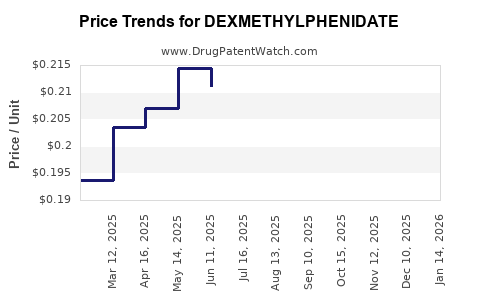
Last updated: February 15, 2026
Dextro-methylphenidate, marketed primarily under brand names like Dexedrine and Focalin, is a stimulant medication prescribed for ADHD and narcolepsy. Its market dynamics are shaped by regulatory status, manufacturing landscape, competition, and healthcare trends.
Market Size and Growth
The global ADHD medication market, including dextro-methylphenidate, was valued at approximately $4.5 billion in 2022. It is projected to reach $6.3 billion by 2028, growing at a compound annual growth rate (CAGR) of roughly 6.2% (2022-2028). The increase stems from rising ADHD diagnoses and greater healthcare access in emerging markets.
Major Players and Production Landscape
- Major Manufacturers: U.S.-based Johnson & Johnson (Janssen), Novartis, and Teva Pharmaceuticals.
- Manufacturing Constraints: Regulatory scrutiny influences supply chain stability, especially amid concerns over misuse and diversion.
- Patent and Generic Status: The original patents for dexmethylphenidate expired in the U.S. around 2014, leading to multiple generic versions.
Regulatory Environment
- Approval Status: U.S. FDA approved dexmethylphenidate for ADHD in 2002. Similar approvals exist in Europe and other regions.
- Control Status: Schedule II substance under the Controlled Substances Act, which limits prescribing volume and impacts pricing strategies.
Pricing Trends and Projections
Current Pricing (U.S.):
- Brand-name Dexedrine (immediate-release): approximately $350–$450 per 30-day supply.
- Generics (immediate-release): approximately $50–$80 per 30-day supply.
- Extended-release formulations (e.g., Focalin XR): approximately $200–$300 per 30-day supply.
Factors Affecting Price Dynamics:
- Patent expiry triggered generic competition.
- Insurance reimbursement policies influence patient out-of-pocket costs.
- Manufacturing costs are stabilized by multiple producers.
Projection for 2028:
| Parameter |
2023 Estimate |
2028 Projection |
| Average wholesale price (AWP) |
$10–$15 per 10mg tab (generic) |
Slight decline to $8–$12 due to generic proliferation |
| Retail price |
$50–$80 for 30-day supply (generic) |
Flat or slight decrease linked to increased competition |
| Brand premium over generic |
5–10x |
Narrowing as generics dominate market |
While generic competition exerts downward pressure, the controlled substance status maintains some price rigidity, especially for branded formulations.
Market Drivers and Barriers
Drivers:
- Global increase in ADHD diagnosis rate.
- Expansion into pediatric and adult markets.
- Growing acceptance of pharmacological treatment options.
Barriers:
- Stringent regulatory oversight.
- Potential for abuse and diversion.
- Market saturation in developed regions.
Competitive Landscape
| Company |
Market Share |
Key Products |
Regulatory Status |
| Janssen (Johnson & Johnson) |
~45% |
Concerta, Dexedrine |
Patented, branded products |
| Novartis |
~20% |
Focalin (dexmethylphenidate) |
Generic formulations available |
| Teva Pharmaceuticals |
~15% |
Generic dextro-methylphenidate |
Major generic producer |
The generic segment accounts for over 70% of the market volume, with downstream price competition shaping profits.
Future Market Trends and Price Outlook
- Consolidation: Larger generic manufacturers may further stabilize prices through increased market share.
- New Formulations: Extended-release and alternative delivery systems could command premium prices, impacting overall market dynamics.
- Regulatory Changes: Potential scheduling or abuse-deterrent systems could influence pricing and availability.
- Global Expansion: Emerging markets offer growth opportunities; however, local regulatory frameworks and affordability issues could constrain pricing.
Key Takeaways
- The dextro-methylphenidate market is broadening due to increased diagnoses, yet high regulatory hurdles and Schedule II classification limit rapid price growth.
- Generic competition dominates, pushing prices downward, although branded products maintain a significant premium.
- Pricing in the U.S. for generics likely to stabilize around $8–$12 per 10mg tablet by 2028.
- The global market's expansion, especially in Asia-Pacific, could influence pricing trends due to differing regulations.
- Patent expirations, regulatory oversight, and new formulations shape the forthcoming landscape.
FAQs
1. How will patent expirations affect dextro-methylphenidate pricing?
Patent expirations increase generic competition, generally leading to price reductions. As generics account for most sales, this trend dominates pricing dynamics.
2. What is the impact of regulatory restrictions on market supply?
The Schedule II status limits prescribing and distribution, constraining supply and maintaining some price stability despite competition.
3. Are there emerging formulations that could affect prices?
Yes. Extended-release formulations and abuse-deterrent systems could command higher prices, though their market share remains limited.
4. How do international markets influence global pricing?
Regions with less regulatory control may offer lower prices, impacting global averages. However, local laws and healthcare reimbursement models significantly shape these markets.
5. What is the outlook for new entrants in the dextro-methylphenidate market?
Entry is challenging due to regulatory hurdles and established players. While generics dominate, innovation in delivery systems could provide niche opportunities.
Citations:
[1] MarketsandMarkets. "ADHD Medicines Market," 2022.
[2] IQVIA. "U.S. Prescription Drug Trends," 2022.
[3] U.S. FDA. "Approved ADHD Medications," 2022.
[4] Statista. "Global ADHD Medication Market," 2022.