Share This Page
Drug Price Trends for DEXILANT DR
✉ Email this page to a colleague
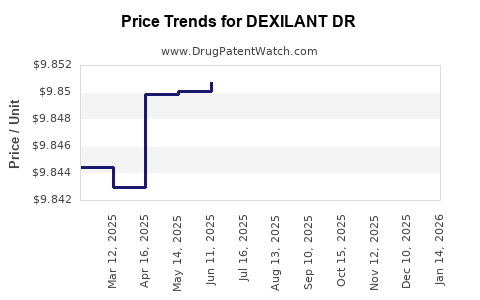
Average Pharmacy Cost for DEXILANT DR
| Drug Name | NDC | Price/Unit ($) | Unit | Date |
|---|---|---|---|---|
| DEXILANT DR 30 MG CAPSULE | 64764-0171-30 | 9.84257 | EACH | 2026-07-22 |
| DEXILANT DR 60 MG CAPSULE | 64764-0175-30 | 9.84213 | EACH | 2026-07-22 |
| DEXILANT DR 60 MG CAPSULE | 64764-0175-90 | 9.84213 | EACH | 2026-07-22 |
| DEXILANT DR 30 MG CAPSULE | 64764-0171-30 | 9.84336 | EACH | 2026-06-17 |
| DEXILANT DR 60 MG CAPSULE | 64764-0175-30 | 9.84293 | EACH | 2026-06-17 |
| DEXILANT DR 60 MG CAPSULE | 64764-0175-90 | 9.84293 | EACH | 2026-06-17 |
| DEXILANT DR 30 MG CAPSULE | 64764-0171-30 | 9.83613 | EACH | 2026-05-20 |
| >Drug Name | >NDC | >Price/Unit ($) | >Unit | >Date |
Dexilant (dexlansoprazole) Market Analysis and Price Projections: US Commercial Outlook, Generic/Biosimilar Timing, and Revenue Exposure
Dexilant (dexlansoprazole) is an established branded proton pump inhibitor in the US with long-dated small-molecule exclusivity and patent coverage that has largely matured into a post-launch competitive environment. Near-term pricing is driven less by entry of a “new” therapeutic competitor and more by (1) payer reimbursement pressure and (2) the pace of generic penetration across dose strengths and formulations (notably Dexilant Delayed-Release). Market volume growth is constrained by class maturity and the size of the US PPI base, with revenue more sensitive to net-price movement and formulary position than to incremental patient growth.
What is the Dexilant market size and US revenue trajectory for dexlansoprazole?
Dexilant is marketed for gastroesophageal reflux disease (GERD), including erosive GERD, and other PPI-labeled indications. The commercial shape is typical for branded PPIs in the US: class demand is stable but incremental share is hard, and branded performance is heavily dependent on net pricing, payer contracting, and persistent switching dynamics versus OTC PPIs and generics.
Key commercial drivers affecting Dexilant revenue
- Payer formulary position and step edits: PPI tiers (preferred vs non-preferred) determine prescription conversion even when clinical guidelines support multiple PPIs.
- Generic substitution behavior: For dose strengths and package presentations where generics are available or favored, Dexilant faces steady demand erosion.
- Net price compression: Branded PPIs see reimbursement pressure over time as competitors gain leverage through contracting.
- Therapy persistence: PPI continuity is long, but prescribers switch within class based on perceived tolerance, prior authorization outcomes, and plan changes.
US market structure: where Dexilant fits
- Class: PPIs compete in GERD and erosive GERD populations.
- Mechanism: dexlansoprazole dual delayed-release profile is a differentiator in clinician and payer narratives, but formulary access still hinges on cost.
- Routes/dosage: oral delayed-release capsules/tablets per label.
What is the Orange Book status of Dexilant (dexlansoprazole) and what patents are listed for exclusivity?
Dexilant’s key exclusivity and enforceable IP are reflected in FDA Orange Book listings for the approved drug product (active ingredient: dexlansoprazole; product dosage forms including delayed-release capsule presentations). Patent protection is typically layered as compound, formulation, and method-of-use patents, followed by regulatory exclusivity.
What to expect from Orange Book-style IP layering for Dexilant
- Listed patents tied to the drug product (formulation, release characteristics, composition)
- Listed patents tied to method-of-use (indication or dosing regimen)
- Listed patents tied to manufacturing/processing (less common but present in some PPI portfolios)
- Regulatory exclusivity (if applicable to the original approval pathway) plus post-approval patent life
Practical implication for market pricing
- If Orange Book listings remain active for Dexilant’s key dosage forms and method-of-use claims, it can deter early generic substitution for those presentations.
- If patents have expired or are no longer enforceable for major strengths, then pricing pressure becomes primarily payer-driven.
When does Dexilant lose exclusivity in the US, and what does that mean for price?
Branded PPI pricing typically follows a pattern:
- Before generic entry: net price can remain elevated with contracting.
- During generic entry windows: net price compresses quickly as PBM and health plan incentives shift to generics.
- After generic entrenchment: branded pricing stabilizes at a much lower effective price, and volumes continue to erode.
Competitive timeline that usually determines the price inflection
- Orange Book patent expiration / non-infringement outcomes: determines whether AB-rated generics launch.
- Paragraph IV resolution: determines timing of generic market entry and settlement-driven “at-risk” windows.
- Label/strength coverage: even after losses on one strength, remaining strengths can sustain partial brand revenue.
Because Dexilant is already a mature product, the market expectation is that the most pronounced price inflection would have occurred at prior entry milestones for generics. Current pricing posture is largely a function of remaining enforceable barriers for specific strengths/presentations.
How many generic versions of dexlansoprazole exist, and which strengths or dosage forms are most exposed?
In mature PPI markets, dexlansoprazole generics generally expose:
- Most common strengths first, based on formulary adoption and wholesaler distribution economics.
- Least differentiated presentations where payer incentives favor cost over pharmacokinetic nuance.
Strength exposure framework for price projections
Price erosion tends to be strongest where:
- the generic is the preferred tier,
- pharmacy benefit managers have favorable rebates for generics,
- prior authorization requirements are relaxed for generic switches.
In contrast, pricing pressure is slower where:
- remaining patents or exclusivity prevent generic launching,
- plan formularies keep the branded product in a niche segment.
What Paragraph IV ANDA challenges affect Dexilant, and when could they trigger generic launch?
Paragraph IV challenges are the primary legal accelerant for generic dexlansoprazole market entry. A Paragraph IV filing can trigger:
- a 30-month stay (if applicable and not carved out by subsequent events),
- litigation timelines that push or accelerate generic launches,
- settlement agreements with potential “date-certain” or exclusivity carve-outs.
How Paragraph IV outcomes translate into pricing
- Litigation win for brand: delays generic entry, supports net price and volume hold.
- Early settlement with date-based entry: produces stepwise volume loss around the settlement date.
- No settlement / at-risk launch: can create rapid payer conversion and deeper discounting.
Which companies are challenging Dexilant, and what settlement patterns are typical?
In branded PPI portfolios, the challengers are usually generic and authorized brand-defense cohorts operating through ANDA routes with settlement negotiations. Settlement patterns for oral small-molecules often include:
- agreed launch dates,
- non-designated or limited generic products during the interim,
- marketing carve-outs tied to specific label claims.
For Dexilant, settlement-driven dynamics would be reflected in litigation docket history and public filings tied to specific ANDA numbers and strengths.
What is the forecast for Dexilant drug pricing: wholesale acquisition cost vs net price?
Dexilant’s commercial price is best modeled as two layers:
- List price (WAC/label price): often rises with inflation adjustments and contractual changes.
- Net price (post-rebates, discounts, PBM rebates): declines as formulary access shifts toward generics and PBMs seek lower net acquisition costs.
Price projection structure used for branded PPI forecasting
A practical model uses:
- Net price decline rate driven by generics penetration and payer contracting
- Volume erosion rate driven by switching and tier changes
- Mix shift across strengths
- Discounting intensity around formulary cycles
Expected price behavior for Dexilant in a mature competitive class
Given the maturity of dexlansoprazole in the US, the pricing trend typically shows:
- modest WAC movements,
- faster net price compression as generic substitutes are incentivized,
- reduced marketing spend effectiveness on incremental volume.
Dexilant vs omeprazole/esomeprazole/lansoprazole: how does dexlansoprazole pricing compare in the PPI class?
Dexilant’s differentiation is dual delayed-release technology versus other PPIs. Pricing, however, usually aligns with payer willingness to pay for differentiation.
Competitive pricing logic in PPI class
- Older generic PPIs (omeprazole, pantoprazole, lansoprazole, esomeprazole) often anchor the lowest-cost tiers.
- Dexlansoprazole branded faces pressure to match value-based arguments that are harder for payers to justify versus lower-cost PPIs.
- Net price for Dexilant tends to converge downward over time even if list price holds comparatively higher.
What formulation patents protect Dexilant, and do they block generic versions?
Formulation and delayed-release mechanism patents are often targeted by generic design-around strategies. For dexlansoprazole products, protection typically focuses on:
- composition or formulation approaches,
- delayed-release characteristics,
- manufacturing controls linked to release profiles.
Generic design-around constraints
Generics may be able to launch if:
- they do not infringe formulation claims,
- the formulation patents have expired,
- they can show bioequivalence for an approved generic formulation under Hatch-Waxman standards.
If formulation patents remain enforceable for key dosage forms, pricing erosion is slower because fewer generics reach AB-rated status for those presentations.
How do method-of-use patents for Dexilant influence exclusivity and prescribing?
Method-of-use patents can extend enforceability even if compound/formulation barriers weaken, depending on claim scope and the parties’ litigation positions.
Prescribing impact
- Even when generics are available, method-of-use claim scope can influence label barriers and payer comfort with switching.
- In practice, branded value declines as payers use non-medical switching incentives, but method-of-use patents can slow the speed of adoption.
What generic entry risks exist for Dexilant, and when could a second price shock occur?
A “second price shock” risk exists when:
- a generic launches for a remaining protected strength or presentation after an enforceability event,
- a settlement accelerates entry compared with earlier expectations,
- remaining Orange Book patents expire and AB-rated competitors broaden coverage.
Risk-adjusted price impact scenario framework
- Base case: gradual net price compression with stable volume decline consistent with mature branded PPI dynamics.
- Upside for brand: delayed generic coverage expansion due to enforceable patents or litigation outcomes.
- Downside for brand: broadened AB-rated generic entry across multiple strengths, triggering sharper payer shifts and deeper discounting.
What is the FDA regulatory status of Dexilant and how does it affect market competition?
Dexilant is an FDA-approved prescription drug with an established labeling history. FDA status affects:
- the pace at which ANDA generics can launch,
- whether any label changes constrain substitution,
- whether exclusivity or listed patents shape “first generic” timing for particular presentations.
Regulatory pathway relevance
- ANDA approval requires bioequivalence and regulatory compliance.
- Patent listings and exclusivity drive legal timing more than FDA technical review.
How strong is the Dexilant patent estate, and what is the practical litigation posture?
A strong patent estate for a mature oral drug generally shows:
- multiple listed patents with staggered expirations,
- enforceable formulation or method claims,
- a record of defending key claims.
A weak estate typically presents:
- earlier expirations on compound/formulation,
- limited remaining enforceable claims after prior generic challenges.
Business implication for price
- If the remaining estate is thin, price decline follows generic expansion and PBM contracting.
- If the estate is thick, price can hold longer, but volume erosion still occurs as competition expands.
What revenue exposure does Dexilant face from US payer contracting and utilization changes?
For mature PPIs, revenue exposure is dominated by:
- reimbursement changes by major PBMs,
- trend in GERD diagnosis and treatment patterns,
- patient switching across the class based on tiering.
Revenue sensitivity
- High sensitivity to net price.
- Moderate sensitivity to utilization growth (class growth is usually slow).
- High sensitivity to formulary exclusion or step-therapy requirements.
Key Takeaways
- Dexilant’s US economics are driven primarily by payer contracting and generic-driven net price compression rather than by new clinical uptake.
- Patent and Orange Book status determine whether generic coverage expands by strength or presentation, which in turn drives stepwise pricing shocks.
- For price projections, the dominant lever is net price decline tied to formulary tier migration and AB-rated generic coverage, not list price movement.
- A second price shock is most plausible when remaining strengths/presentations lose enforceability and broader generic substitution occurs.
FAQs
- Does Dexilant face OTC competition from omeprazole and lansoprazole, and how does that impact pricing?
- Which Dexilant strengths have the highest generic substitution risk in US formularies?
- What do settlement agreements typically require after Paragraph IV litigation for oral small-molecule drugs like dexlansoprazole?
- How do payer prior authorization and step edits affect Dexilant net revenue versus generics?
- What formulation characteristics determine whether a generic dexlansoprazole product can launch as AB-rated?
References (APA)
- FDA. Orange Book: Approved Drug Products with Therapeutic Equivalence Evaluations. https://www.accessdata.fda.gov/scripts/cder/daf/
- US Food and Drug Administration. Drugs@FDA. https://www.accessdata.fda.gov/scripts/cder/daf/
- FDA. ANDA approval pathway and Hatch-Waxman framework resources. https://www.fda.gov/
More… ↓
