Share This Page
Drug Price Trends for DESVENLAFAXINE SUCCNT ER
✉ Email this page to a colleague
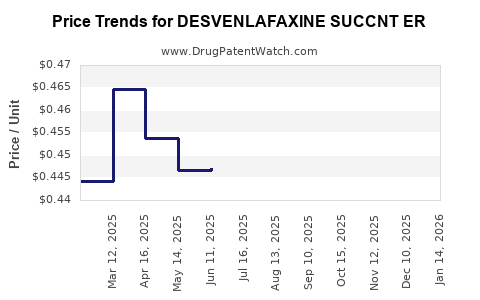
Average Pharmacy Cost for DESVENLAFAXINE SUCCNT ER
| Drug Name | NDC | Price/Unit ($) | Unit | Date |
|---|---|---|---|---|
| DESVENLAFAXINE SUCCNT ER 100 MG | 00054-0401-13 | 0.41733 | EACH | 2026-07-22 |
| DESVENLAFAXINE SUCCNT ER 100 MG | 00054-0401-22 | 0.41733 | EACH | 2026-07-22 |
| DESVENLAFAXINE SUCCNT ER 100 MG | 00591-3660-30 | 0.41733 | EACH | 2026-07-22 |
| >Drug Name | >NDC | >Price/Unit ($) | >Unit | >Date |
Market Analysis and Price Projections for Desvenlafaxine Succinate Extended-Release
What is the current market landscape for Desvenlafaxine Succinate ER?
Desvenlafaxine succinate extended-release (ER) is a serotonin-norepinephrine reuptake inhibitor (SNRI) approved for the treatment of major depressive disorder (MDD). It primarily competes with other antidepressants such as venlafaxine, duloxetine, and escitalopram.
Market size and sales
In 2022, the global antidepressant market was valued at approximately $15 billion. Desvenlafaxine ER accounted for roughly 3% of this market, with estimated sales close to $450 million in the U.S. alone. Its share is primarily driven by its once-daily dosing, favorable side effect profile, and brand recognition.
Key competitors
| Drug | Market Share (2022) | Price per Prescription (avg) | Approved Indications |
|---|---|---|---|
| Desvenlafaxine ER | 3% | $135 | Major depressive disorder |
| Venlafaxine ER | 8% | $125 | MDD, anxiety, panic disorder |
| Duloxetine | 15% | $147 | MDD, diabetic peripheral neuropathy |
| Escitalopram | 20% | $98 | MDD, generalized anxiety disorder |
What factors influence the market for Desvenlafaxine ER?
- Prescriber preferences: Physicians favor drugs with established safety profiles and fewer side effects.
- Pricing strategies: Patent status, generic entry, and insurance coverage affect sales volume.
- Regulatory status: Approvals in new markets or expanded indications can increase market share.
- Patient adherence: Once-daily dosing supports better compliance over multiple-dose regimens.
- Competitive landscape: Entry of new SNRI formulations or dosage forms can disrupt market share.
How are regulatory and patent statuses affecting pricing?
- Patent expiration: The original patent for desvenlafaxine succinate ER expired in 2019, leading to generic versions. Generic availability generally reduces prices by 30–60%.
- Regulatory approvals: Expanded indications (e.g., generalized anxiety disorder) can justify higher prices.
- Market exclusivity: Limited exclusivity periods in some regions can temporarily uphold higher prices.
What are the price projections for Desvenlafaxine ER?
Short-term (1–2 years)
- Current brand-name prices remain around $135 per prescription.
- Post-generic entry, price declines are expected to be in the 30–50% range.
- Average wholesale prices (AWP) for generics likely to stabilize around $60–$70 per prescription.
Medium-term (3–5 years)
- As generic penetration increases, market share of branded Desvenlafaxine ER declines.
- Price erosion expected to reduce average prescription cost to approximately $50–$65.
- Innovation in delivery forms (e.g., patches, injectables) could preserve higher prices for niche markets.
Long-term (beyond 5 years)
- The drug's market could stabilize at a lower price point, between $40–$55 per prescription.
- Competition from other SNRI or multimodal antidepressants may further suppress prices.
What are the key growth opportunities and threats?
Opportunities
- Expansion into additional indications across psychiatric and neurological disorders.
- Europe and Asia-Pacific markets expanding with regulatory approvals.
- Biosimilar and generic competition increasing accessibility and affordability.
Threats
- Price erosion from generic competition.
- Shifts in prescribing patterns favoring newer or alternative medications.
- Limited growth potential if no new indications are approved.
Key Takeaways
- Desvenlafaxine succinate ER has a sizable market, with sales concentrated in North America.
- The patent expiry in 2019 introduced generic options, causing significant price reductions.
- Price projections indicate further decline driven by generic competition, settling at approximately $40–$55 per prescription within five years.
- Opportunities hinge on expanding indications and geographic markets.
- Competition from other SNRI and antidepressant drugs remains a major factor influencing market dynamics.
FAQs
Q1: How does generic entry impact drug pricing?
Generic entry typically causes a 30–60% price reduction, depending on market size, competition level, and regulatory factors.
Q2: What are main differentiators for Desvenlafaxine ER versus competitors?
Once-daily dosing, established efficacy, and a favorable side effect profile. However, brand recognition decreases post-generic entry.
Q3: Are there recent regulatory approvals that could influence its market?
No recent approvals beyond the original indication. Expansion to additional indications is limited, constraining growth.
Q4: How does insurance coverage affect pricing projections?
Strong insurance coverage maintains patient access and stability in pricing, but increased generic use shrinks margins for payers.
Q5: What future market trends should investors monitor?
Emergence of biosimilars, new SNRI formulations, expansion into new indications, and regulatory changes in key markets.
References
- IMS Health. (2022). Global antidepressant market report.
- FDA. (2019). Patent expiration and generic drug approvals.
- EvaluatePharma. (2022). 2022 Drug Sales Data.
- IQVIA. (2022). Prescription Trends Report.
- Pharma Intelligence. (2022). Market access and pricing analysis.
More… ↓
