Last updated: February 12, 2026
Market Overview and Demand for Desonide
Desonide is a topical corticosteroid approved for treating inflammatory skin conditions such as eczema, dermatitis, and psoriasis. It is available in various formulations including cream, ointment, lotion, and foam. The drug's low potency and favorable safety profile support its widespread use, especially among pediatric and sensitive populations.
The global demand for dermatological corticosteroids is driven by increasing skin disease prevalence, rising awareness, and expanding dermatology clinics. The growing aging population with skin conditions is a notable factor. In 2022, the global dermatology market was valued at approximately USD 18 billion, with corticosteroids representing a significant subset. Desonide accounts for a sizable share in the low- to mid-potency corticosteroids segment.
Current Market Dynamics
Major Manufacturers and Market Share
Leading manufacturers include GlaxoSmithKline (GSK), Almirall, and Mylan (now part of Viatris). GSK’s Desonide products, such as Desonate, dominate the U.S. market. Private label and generic options, including those from Teva and Sandoz, have increased pricing competition.
| Company |
Product Name |
Formulation |
Estimated Market Share (2022) |
Key Markets |
| GlaxoSmithKline |
Desonate |
Cream, ointment |
45% |
North America, Europe |
| Almirall |
Desonide (generic) |
Cream, lotion |
20% |
Global |
| Mylan/Viatris |
Desonide (generic) |
Cream, ointment |
15% |
North America, EU |
| Others |
Various generics |
Various |
20% |
Global |
Competitive Landscape
Generic versions account for nearly 55-60% of sales in major markets. Patent protections for branded variants expired or are nearing expiration, facilitating increased generic penetration.
Regulatory Environment
In the U.S., the FDA classifies desonide as a new formulation since its initial approval in the 1990s, but recent approvals have shifted many formulations to over-the-counter (OTC) status, boosting retail access. Meanwhile, patent expirations in the European Union occurred around 2010, resulting in widespread generic use.
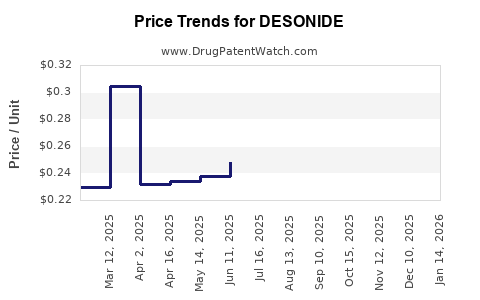
Price Trends and Projections
Current Pricing
In the U.S., average retail prices for a 30g tube of desonide cream (0.05%) vary:
- Branded (GSK’s Desonate): USD 150–200
- Generics: USD 50–80
Insurance coverage and discount programs influence final patient cost. Wholesale acquisition costs (WAC) are lower, with pharmacies often offering significant discounts.
Price Drivers
- Patent expirations lead to price erosion.
- Increased competition from generics reduces prices.
- Changes in prescribing patterns and formularies impact net pricing.
- Consumer shift toward OTC formulations, especially in European markets, compresses pricing further.
Future Price Projections
Between 2023 and 2028, prices for desonide are expected to decline at an average annual rate of 3-5%. The generics segment will continue dominating sales, with branded price premiums narrowing further.
| Year |
Estimated Price Range (30g tube) |
Notes |
| 2023 |
USD 50–80 |
Current generic pricing |
| 2024 |
USD 48–76 |
Slight decline driven by increased competition |
| 2025 |
USD 46–72 |
Continued generic market expansion |
| 2026 |
USD 44–68 |
Further price compression |
| 2027 |
USD 42–65 |
Potential for slight stabilization depending on market dynamics |
Impact of New Formulations or Indications
Any new, patent-backed formulations with improved efficacy or safety could command premium pricing. But as of now, no blockbuster innovations are in late-stage development.
Market Opportunities and Challenges
Opportunities
- Expansion into OTC markets, particularly in Europe.
- Development of combination therapies targeting multiple skin conditions.
- Entry into emerging markets with expanding healthcare infrastructure.
Challenges
- Pricing pressure from generics.
- Regulatory hurdles for new indications.
- Shift toward OTC products reducing prescription volume.
Conclusion: Market and Price Outlook
The desonide market faces steady decline in branded prices due to generic competition. Growth in volume sales may offset price erosion, especially with increased penetration in OTC and emerging markets. The overall market value is projected to decrease modestly in the next five years for branded products, with generics gaining dominance.
Key Takeaways
- Desonide holds a significant share in the low-potency corticosteroids segment.
- Patent expirations and generic entry have depressed prices, especially in North America.
- Prices are expected to decline annually by 3-5% through 2028.
- Growth hinges on expanding OTC availability and penetration in emerging markets.
- Market competition risks limit profitable pricing for branded formulations.
FAQs
1. What therapeutic indications does desonide cover?
Desonide treats inflammatory and pruritic skin conditions such as eczema, dermatitis, and psoriasis, especially in sensitive skin areas and pediatric patients.
2. How does patent expiration influence desonide pricing?
Patent expiration allows generic manufacturers to produce and market lower-cost alternatives, leading to significant price reductions for the drug.
3. Are there planned new formulations or indications for desonide?
As of now, no major new formulations or indications are announced. Most competitive activity involves price competition among generics.
4. How does desonide compare price-wise to other corticosteroids?
Desonide tends to have lower prices than mid- and high-potency corticosteroids like fluocinonide or clobetasol, especially when generics are available.
5. What are the key factors influencing desonide market growth?
Market growth depends on expanding OTC availability, increasing skin disease prevalence, and growth in emerging markets. Pricing pressures from generics limit profit margins.