Last updated: February 12, 2026
Desmopressin, a synthetic analog of vasopressin, is used primarily for diabetes insipidus, bedwetting, and bleeding disorders such as von Willebrand disease and hemophilia A. The drug's market dynamics are influenced by its therapeutic efficacy, patents, generic development, regulatory status, and emerging competitor therapies.
Current Market Status
- The global desmopressin market was valued at approximately $1.2 billion in 2022.
- Growth rate (CAGR): 4-6% over the next five years, driven by expanding indications and aging populations.
- Leading markets: United States, European Union, Japan.
- Major manufacturers: Ferring Pharmaceuticals, Pfizer, Sandoz (Novartis), and Mylan (part of Viatris).
Market Segments
| Segment |
Share (2022) |
Growth Drivers |
| Oral desmopressin |
50% |
Ease of administration, compliance |
| Intranasal formulations |
30% |
Still popular but declining due to inconvenience |
| Injectable forms |
20% |
Used in hospital settings, emergency situations |
Growth is mainly driven by increased diagnosis of conditions like diabetes insipidus and bleeding disorders, plus expanding use in pediatric and adult populations.
Patent and Regulatory Influence
- Many formulations, especially injectable and oral tablets, are off-patent, opening markets for generics.
- Patent expirations observed between 2013 and 2020 in key markets, leading to increased generic competition.
- Regulatory approvals for new formulations or delivery methods could induce price shifts, but are currently limited.
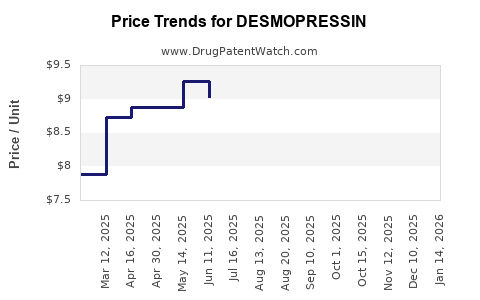
Price Projections
| Formulation |
2022 Avg. Price (per unit) |
Projected 2027 Price (per unit) |
Notes |
| Oral tablets (5-10 mcg) |
~$5 per strip |
$3-6 per strip |
Increased generics reduce price |
| Intranasal spray |
~$15 per spray |
$10-20 per spray |
Slight price stability; affected by competition |
| Injectable (vials) |
~$20-$30 per vial |
$15-$25 per vial |
Price compression from competition and biosimilar entry |
Note: Prices vary by region, dosage strength, and formulation. US and European markets show similar trends but differ in pricing levels due to reimbursement policies.
Competitive and Pricing Trends
- Generics dominate the market, causing price erosion.
- Biosimilars are in early development phases; upcoming entries could further depress prices over the next decade.
- The rise of alternative therapies (e.g., desmopressin analogs, other hemostatic agents) could impact market share.
Key Drivers and Risks
- Increase in diagnosed indications: Expanding use in enuresis, bleeding, and sleep disorders.
- Patent cliffs: Generic entry lowers prices.
- Regulatory challenges: New formulations or delivery methods may face approval hurdles.
- Pricing pressures: Payers seek low-cost options, influencing Medicare/Medicaid reimbursement.
Conclusion
The desmopressin market is mature, with steady growth driven by indications expansion and aging demographics. Price erosion due to generics is expected to continue, with prices decreasing by approximately 20-40% over five years for key formulations. The clinics' preference for oral over nasal or injectable forms influences market dynamics.
Key Takeaways
- The global market size is approximately $1.2 billion, growing at 4-6% annually.
- Oral tablets and intranasal sprays are the primary formulations, with prices declining due to generics.
- Price drops of 20-40% are projected for key formulations through 2027.
- Regulatory and patent developments will shape the landscape, with biosimilars emerging.
- Competition and payer policies pressure prices downward, impacting margins.
FAQs
-
What are the main therapeutic uses of desmopressin?
It treats diabetes insipidus, enuresis (bedwetting), and bleeding disorders such as von Willebrand disease and hemophilia A.
-
How does patent protection influence desmopressin prices?
Patent expirations, mainly between 2013 and 2020, led to increased generic competition, reducing prices significantly.
-
What are the key drivers for market growth?
Improved diagnosis rates, expanded indications, and aging populations.
-
What potential threats could disrupt the market?
Development of biosimilars, new therapeutic alternatives, and regulatory hurdles for new formulations.
-
How do regional differences affect pricing?
US and European markets display similar trends; however, reimbursement policies cause variations in unit prices.
Citations
[1] MarketsandMarkets, "Desmopressin Market by Application and Region," 2022.