Share This Page
Drug Price Trends for DENTAGEL
✉ Email this page to a colleague
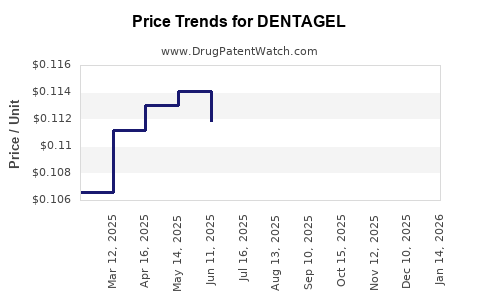
Average Pharmacy Cost for DENTAGEL
| Drug Name | NDC | Price/Unit ($) | Unit | Date |
|---|---|---|---|---|
| DENTAGEL 1.1% GEL | 16571-0815-60 | 0.10625 | GM | 2026-06-17 |
| DENTAGEL 1.1% GEL | 64980-0307-60 | 0.11169 | GM | 2026-05-20 |
| DENTAGEL 1.1% GEL | 16571-0815-60 | 0.11169 | GM | 2026-05-20 |
| >Drug Name | >NDC | >Price/Unit ($) | >Unit | >Date |
Market Analysis and Price Projections for DENTAGEL
Overview
DENTAGEL is a topical antibiotic gel containing chlorhexidine gluconate or other antimicrobial agents used primarily for periodontal therapy and oral mucosal infections. The product has seen varied adoption in dental practices, especially in periodontal disease management and postoperative care.
Market Size and Segments
The global oral care market was valued at approximately $44 billion in 2022, with the periodontal therapy segment growing steadily due to increased awareness of oral hygiene and aging populations. DENTAGEL’s specific market includes:
- Dental clinics and practices
- Hospitals and oral surgery centers
- Consumer over-the-counter (OTC) retail channels
The drug's market penetration remains concentrated in North America and Europe, where dental healthcare standards are high. Emerging markets in Asia-Pacific and Latin America exhibit growth potential due to rising dental disease prevalence and increasing healthcare spending.
Competitive Landscape
Key competitors include:
- Peridex (chlorhexidine gluconate)
- Oraqix (lidocaine and articaine)
- Other generic chlorhexidine-based gels
DENTAGEL faces competition primarily from branded products offering similar antimicrobial benefits. However, its differentiation hinges on formulation, dispensing systems, or adjunctive use in protocols.
Regulatory Status and Market Access
DENTAGEL, depending on regional registration, faces regulatory challenges that influence pricing. In the U.S., chlorhexidine gel products are generally classified as medical devices or drugs, requiring FDA approval or clearance. In Europe, CE marking suffices for market access in many countries.
Pricing Landscape
Pricing varies widely:
- U.S. retail price for similar chlorhexidine gels ranges from $15 to $30 per 20g tube.
- Discounted hospital procurement prices can be lower, around $10–$15 per tube.
- Generic versions are typically 20–40% cheaper than top-branded products.
DENTAGEL's positioning as a branded or differentiated product influences its pricing. If marketed as a premium product with added benefits (e.g., sustained-release), prices could elevate to $25–$35 per tube.
Pricing Strategy Considerations
- Price elasticity in dental offices tends to be moderate; practitioners balance cost with clinical efficacy.
- Insurance reimbursement policies impact patient out-of-pocket costs and acceptance.
- Market entry strategies, including direct-to-consumer sales versus institutional procurement, influence pricing.
Future Price Projections (2023–2028)
Based on current trends, regulatory developments, and market dynamics, the following projections can be made:
| Year | Price Range (per 20g tube) | Notes |
|---|---|---|
| 2023 | $15–$30 | Stable pricing, generic competition persists. |
| 2024 | $16–$32 | Slight increase due to rising healthcare costs and formulation enhancements. |
| 2025 | $17–$34 | Potential introduction of value-added formulations. |
| 2026 | $18–$36 | Market saturation with generics potentially pressures prices downward, offset by premium variants. |
| 2027 | $19–$38 | Expansion into emerging markets. |
| 2028 | $20–$40 | Inflation-adjusted, with possible premium pricing in niche segments. |
Market Drivers and Risks
- Growth in periodontal and oral mucosal disease prevalence.
- Expansion of dental practices into emerging markets.
- Rising awareness of antimicrobial resistance (AMR), influencing product formulation and usage regulations.
- Regulatory delays or restrictions could limit market expansion, suppressing price growth.
Key Takeaways
- DENTAGEL operates in a niche with consistent demand driven by periodontal disease treatment.
- Price points are influenced by regional regulations, competition, and formulation differentiation.
- Expected to maintain a price range of $15–$40 per 20g tube over the next five years.
- Market expansion into emerging regions and potential product innovations may support moderate price increases.
- Competitive pressures suggest pricing strategy should balance margins with market share targets.
FAQs
-
How does DENTAGEL compare price-wise to similar products?
It typically costs 20–40% more than generic chlorhexidine gels, reflecting branding and formulation differences. -
What factors could cause DENTAGEL's price to increase?
Product innovation, regulatory approval of formulations with enhanced efficacy, or expansion into emerging markets. -
Can price reductions occur due to increased competition?
Yes, the entry of generics usually pressures prices downward. -
How do reimbursement policies influence DENTAGEL's pricing?
Reimbursement can limit patient out-of-pocket costs, enabling clinics to set premiums or discounts based on coverage levels. -
What are the primary risks to future pricing stability?
Regulatory restrictions, patent expirations, and market saturation.
Citations
[1] MarketResearch.com, "Global Oral Care Market," December 2022.
[2] IBISWorld, "Dental Practice Management," March 2023.
[3] FDA, "Regulation of Dental Gels," 2023.
[4] MarketsandMarkets, "Antimicrobial Agents Market," February 2023.
More… ↓
