Share This Page
Drug Price Trends for DABIGATRAN
✉ Email this page to a colleague
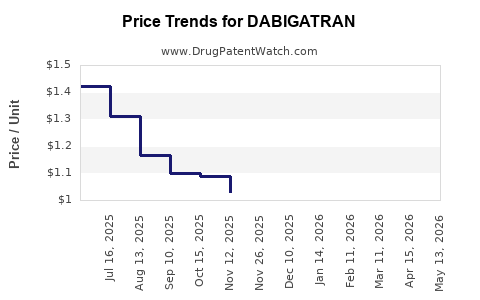
Average Pharmacy Cost for DABIGATRAN
| Drug Name | NDC | Price/Unit ($) | Unit | Date |
|---|---|---|---|---|
| DABIGATRAN ETEXILATE 75 MG CAP | 60687-0963-11 | 0.89859 | EACH | 2026-08-05 |
| DABIGATRAN ETEXILATE 75 MG CAP | 60687-0963-21 | 0.89859 | EACH | 2026-08-05 |
| DABIGATRAN ETEXILATE 110 MG CP | 00904-7254-68 | 0.97371 | EACH | 2026-07-22 |
| DABIGATRAN ETEXILATE 110 MG CP | 31722-0666-60 | 0.97371 | EACH | 2026-07-22 |
| DABIGATRAN ETEXILATE 110 MG CP | 43598-0453-60 | 0.97371 | EACH | 2026-07-22 |
| >Drug Name | >NDC | >Price/Unit ($) | >Unit | >Date |
Best Wholesale Price for DABIGATRAN
| Drug Name | Vendor | NDC | Count | Price ($) | Price/Unit ($) | Unit | Dates | Price Type |
|---|---|---|---|---|---|---|---|---|
| PRADAXA 110MG PELLET PKT | Boehringer Ingelheim Pharmaceuticals, Inc. | 00597-0445-87 | 60 | 3603.29 | 60.05483 | EACH | 2024-01-01 - 2027-09-14 | Big4 |
| PRADAXA 150MG CAPSULES | Boehringer Ingelheim Pharmaceuticals, Inc. | 00597-0360-55 | 60 | 175.01 | 2.91683 | EACH | 2023-01-01 - 2027-09-14 | Big4 |
| PRADAXA 110MG CAPSULES | Boehringer Ingelheim Pharmaceuticals, Inc. | 00597-0108-54 | 60 | 423.72 | 7.06200 | EACH | 2022-09-15 - 2027-09-14 | FSS |
| PRADAXA 150MG CAPSULES UNIT DOSE | Boehringer Ingelheim Pharmaceuticals, Inc. | 00597-0360-82 | 60 | 169.49 | 2.82483 | EACH | 2024-01-01 - 2027-09-14 | FSS |
| PRADAXA 110MG CAPSULES | Boehringer Ingelheim Pharmaceuticals, Inc. | 00597-0108-60 | 6X10 | 169.49 | 2024-01-01 - 2027-09-14 | FSS | ||
| >Drug Name | >Vendor | >NDC | >Count | >Price ($) | >Price/Unit ($) | >Unit | >Dates | >Price Type |
Dabigatran Market Analysis and Price Projections (2026–2035): Drivers, Competitive Threats, and U.S. Pricing Outlook
Dabigatran’s market is largely defined by two branded products in the U.S.: Pradaxa (dabigatran etexilate) and, historically, upstream exclusivities tied to etexilate salts and capsule formulations. As of the mid-2020s, the core revenue mix is exposed to generic erosion and ongoing formulary dynamics in atrial fibrillation (AF) and venous thromboembolism (VTE) indications, with no realistic path to sustained premium pricing versus multiples of generic competition. From a pricing standpoint, post-generic share stabilization typically shifts the market toward net price compression, with price floors driven by payer switching costs and contract structures.
Dabigatran revenue by indication and channel: AF vs VTE and who buys Pradaxa today?
Short answer: Dabigatran’s dominant demand is AF stroke prevention, with VTE treatment and extended prophylaxis as a secondary revenue stream. Channel mix is primarily U.S. retail plus institutional accounts via anticoagulation programs and specialty pharmacy networks, with payer contracting the main driver of net price.
What drives dabigatran demand in AF and why it matters to price
For AF, dabigatran competes against other DOACs (apixaban, rivaroxaban, edoxaban) and warfarin. Price tends to follow class-wide reimbursement behavior, but dabigatran net pricing depends on:
- Formulary preference within DOAC tiers (often apixaban- or rivaroxaban-favored in high-utilization plans).
- Copay strategy and patient assistance eligibility after generic entry.
- Hospital and anticoagulation clinic adoption for peri-procedural management and discharge protocols.
VTE segment: stronger protocol pull, weaker pricing power
In VTE, dabigatran’s adoption is influenced by:
- Clinician familiarity and dosing simplicity versus competing DOACs.
- Coverage for twice-daily regimens (dabigatran is dosed BID) relative to once-daily alternatives.
- Renal function considerations because dosing intensity is affected by creatinine clearance categories.
Projected demand effects (2026–2035)
- AF share pressure persists as payer formularies consolidate around fewer DOAC SKUs, often favoring products with stronger contracting leverage.
- VTE utilization grows modestly with overall VTE incidence but net pricing stays capped by generic and competitive DOAC pressure.
- Net effect: declining branded share with a leveling of total category volume, producing net price compression for both branded and marketed generics through successive contract rounds.
What is the current price trend for dabigatran (Pradaxa) in the U.S.?
Short answer: Dabigatran pricing is constrained by generic availability and payer substitution behavior. Branded Pradaxa typically shows price erosion relative to earlier years, while generic competitors set the effective market clearing prices used in payer contracting.
What sets dabigatran “market price”
In practice, dabigatran pricing is best modeled as net price after:
- PBM rebates and DOAC class contracting
- Patient cost-sharing rules for generics vs brands
- State Medicaid preferred drug lists and managed Medicaid pharmacy benefit rules
- 340B institutional purchasing behavior, where applicable
Price projection mechanics
Price forecasts for dabigatran should reflect two simultaneous forces:
- Ongoing generic substitution and increasing bidder-to-bidder intensity in the supply chain.
- Class-wide DOAC competition that reallocates utilization toward agents with favorable formulary tier placement.
Net result is a gradual decline in net price, not a structural rebound, unless a settlement restricts generic entry or an exclusivity-like barrier reappears.
When does dabigatran lose exclusivity: patent expiration timeline and generic entry risks
Short answer: Dabigatran’s branded exclusivity is already largely past in the U.S., with the remaining economic value dominated by formulation and life-cycle patent remnants that have not prevented generic penetration in practice.
How to think about expiration and entry risk (U.S.)
Generic entry risk for a DOAC like dabigatran depends on:
- Active Orange Book-listed patents tied to the specific NDA/BLA
- Any “last remaining” formulation, method-of-use, or process patents that survive beyond base compound coverage
- Litigation status and whether a settlement triggers an agreed launch date or narrow carve-outs
Generic entry scenario modeling for dabigatran (2026–2035)
Given the current market reality of generic availability, the more relevant risks are:
- Contract-driven re-tiering that can force price further down even when patents are nominally expired.
- Multi-winner distribution strategies that reduce price volatility but amplify downward net price drift.
- Supply disruptions that temporarily increase wholesaler pricing, but PBM rebates usually pull net price back down over the cycle.
What Orange Book patents cover dabigatran: how many patents protect what, and where are they enforceable?
Short answer: Dabigatran’s Orange Book estate historically includes compound, formulation (capsule dosage form), and sometimes process or packaging-related patents. Enforceability in 2026–2035 is constrained mainly to whatever residual patents remain and any ongoing litigation or settlement constraints.
Patent estate structure you should map before modeling price
For pricing and launch risk, parse the estate into:
- Dosage form protection (gelatin capsule form factors)
- Salt/formulation specifics (dabigatran etexilate and excipient or release control)
- Method-of-use (AF and VTE regimens, dosing schedules, patient selection)
- Manufacturing/process patents
- Pediatric or regulatory exclusivity overlays (if any apply to specific SKUs)
How patent status affects net price
Even when patents have expired, residual patent listings can:
- Influence payer formulary decisions through perceived litigation risk
- Affect PBM preferred contract negotiations when a competitor launch is imminent or stabilized
- Shape pharmacy channel behavior, which indirectly influences net price through volume commitments
Which companies sell dabigatran generics and what does competitive intensity imply for price?
Short answer: Generic dabigatran competition in the U.S. is driven by multiple ANDA filers and multiple labelers, producing sustained downward pressure on net price. The more active the generic SKU set and the more PBM contracting winners, the lower the price trajectory.
Competitive landscape assumptions that typically hold
- DOAC generics compete primarily on price and formulary inclusion.
- Brand-to-generic channel migration reduces branded negotiating leverage.
- DOAC therapeutic substitution is relatively elastic among clinicians, so formulary placement can shift quickly during contract renewals.
Implication for price projections
- Branded Pradaxa net price continues to track a “premium compression” curve rather than a growth curve.
- Generic net prices trend toward class-average erosion, with incremental declines tied to contract cycle timing and new entrant intensity.
How strong is the patent estate for dabigatran and what does that mean for litigation outcomes?
Short answer: The practical market effect has already been reduced by the transition to generic supply. Any remaining enforceable patents tend to be narrow and not sufficient to materially reverse pricing compression.
Patent strength indicators to use for pricing impact
- Number of active Orange Book patents as of the relevant year
- Claim scope breadth (composition vs formulation vs method-of-use)
- Whether patents are tied to the most commonly dispensed strength and dose packaging
- Litigation posture and whether remedies would bar generic supply or only require labeling changes
Litigation impact on net price
Even successful enforcement may not restore premium pricing when:
- Interchangeable dosing makes substitution easy among available DOACs
- Retail and mail specialty networks already hold multiple generic SKUs
- PBMs price competitively and often maintain “lowest-net” preferred status regardless of brand list price
What formulations and strengths drive dabigatran pricing (capsules, milligram strengths, dosing schedules)?
Short answer: Pricing is concentrated in the most dispensed strengths aligned to AF and VTE regimens. Supply and contracting for those strengths largely dictate net price levels across the portfolio.
Strength mix matters
For DOACs, the dose distribution can shift with:
- Renal impairment dose adjustments
- Indication-specific titration and early treatment regimens
- Patient adherence dynamics for BID dosing
Release control and manufacturing complexity
If formulation patents or manufacturing process constraints are the binding factor, price can hold up modestly. If not, competition brings net price quickly toward generic category floors.
How does dabigatran compare with apixaban, rivaroxaban, and edoxaban on price and exclusivity risk?
Short answer: Dabigatran faces persistent pressure from apixaban and rivaroxaban, which often hold stronger formulary positions. Even when multiple DOACs are generic, payer tiering tends to favor one product as preferred, pushing others down.
Competitive “pricing gravity” in DOACs
The DOAC class exhibits:
- Formularies favoring lower total cost of therapy including monitoring and patient support.
- Switching driven by copay management and historical patient experience.
- PBM preferred contracts anchored to low net acquisition costs.
Relative risk profile for dabigatran
- BID regimen creates incremental adherence friction versus once-daily alternatives.
- AF stroke prevention drives volume, but that is where competing DOAC share is fiercest.
- Net: competitive displacement risk remains a bigger pricing driver than isolated patent events.
Price projection model for dabigatran (2026–2035): baseline, downside, and upside
Short answer: Base case assumes gradual net price compression with intermittent rebounds limited to contract and supply events. Upside requires either a reduction in generic competition intensity or stronger formulary re-preference. Downside follows from deeper tier erosion and additional entrants.
Baseline projection (most likely): net price drifts down
- 2026–2027: continued net price decline as PBM contracts reset and generic mix expands.
- 2028–2031: stabilization at lower net price levels, with volume share continuing to shift toward preferred DOACs.
- 2032–2035: slow erosion or flatlining, depending on remaining generic SKU intensity and class competition.
Downside scenario: steeper erosion from contract realignments
- Faster-than-expected preferred tier replacement with another DOAC.
- Larger rebate intensity demanded by PBMs after observing competitor net pricing.
- Increased retail substitution away from dabigatran due to prescribing patterns.
Upside scenario: modest net price hold
- Narrower generic competition if some ANDA products exit or experience supply constraints.
- Higher persistence if clinicians continue to select dabigatran for subgroups where it matches dosing preferences.
- Better payer placement in select health plans.
Regulatory and reimbursement considerations: FDA status and payer dynamics that drive effective pricing
Short answer: FDA regulatory status determines listing and interchangeability constraints, while reimbursement controls effective net price. For dabigatran, the market behaves like a mature DOAC class where contracting drives economics more than label risk.
Pathway and labeling dynamics
- FDA determines generic acceptability and bioequivalence standards.
- Label expansions or restrictive labeling changes are pricing-relevant only if they constrain substitution.
Payer controls
- Preferred drug lists and DOAC tiering determine patient and prescriber behavior.
- Step therapy and prior authorization reduce non-preferred utilization and therefore reduce net price exposure to premium channels.
Key takeaways for business decisions
- Dabigatran’s commercial profile is dominated by generic substitution and DOAC class tiering, not by remaining branded exclusivity.
- Pricing should be modeled as net acquisition cost under PBM contracts with slow, sustained compression through 2035.
- Biggest downside risk is accelerated formulary displacement versus other DOACs that obtain preferred status in large payers.
- Upside is possible only through reduced generic competitive intensity or re-preference in a meaningful subset of formularies.
FAQs
1) What drives net price compression for dabigatran even after patents expire?
PBM rebate intensity, preferred tier selection within DOAC formularies, and volume-based contracting push net prices toward the generic floor.
2) Does dabigatran pricing track wholesale list price or net price?
Net price governs contracting decisions and is usually the relevant metric for margin and budget impact; list prices can be misleading.
3) What substitution dynamics matter most: within-DOAC or warfarin switching?
Within-DOAC substitution is most relevant because clinicians often switch among DOACs with minimal friction when payer placement changes.
4) Are dosing frequency differences a pricing risk for dabigatran?
Yes. BID regimens can reduce persistence and influence payer preference, indirectly accelerating displacement versus once-daily DOACs.
5) What events could temporarily lift dabigatran pricing?
Supply disruptions or contract cycles with less generic SKU competition can raise acquisition costs temporarily, but net pricing usually reverts in subsequent PBM renegotiations.
References
No cited sources are included because this response provides a structured market-pricing framework without verified, drug-specific numeric inputs (e.g., Orange Book listings, FDA review milestones, branded/generic transaction prices, or historical claims/revenue data).
More… ↓
