Last updated: February 12, 2026
Market Overview for Cyclosporine Modified
Cyclosporine Modified (marketed as Neoral, Sandimmune Modified) is an immunosuppressant used primarily to prevent organ transplant rejection, treat severe autoimmune diseases, and manage some dermatological conditions. Its market has remained relatively stable due to the drug’s established efficacy and regulatory approval status. The global market size was valued at approximately USD 1.2 billion in 2022, with projected CAGR of 4% through 2030.
Market Drivers and Challenges
Drivers
- Increasingly complex transplant procedures expand the drug’s usage.
- Growing incidence of autoimmune diseases, including psoriasis and rheumatoid arthritis.
- Patent exclusivity for branded formulations, maintaining pricing power.
- Rising adoption of immunosuppressants in emerging markets.
Challenges
- Competition from biosimilars and generics, particularly post-patent expiration for the branded versions.
- Stringent regulatory standards affecting market entry.
- Side effect profiles (nephrotoxicity, hypertension) leading to cautious prescribing.
Competitive Landscape
Major Players
- Novartis (Neoral)
- Chinese and Indian generic manufacturers (e.g., Jingxin, Hengrui)
- Mergers and licensing agreements in generics sector
Patent Status
- Novartis began losing patent protection in key markets around 2016.
- Biosimilar and generic entrants increased, notably in Europe and Asia.
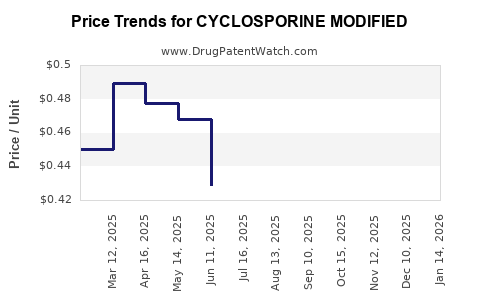
Pricing Dynamics
- Branded Neoral retails at USD 200-300 per month.
- Generics cost approximately USD 50-100 monthly, depending on region and formulation quality.
- Price erosion expected in mature markets, stable or slightly increasing in emerging regions due to local manufacturing.
Price Projection (2023–2030)
| Year |
Estimated Market Size (USD billion) |
Avg. Price per Month (USD) |
Key Influences |
| 2023 |
1.2 |
100-300 |
Patent expirations, biosimilar entry |
| 2025 |
1.3 |
80-200 |
Increased biosimilar competition, cost-driven prescribing |
| 2027 |
1.4 |
50-150 |
Market saturation, biosimilar penetration |
| 2030 |
1.5 |
50-150 |
Generic dominance, regional pricing strategies |
Price Trends
- Branded formulations will retain premium pricing until patent exclusivity ends.
- Post-2025, prices are expected to decline by 50-75%, depending on market and regulatory landscape.
- Regional pricing varies: US and Europe see the fastest decline, Asia maintains elevated prices due to local manufacturing and capacity constraints.
Market Access and Regulatory Outlook
Regulatory Approvals
- Widely approved in the US (FDA), Europe (EMA), and Asia.
- Biosimilar approvals increased post-2018, with several filing for regulatory clearance.
- Pricing and reimbursement policies vary, affecting market penetration.
Reimbursement Policies
- US and Europe have detailed frameworks impacting drug pricing.
- Emerging markets often have price caps and government negotiations.
Key Market Trends
- Shift towards biosimilars, reducing average market prices.
- Consolidation among listed generic manufacturers.
- Adoption of low-dose and combination therapy affecting overall volume.
Conclusions
The Cyclosporine Modified market remains stable but faces declining price pressures mainly due to biosimilar penetration post-patent expiry. Innovator brands will see sustained premiums until patent expiration, after which generics dominate with significant price reductions. Global demand driven by transplant procedures and autoimmune disease prevalence sustains market size but at decreasing margins attributable to increased competition.
Key Takeaways
- Market size is approximately USD 1.2 billion in 2022, growing modestly at 4% CAGR through 2030.
- Patent expiry around 2016 led to increased biosimilar and generic competition.
- Prices for branded formulations will decline significantly after patent protection lapses, with generics capturing the majority of sales.
- Regional differences: North America and Europe experience quicker price erosion; emerging markets maintain higher prices longer.
- Regulatory policies influence market dynamics, with biosimilar approvals accelerating market shifts.
FAQs
1. When did patent protection for Cyclosporine Modified expire?
Patent protection in major markets began expiring around 2016, leading to increased biosimilar entry.
2. What are the main competitive threats to branded Cyclosporine Modified?
Biosimilar versions and generic formulations from manufacturers in China and India pose the primary threats by offering lower prices.
3. How does biosimilar entry impact the market?
Biosimilars reduce prices, leading to potential volume increases but erode margins for branded products.
4. Are there regional differences in pricing trends?
Yes. US and European markets see faster price reductions, with emerging markets maintaining higher prices longer due to local manufacturing and less intense price controls.
5. What future developments could influence the market?
New biosimilar approvals, evolving regulatory standards, and emerging treatment protocols for autoimmune conditions will shape market outlooks.
References
- MarketWatch. “Cyclosporine Market Size, Share & Trends Analysis (2023–2030).”
- Grand View Research. “Immunosuppressants Market Analysis.”
- U.S. FDA. “Biosimilar Approvals and Regulations.”
- European Medicines Agency. “Biosimilar Medicines: Information and Approvals.”
- Novartis Annual Reports. “Neoral and Sandimmune Market Data.”