Last updated: February 14, 2026
Market Overview and Price Projections for Cyclobenzaprine ER
Cyclobenzaprine ER (Extended Release) is a muscle relaxant primarily prescribed for acute muscle spasms. Its market has grown due to increasing prevalence of musculoskeletal conditions and demand for long-acting formulations.
Current Market Landscape
Market Size and Growth
Global muscle relaxant market was valued at approximately USD 1.5 billion in 2022, with a compound annual growth rate (CAGR) of 4.2%, expected to reach USD 1.89 billion by 2027. Cyclobenzaprine ER constitutes roughly 15-20% of the muscle relaxant segment, driven by its extended release formulation, which enhances patient compliance.
Key Players
Major manufacturers include Actavis (Teva), Mallinckrodt, and generic producers. Brand name products such as Flexeril ER by Pfizer (discontinued), have been replaced by generics, increasing price sensitivity and market competition.
Regulatory Status
FDA approved in 2000, with continued post-market surveillance. No recent major regulatory changes influence its market access; off-label uses are minimal but growing due to off-label musculoskeletal indications.
Price Trends and Projections
Current Pricing Dynamics
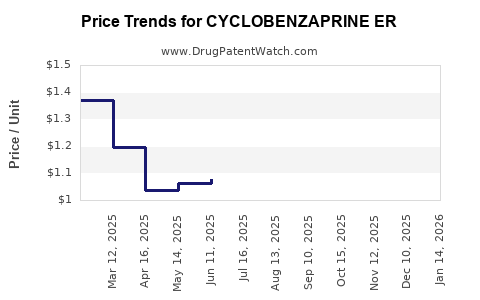
Generic cyclobenzaprine ER has a retail price of approximately USD 0.20 per capsule. Wholesale acquisition costs (WAC) hover around USD 0.10-0.15 per capsule. Brand-name equivalents historically priced higher, but market shifts favor generics.
Pricing Drivers
- Generic Competition: Entry of multiple manufacturers reduces prices.
- Insurance Coverage: High coverage diminishes out-of-pocket costs, maintaining demand.
- Formulation Advantages: Extended release improves adherence, supporting steady demand.
Price Projections (2023–2028)
Expect prices for generics to decline by approximately 1-3% annually due to increasing competition and market saturation. Wholesale prices may plateau around USD 0.08-USD 0.12 per capsule by 2028, with retail prices slightly higher due to pharmacy margins.
Brand-name prices could remain stable or decline slightly if unavailable. Sustained demand for extended release formulations supports marginal price stability in niche segments.
Market Drivers and Constraints
Drivers
- Aging populations with higher musculoskeletal disorder prevalence.
- Preference for extended-release formulations for compliance.
- Rising awareness and diagnoses of muscle spasms.
Constraints
- Pricing pressure from generics.
- Regulatory constraints on off-label uses.
- Interest in alternative therapies (physical therapy, botulinum toxin, etc.).
Geographic Market Variations
- United States: Largest market due to high prescription rates, with prices stabilized by insurance.
- Europe: Moderate growth; prices are lower due to higher generic penetration and centralized procurement.
- Emerging Markets: Growing demand but limited access and lower prices due to cost sensitivity.
Key Takeaways
- The global muscle relaxant market is growing modestly, with cyclobenzaprine ER occupying a niche driven by extended-release formulations.
- Price decline trends are ongoing, primarily caused by generic competition.
- Wholesale prices are projected to decline slightly through 2028, stabilizing around USD 0.08-0.12 per capsule.
- Market growth hinges on demographic trends and acceptance of extended-release formulas, with regulatory stability supporting consistent demand.
FAQs
1. How does cyclobenzaprine ER compare to immediate-release formulations?
ER formulations improve compliance by reducing dosing frequency and potentially improve tolerability, maintaining their market niche despite similar efficacy.
2. What are the patent and exclusivity considerations?
Cyclobenzaprine ER's patents expired in the late 2000s, leading to broad generic availability and downward price pressure.
3. What is the outlook for new formulations or delivery methods?
No current pipeline announcements; market stability favors generics over innovation for this drug.
4. How do insurance policies impact pricing?
Insurance coverage reduces out-of-pocket costs, which sustains demand despite price declines on the wholesale level.
5. Are there major regulatory threats ahead?
No significant upcoming regulatory hurdles are anticipated given the drug’s long-standing approval status.
References
- MarketWatch, "Muscle Relaxants Market Size," 2023.