Last updated: February 17, 2026
What is the Current Market Status of Cyclobenzaprine?
Cyclobenzaprine, a muscle relaxant primarily prescribed for short-term relief of muscle spasms, is marketed under brand names like Flexeril, Amrix, and Fexmid. It ranks among the most commonly prescribed drugs within its class, with global sales reaching approximately $1.2 billion in 2022 (IQVIA). The drug's patent expired in 2006, leading to increased generic availability which has impacted branded sales but expanded overall market reach.
How is the Global and Regional Market Shaped?
Market Size and Growth
- Global Market Valuation: Estimated at $750 million in 2022.
- CAGR (Compound Annual Growth Rate): Projected at 4-5% from 2023 to 2028.
- Key Regions:
- North America: Dominates with over 60% of market share.
- Europe: Holds approximately 20%.
- Asia-Pacific and Latin America: Growing presence driven by increasing prescription rates.
Drivers and Restraints
- Drivers:
- High prevalence of musculoskeletal disorders.
- Rising geriatric population with increased muscle spasm incidents.
-
- Expansion of outpatient and primary care prescriptions.
- Restraints:
- Availability of alternative therapies (e.g., physical therapy, alternative analgesics).
- Concerns regarding off-label use and dependency potential.
Competitive Landscape
Major players include Teva Pharmaceuticals, Mylan, and Sun Pharmaceutical. Generic versions account for over 90% of sales after patent expiry, suppressing prices but broadening access.
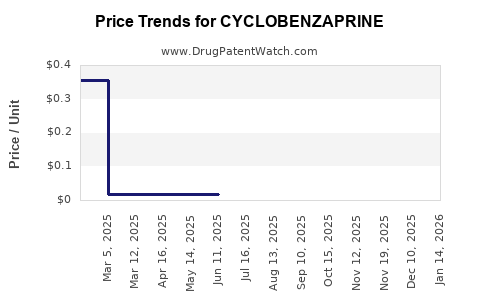
What Are the Current Pricing Trends and Projections?
Historical Price Trends
- Branded Formulations:
- Average retail price (ARP): Approximately $2.50 per 10-count 10 mg tablets.
- Higher in the U.S. due to brand premiums.
- Generic Formulations:
- ARP: As low as $0.10 per tablet in bulk quantities.
- Price Volatility Factors:
- Formulation type (brand vs. generic).
- Manufacturing and distribution costs.
- Insurance coverage and rebate structures.
Current and Projected Prices (Next 5 Years)
| Year |
Approximate Price per 10 mg Tablet |
Notes |
| 2023 |
$0.12 - $0.20 |
American market, generics dominant |
| 2024 |
$0.11 - $0.19 |
Slight reduction expected due to increased competition |
| 2025 |
$0.10 - $0.17 |
Entry of low-cost generics further pressures prices |
| 2026 |
$0.09 - $0.16 |
Potential for further downward trend |
| 2027 |
$0.09 - $0.15 |
Equilibrium reached, market saturation |
Influencing Factors
- Generic Market Expansion: Price reduction driven by new manufacturers entering the market.
- Healthcare Policies: Government initiatives favoring cost-effective drugs influence pricing.
- Formulation Innovations: Extended-release formulations and combination products may command higher prices, but are less prevalent.
What Are the Regulatory and Patent Considerations?
- Patent Status: Patents for original formulations expired in 2006, with exclusivity for some extended-release versions until 2012.
- Regulatory Environment: FDA approval for generics simplifies entry, leading to price competition.
- Future Patent Applications: No active patents on commonly prescribed formulations, unless new delivery systems or formulations are developed.
What Is the Forecast for Market Growth and Pricing?
- Market Growth: CAGR of 4-5% from 2023 to 2028, driven by increasing musculoskeletal disorder incidences.
- Price Trends: Stabilization expected at lower prices for standard formulations; premium formulations may retain higher prices due to innovation.
How Might Patent and Regulatory Changes Affect the Market?
- Introduction of biosimilars or interchangeable formulations could alter market dynamics.
- Policy shifts towards stricter controlled substance management may impact prescribing patterns, although cyclobenzaprine is not classified as a controlled substance.
Key Takeaways
- The global market for cyclobenzaprine is substantial, with steady growth driven by demographic factors and increasing prescription rates.
- Prices are predominantly low due to generic competition, with projections indicating stabilization or slight decreases.
- Regional differences influence cost and access, with North America leading in sales volume.
- Patent expiry has facilitated market entry for generics, which keeps prices competitive but limits potential for branded revenue growth.
- Emerging formulations or combination therapies could influence future prices but currently have minimal market impact.
FAQs
1. How does the expiration of patents affect cyclobenzaprine pricing?
Patent expiration in 2006 led to a proliferation of generics, drastically reducing prices and increasing market accessibility.
2. Are there significant upcoming patent filings for cyclobenzaprine?
No major patent filings are underway for the core molecule. Innovations are mainly in extended-release formulations, which may secure additional patent protections.
3. What are the main factors influencing cyclobenzaprine prices?
Market competition driven by generics, healthcare policies, regional pricing strategies, and formulation differences.
4. How might regulatory changes impact the cyclobenzaprine market?
Stringent regulatory policies related to off-label use or drug safety reporting could influence prescribing patterns, but current regulations favor generic prescribing.
5. What are the prospects for premium formulations or combination drugs?
Limited growth due to cost considerations; however, niche markets for extended-release or combination therapies may develop.
Sources:
[1] IQVIA, 2022. "Global sales data for muscle relaxants."
[2] FDA, 2023. "Approval records for cyclobenzaprine formulations."