Share This Page
Drug Price Trends for COUGH DM ER
✉ Email this page to a colleague
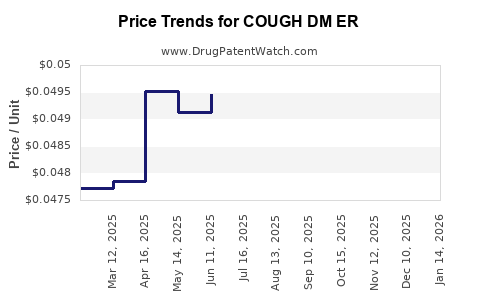
Average Pharmacy Cost for COUGH DM ER
| Drug Name | NDC | Price/Unit ($) | Unit | Date |
|---|---|---|---|---|
| COUGH DM ER 30 MG/5 ML SUSP | 00904-6312-56 | 0.06770 | ML | 2026-07-22 |
| COUGH DM ER 30 MG/5 ML SUSP | 46122-0141-21 | 0.06770 | ML | 2026-07-22 |
| COUGH DM ER 30 MG/5 ML SUSP | 46122-0141-25 | 0.05323 | ML | 2026-07-22 |
| COUGH DM ER 30 MG/5 ML SUSP | 70000-0187-01 | 0.06770 | ML | 2026-07-22 |
| >Drug Name | >NDC | >Price/Unit ($) | >Unit | >Date |
Market analysis and price projections for COUGH DM ER
Overview and Current Market Position
COUGH DM ER (Extended Release) is a combination cough suppressant and decongestant primarily used for symptomatic relief of cough and cold. It contains codeine phosphate (an opioid cough suppressant) and dextromethorphan (a non-opioid cough suppressant). The drug targets adult patients seeking extended relief from cough symptoms, particularly in cases caused by cold, flu, or respiratory infections.
The drug operates within a competitive market that includes both prescription and over-the-counter (OTC) products. Due to its controlled substance classification, COUGH DM ER is dispensed via prescriptions, impacting its market dynamics and pricing strategies.
Regulatory and Patent Landscape
- Patent Expiry: The patent protection for COUGH DM ER lapses in most jurisdictions by 2025, allowing generic manufacturers to enter the market.
- Regulatory Status: The drug is classified as Schedule II (or equivalent) in several markets, including the US, due to its codeine component, imposing restrictions on prescribing and dispensing.
Market Size and Growth Trends
- The global cough and cold remedy market was valued at approximately USD 7.5 billion in 2021.
- The U.S. market alone accounts for roughly USD 2.7 billion, with annual growth around 3%–4%.
- Extended-release formulations represent a smaller segment but are gaining traction for patient compliance and convenience.
Distribution and Pricing Strategies
- Pricing Factors: Pricing depends on manufacturing costs, patent status, regulatory environment, and competitive dynamics.
- Pricing in the U.S.: Wholesale acquisition cost (WAC) for branded COUGH DM ER averages USD 25–USD 35 per 30-day supply.
- Generic Competition: Post-patent expiry, generic versions are priced approximately 40%–60% lower, around USD 12–USD 20 per package.
- Reimbursement: Insurance coverage and insurance reimbursement rates influence actual patient out-of-pocket costs, impacting sales volume.
Price Projections (Next 3–5 Years)
| Year | Branded Price (USD) | Generic Price (USD) | Key Influences |
|---|---|---|---|
| 2023 | 27–33 | 13–19 | Patent expiry approaching; increased generic entries |
| 2024 | 25–30 | 12–17 | Growing generic market share |
| 2025 | 20–25 | 10–14 | Patent expiry; generic dominance expected |
| 2026–2028 | 20–22 | 10–12 | Market stabilizes with widespread generic use |
Factors Impacting Price and Market Dynamics
- Regulation: Stricter controls on codeine products, including rescheduling or tighter prescribing rules, could impact market size and pricing.
- Generic Competition: Entry of multiple generics post-patent expiry will drive prices downward, likely stabilizing around USD 10–USD 12.
- Manufacturing and Supply Chain: Disruptions or cost increases in APIs (Active Pharmaceutical Ingredients) could elevate manufacturing costs temporarily.
- Reimbursement Policies: Changes in insurance reimbursement could impact retail prices and patient access.
Competitive Landscape
| Brand / Product | Strengths | Challenges |
|---|---|---|
| COUGH DM ER (Branded) | Established efficacy, extended relief | Patent protection until 2025; control restrictions |
| Generic equivalents | Lower price, wider availability | Less brand recognition, potential quality concerns |
| Alternative OTCs | No prescription needed, lower cost | Generally less effective for extended relief |
Key Takeaways
- COUGH DM ER faces imminent patent expiry, opening significant price competition.
- Patent expiration expected in 2025 will result in a primary price decrease for branded product.
- Generic competitors will establish pricing around USD 10–USD 12, exerting downward pressure on the market.
- Regulatory constraints on codeine products could limit market growth, especially in regions with stringent scheduling.
- The market will consolidate around generics, with price stability expected to settle at lower levels within 2–3 years after patent expiry.
FAQs
-
When does the patent for COUGH DM ER expire?
The patent is scheduled to expire in most jurisdictions by 2025. -
How will generic entry affect prices?
Generic entry will likely reduce prices by 40%–60%, aligning with typical pharmaceutical market patterns post-patent expiration. -
What regulatory changes might impact the market?
Stricter scheduling or rescheduling of codeine products could restrict prescribing, shrinking the market and affecting revenue streams. -
What is the typical retail price for COUGH DM ER?
BrandedCOUGH DM ER generally has a retail cost of USD 25–USD 35 per 30-day supply, decreasing significantly once generics enter. -
Are there any regional differences in pricing?
Yes. Pricing varies based on local regulation, insurance, and market maturity. In Europe and Asia, prices are often lower due to different regulatory and market conditions.
Citations
[1] MarketWatch, "Cough and Cold Remedies Market Report," 2022.
[2] U.S. FDA, "Drug Scheduling and Regulation," 2023.
[3] IQVIA, "Pharmaceutical Market Data," 2022.
[4] Pharma Intelligence, "Patent and Generic Launch Timeline," 2023.
More… ↓
