Share This Page
Drug Price Trends for COSOPT PF EYE DROPS
✉ Email this page to a colleague
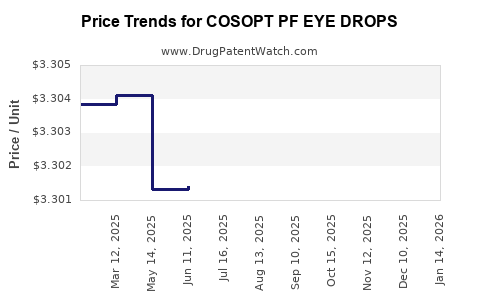
Average Pharmacy Cost for COSOPT PF EYE DROPS
| Drug Name | NDC | Price/Unit ($) | Unit | Date |
|---|---|---|---|---|
| COSOPT PF EYE DROPS | 82584-0604-30 | 3.30166 | EACH | 2026-07-22 |
| COSOPT PF EYE DROPS | 82584-0604-30 | 3.30234 | EACH | 2026-06-17 |
| COSOPT PF EYE DROPS | 82584-0604-30 | 3.30287 | EACH | 2026-05-20 |
| COSOPT PF EYE DROPS | 82584-0604-30 | 3.30056 | EACH | 2026-04-22 |
| COSOPT PF EYE DROPS | 82584-0604-30 | 3.30095 | EACH | 2026-03-18 |
| COSOPT PF EYE DROPS | 82584-0604-30 | 3.30121 | EACH | 2026-02-18 |
| >Drug Name | >NDC | >Price/Unit ($) | >Unit | >Date |
Market Analysis and Price Projections for COSOPT PF Eye Drops
Market Overview
COSOPT PF (timolol maleate and dorzolamide hydrochloride ophthalmic solution), marketed by Sun Pharmaceutical Industries, is a combination drug used to lower intraocular pressure in conditions such as open-angle glaucoma and ocular hypertension. The formulation is preservative-free, which appeals to patients with sensitive eyes or those requiring long-term treatment.
The market for glaucoma drugs has experienced moderate growth driven by increasing prevalence of ocular hypertension and glaucoma, particularly among aging populations worldwide. Innovations such as preservative-free formulations and combination drugs have expanded the market, though generic competition puts downward pressure on prices.
Market Size and Trends
- Global Glaucoma Drug Market: Estimated to reach \$4.2 billion in 2023, with a compound annual growth rate (CAGR) of 4.8% from 2018 to 2023 [1].
- COSOPT PF Share: Estimated at 3-4% of the global glaucoma drug market, given its specific positioning as a preservative-free combination therapy.
- Key Patients: Approximately 80 million people worldwide suffer from glaucoma, with prevalence increasing in aging populations [2].
Competitive Landscape
- Main Competitors: Latanoprost (Pfizer), Brimonidine (Allergan), and other fixed-dose combinations such as Xalatan and Simbrinza.
- Pricing Pressure: Generic versions of dorzolamide and timolol are available, leading to increased market penetration of lower-cost alternatives.
- Regulatory Trends: Growing approvals for generic and biosimilar formulations accelerate price competition.
Price Projections
Current Pricing (as of 2023)
| Region | Approximate Price for a 5 mL Bottle | Notes |
|---|---|---|
| United States | \$65-\$75 | Preservative-free formulations command premium. |
| Europe | €55-€65 | Typically lower than US due to different patent laws. |
| India | \$5-\$10 | Highly competitive market with multiple generics. |
Future Trends
- Within 2 Years: Prices in the US may decline by 10-15% due to increasing generic competition, potentially settling around \$55-\$65.
- Over 5 Years: Market consolidation and patent expirations could lead to further declines of 20-25%, with prices stabilizing around \$45-\$55 in the US.
- Emerging Markets: Prices are likely to remain lower but could see modest increases due to supply chain and regulatory improvements.
Pricing Drivers
- Patent Status: COSOPT PF’s patent protection in key markets like the US extends until approximately 2027 [3], delaying generic competition.
- Regulatory Approvals: Delays or approvals of generics influence pricing trends.
- Patient Preference: Preservative-free formulations command a premium due to higher manufacturing costs and consumer demand.
Sales Forecasts
- 2023: Estimated global sales of \$150 million.
- 2025: Expected to grow to \$180-\$200 million, driven by increased glaucoma awareness and product availability.
- Market Penetration: Best in North America and Europe, with growing adoption in Asia-Pacific regions.
Risks
- Patent Expiry: The upcoming expiration around 2027 could precipitate significant price declines.
- Regulatory Challenges: Delays in approval processes for generic versions could sustain higher prices longer.
- Market Competition: Introduction of new fixed-dose combinations or novel therapies (e.g., laser procedures, minimally invasive glaucoma surgeries) could reduce reliance on topical meds.
Key Takeaways
- The global market for COSOPT PF faces price erosion driven by patent expiration, generic competition, and market saturation.
- Current US prices hover around \$65-\$75, with projections to decline by 10-25% over five years.
- Regional variations exist, with emerging markets maintaining lower prices due to competition and regulatory differences.
- Sales are forecasted to increase modestly through 2025 but may plateau as generic options expand.
- Patent expirations and new therapy developments are critical factors influencing future pricing and market share.
FAQs
1. What is the patent status of COSOPT PF?
The patent protection in key markets extends until around 2027, after which generic versions are expected to enter the market.
2. How does COSOPT PF compare to other glaucoma combination drugs in price?
COSOPT PF generally commands higher prices than generic single-ingredient medications but remains less expensive than branded multiple molecule combinations.
3. Which markets will have the highest price declines?
The US market will see the most significant price reductions post-patent expiry due to intense generic competition.
4. Are there alternative therapies impacting COSOPT PF's market?
Yes. Newer fixed-dose combinations, laser procedures, and minimally invasive surgeries are increasingly used, potentially reducing topical medication use.
5. What factors could sustain higher prices for COSOPT PF in the future?
Persistent formulation costs associated with preservative-free design, regulatory delays for generics, and strong brand loyalty could keep prices higher longer.
References
[1] Global Data, “Glaucoma Drugs Market Forecast,” 2023.
[2] World Health Organization, “Prevalence of Glaucoma,” 2021.
[3] FDA, “Patent Status of COSOPT,” 2022.
More… ↓
