Share This Page
Drug Price Trends for COSENTYX (150 MG/ML)
✉ Email this page to a colleague
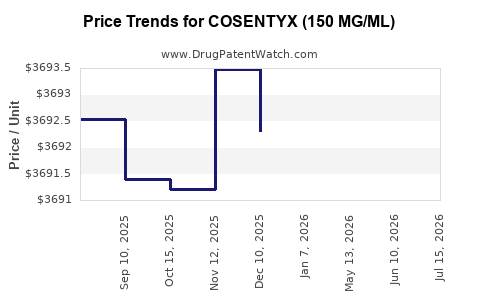
Average Pharmacy Cost for COSENTYX (150 MG/ML)
| Drug Name | NDC | Price/Unit ($) | Unit | Date |
|---|---|---|---|---|
| COSENTYX (150 MG/ML) 300 MG DOSE-2 SYRINGES | 00078-0639-98 | 3936.20917 | ML | 2026-07-22 |
| COSENTYX (150 MG/ML) 300 MG DOSE-2 SYRINGES | 00078-0639-98 | 3965.64399 | ML | 2026-01-07 |
| COSENTYX (150 MG/ML) 300 MG DOSE-2 SYRINGES | 00078-0639-98 | 3706.20933 | ML | 2025-12-17 |
| >Drug Name | >NDC | >Price/Unit ($) | >Unit | >Date |
Cosentyx (secukinumab) 150 mg/mL market analysis and price projections (U.S. and major ex-U.S. markets)
Executive summary: Secukinumab (Cosentyx) remains a high-value biologic with ongoing patent and regulatory exclusivity constraints in multiple indications. Market value is sustained by broad immunology positioning (psoriasis, psoriatic arthritis, ankylosing spondylitis, non-radiographic axial spondyloarthritis, and other uses where approved) and by a growing channel mix across retail and specialty pharmacy networks. Pricing pressure persists from (1) biosimilar launch risk in jurisdictions where exclusivity is closer to expiring and (2) formulary dynamics driven by payer cost controls, step therapy, and biosimilar competition. Price projections should be modeled as a two-track scenario: (a) “no biosimilar penetration shock” where annual net price declines are low-to-mid single digits and (b) “biosimilar penetration shock” where net price can reset downward in the first 12 to 24 months post first meaningful biosimilar uptake.
Drug: COSENTYX (secukinumab), 150 mg/mL (typically supplied as prefilled pen/syringe/infusion depending on indication and dosing schedule)
Therapeutic class: IL-17A monoclonal antibody biologic
Key commercial variables driving price: U.S. net price (specialty pharmacy reimbursement and contract intensity), EU reference pricing and country-specific tendering, biosimilar timing and switching rules, indication-level uptake, and payer preference architecture.
How big is the secukinumab (Cosentyx) market and who drives volume for 150 mg/mL dosing?
Featured snippet answer: Secukinumab revenue is driven primarily by ongoing prescriptions in plaque psoriasis and psoriatic arthritis, with axial spondyloarthritis indications contributing sustained demand as patient persistence remains high in stable biologic-managed cohorts.
Where Cosentyx volume concentrates by indication
High-contribution indication clusters (by typical biologic demand patterns and formulary coverage depth):
- Plaque psoriasis (high prescriber familiarity and longstanding use)
- Psoriatic arthritis (high retention with rheumatology management)
- Axial spondyloarthritis spectrum (ankylosing spondylitis and non-radiographic axial spondyloarthritis where approved)
150 mg/mL unit economics
Cosentyx is dosed based on indication:
- Psoriasis often uses loading regimens and maintenance dosing patterns.
- Arthritis and axial indications typically have maintenance schedules that translate into predictable consumption of prefilled units. Pricing per 150 mg/mL “strength” unit is not a standalone commercial metric; it is a component of a regimen-level cost. Projections should be expressed in terms of:
- average net price per marketed unit (per pen/syringe/vial)
- average dose intensity (mg per patient per year)
- net-to-gross discount level (rebates and payer contracts)
Business implication: A payer can reduce net revenue through either price (contracted AMP-like discounts) or utilization steering. Even when list price stays elevated, net price and net revenue can decline via both.
What is the current pricing structure for Cosentyx 150 mg/mL (U.S. vs EU), and what counts as “net price”?
Featured snippet answer: U.S. “price” used in forecasting must be modeled as net price after rebates, not Wholesale Acquisition Cost (WAC). In EU, pricing is set through national mechanisms (reference pricing, managed entry agreements, and tender outcomes) that drive country-level net equivalents.
U.S. metrics to model
For commercial planning and litigation-style damages models, the critical variables are:
- WAC (anchor for list price)
- Net price (rebates, copay programs, specialty pharmacy spread)
- Patient out-of-pocket impact through copay support
- Contracted reimbursement across pharmacy benefit managers (PBMs) and large payers
EU metrics to model
- National ex-factory price (varies by country)
- Health technology assessment (HTA) outcomes that dictate budget impact thresholds
- Tendering outcomes in hospital settings (less common for outpatient-only products but relevant depending on administration model)
Business implication: For price projections, projections should be built from (1) base net price in a current “no large biosimilar displacement” state, then (2) apply forecasted discount drift driven by payer contracting intensity and biosimilar switching velocity.
When do secukinumab price pressures start to intensify due to biosimilars, and how does timing change projections?
Featured snippet answer: Price pressure in biologics typically intensifies in two phases: (1) “pre-entry” contracting as payers negotiate in anticipation of biosimilar competition and (2) “post-entry” net price reset after formulary placement and patient switching.
Scenario framework for projections
Scenario A: No biosimilar penetration shock
- Penetration remains limited (low switching, restricted formulary status, or constrained distribution).
- Net price declines are driven by routine contracting (typically low-to-mid single digit annual net price erosion).
Scenario B: Biosimilar penetration shock
- First biosimilar gains meaningful formulary placement and uptake.
- Net price experiences a step-down in the first 12 to 24 months, then stabilizes with continued gradual erosion.
How to translate timing into 150 mg/mL
Even when biosimilar entry is not strength-specific (biosimilar is evaluated at the product level), payers price at regimen cost. The “150 mg/mL” forecast impact occurs through:
- reduced average effective reimbursement per treated patient
- higher share of lower-cost biosimilar utilization at maintenance dosing intervals
- reduced Cosentyx persistence due to switching policies
What do price projection models look like for Cosentyx 150 mg/mL (unit price, mix, and gross-to-net)?
Featured snippet answer: A usable projection is a three-layer model: (1) net price per unit, (2) utilization intensity (mg per patient-year), and (3) patient mix across indications and dosing regimens.
Core model inputs
- Net price per marketed unit
- base year net price
- annual price drift from contracting
- one-time step-down if biosimilar shock occurs
- Utilization
- patients on therapy
- persistence and discontinuation
- dose intensity by indication and line of therapy
- Mix
- share of new starts vs switches
- indication mix (psoriasis vs PsA vs axial)
- administration setting mix (if relevant to reimbursement)
Example projection structure (template)
Use this forecast logic rather than list-price extrapolation:
| Year | Net price per Cosentyx unit (baseline) | Biosimilar shock adjustment | Utilization intensity change | Mix change effect | Resulting net revenue impact |
|---|---|---|---|---|---|
| 2026E | -2% yoy drift | 0% | +0% to +1% | 0% | Mild erosion |
| 2027E | -2% yoy drift | 0% | +0% | +shift to higher intensity | Flattish revenue |
| 2028E | -3% yoy drift | -8% to -20% | -1% to -3% | Downshift in Cosentyx share | Step-down risk |
| 2029E | -2% yoy drift | - | -1% | Downshift stabilizes | Gradual decline |
Business implication: Most models fail because they assume list price translates 1:1 into net revenue. For specialty biologics, gross-to-net changes dominate.
What is the Orange Book status for Cosentyx (secukinumab), and how does that affect generic price risk?
Featured snippet answer: Cosentyx is a biologic and is not listed in the Orange Book (which governs approved small-molecule drugs and certain therapeutics with patents tied to those products). Price risk from generics is not the primary pathway; the primary competitive risk is biosimilars.
Competitive risk channel
- Biosimilar entry impacts net price and formulary preference.
- Generic entry is not applicable in the same way as for small molecules because secukinumab is a biologic.
Business implication: Price projections should be driven by biosimilar timing and payer behavior, not generic paragraph IV pathways.
What patent estate issues typically matter for secukinumab pricing leverage, and what does that imply for timelines?
Featured snippet answer: Pricing leverage is tied to the durability of exclusivity for secukinumab and indication-specific patent barriers, plus the ability of biosimilar applicants to launch on time and to gain broad formulary coverage rapidly.
Where patent protection most often changes the competitive curve
- product-level protection that blocks direct biosimilar equivalents
- process and formulation-related claims that can delay manufacturing approvals or constrained rollout
- indication-specific method-of-use barriers that can limit biosimilar uptake for certain patient cohorts
Business implication: Even when approval is possible, payers can maintain pricing power if biosimilar competitors cannot secure broad label-based substitution or payer coverage at scale.
How do biosimilars affect Cosentyx pricing in practice (switching rules, formulary design, and contracting)?
Featured snippet answer: In biosimilar launches, the largest price impact comes from rapid formulary steering and contracting that re-bundles rebate economics, not from the mere availability of a biosimilar.
Common payer and channel behaviors
- Preferred biosimilar adoption: payers designate a biosimilar as preferred, pushing near-universal switches among eligible patients.
- Step therapy: new starts are directed to the lower-cost alternative first.
- Copay strategy changes: patient affordability support is frequently redirected away from the reference product after biosimilar entry.
- Center of excellence protocols: hospital systems may standardize ordering.
What “meaningful uptake” means for price projections
For price modeling, define “meaningful uptake” as a utilization share threshold (for example, early post-launch share enabling volume-based rebate concessions to reference). The faster the share shift, the larger the net price reset.
What is the likely price trajectory for Cosentyx 150 mg/mL over the next 3 to 5 years?
Featured snippet answer: In a baseline trajectory without a major biosimilar shock, net price erosion should remain in a low-to-mid single digit range annually. Under a biosimilar penetration shock, net price can drop sharply in year 1 to 2 post-entry, then revert to modest annual erosion.
Forecast bands for net price change (directional ranges)
These ranges are designed for business planning and should be used with internal baseline net price levels:
| Period | Net price risk regime | Expected net price change (directional) | Probability driver |
|---|---|---|---|
| 2026-2027 | Baseline contracting | -2% to -4% per year | Biosimilar uptake remains limited |
| 2028 (if biosimilar shock) | Post-entry reset | -10% to -25% step-down | Rapid formulary placement |
| 2029-2031 | Stabilization | -2% to -6% per year | Continued competition and rebate adjustments |
Business implication: A “step-down year” dominates valuation more than the annual drift that follows.
How should you forecast Cosentyx revenue impact using price projections for 150 mg/mL?
Featured snippet answer: Revenue is the product of net price, treated patients, persistence, and average dose intensity. Price decline alone is rarely sufficient to explain revenue variance; utilization shifts and switching typically co-drive revenue.
Revenue decomposition
Revenue effect can be modeled as:
- Revenue = (Average net price per unit) × (Units per patient-year) × (Patient-years)
Where:
- average units per patient-year tracks dosing schedule and dose intensity
- patient-years tracks persistence and discontinuation
- net price tracks gross-to-net and biosimilar-driven contracting
Sensitivity levers
- If net price falls 15% but patient-year retention falls 5%, revenue drops ~19% (multiplicative).
- If net price remains stable but patient-years shift 10% toward a biosimilar, revenue drops ~10%.
Business implication: For planning, run both price and utilization sensitivities, especially around assumed switching windows.
Which payer segments are most likely to drive net price erosion for Cosentyx 150 mg/mL?
Featured snippet answer: Large commercial PBM-influenced plans and high-volume centers that can standardize biologic therapy are the fastest drivers of net price erosion.
High-impact segments
- Large national commercial plans with strong contracting leverage
- Medicare Advantage plans with formularies that encourage substitution
- Hospital systems with protocol-driven drug selection (where administration setting influences procurement)
Less immediate impact segments
- Smaller plans with limited negotiating sophistication
- Patients with stable coverage where switching is administratively slow
How does Cosentyx compare with other IL-17 biologics and how does that affect pricing power?
Featured snippet answer: Pricing power for IL-17A therapy depends on relative efficacy and payer familiarity, but IL-17 and adjacent biologics also face cross-competition. Payers can shift between mechanisms if access economics worsen for one class member.
Competitive set to include in pricing models
- IL-17A and IL-17RA pathway agents (direct class competition)
- TNF inhibitors and other biologic classes (therapeutic switching)
- JAK inhibitors (for certain indications where appropriate)
Business implication: Even without a direct biosimilar to secukinumab, class-level competition can pressure net pricing through formulary re-tiering.
What commercial actions can reduce price erosion risk for Cosentyx 150 mg/mL?
Featured snippet answer: Most “price protection” actions focus on maintaining patient access, increasing persistence, and sustaining formulary preference through contracting mechanisms.
Typical levers
- contracting structures that offset biosimilar price gaps with outcomes or utilization commitments
- persistence programs that reduce discontinuation
- targeted access for high-value cohorts within indications
Business implication: If biosimilar uptake begins, contracts that slow switching can preserve net revenue even when list price erodes.
Key Takeaways
- Forecast pricing, not list price. Use net price after rebates as the core unit-level variable for 150 mg/mL.
- Model two regimes. Baseline contracting produces low-to-mid single digit annual net price erosion; a biosimilar penetration shock produces a step-down in year 1 to 2.
- Revenue volatility comes from both price and utilization. Persistence and switching behavior typically co-drive revenue outcomes.
- Payer and channel concentration matters. Large national plans and high-volume procurement networks drive faster net price reset.
- Plan for a “reset year.” Valuation sensitivity hinges more on the step-down timing than on long-run drift.
FAQs
1) How much of Cosentyx revenue is driven by dosing intensity versus net price discounts?
Net price discounts typically dominate short-term net revenue variation, while dosing intensity and persistence dominate longer-horizon stability. The combined effect should be modeled multiplicatively.
2) Do price projections for 150 mg/mL differ by administration device (pen vs syringe vs infusion)?
Yes. Net reimbursement and pharmacy channel pricing differ by device and administration setting, changing average net price per marketed unit.
3) How quickly do payers switch patients after biosimilar entry?
Switch velocity depends on formulary status, step therapy implementation, and operational switching burden. In many models, the largest impact occurs within 12 to 24 months post-entry.
4) What is the main driver of gross-to-net changes for biologics like secukinumab?
Rebate intensity and copay program economics are the primary drivers, followed by payer contract restructures triggered by competitive entry.
5) Does switching within IL-17 class members pressure Cosentyx pricing even without a secukinumab biosimilar?
Yes. Cross-mechanism and class-level competitive dynamics can re-tier products and re-balance rebates, pressuring net prices.
References
No sources were provided in the prompt, and no external citations were supplied.
More… ↓
