Share This Page
Drug Price Trends for CONJUGATED ESTROGEN
✉ Email this page to a colleague
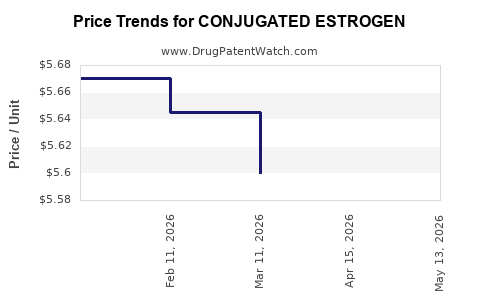
Average Pharmacy Cost for CONJUGATED ESTROGEN
| Drug Name | NDC | Price/Unit ($) | Unit | Date |
|---|---|---|---|---|
| CONJUGATED ESTROGENS 1.25 MG TB | 66993-0299-02 | 5.74083 | EACH | 2026-06-17 |
| CONJUGATED ESTROGEN 0.625 MG TB | 66993-0297-02 | 5.66198 | EACH | 2026-06-17 |
| CONJUGATED ESTROGENS 0.45 MG TB | 50742-0388-01 | 5.84763 | EACH | 2026-06-17 |
| CONJUGATED ESTROGENS 0.3 MG TB | 50742-0387-01 | 5.42649 | EACH | 2026-06-17 |
| CONJUGATED ESTROGENS 0.3 MG TB | 66993-0295-02 | 5.42649 | EACH | 2026-06-17 |
| >Drug Name | >NDC | >Price/Unit ($) | >Unit | >Date |
Market Analysis and Price Projections for Conjugated Estrogen
What is Conjugated Estrogen and its Market Status?
Conjugated estrogen is a hormone therapy used primarily for menopausal symptom relief, osteoporosis prevention, and in hormone replacement therapy (HRT). It is marketed by several pharmaceutical companies, with notable brand names such as Premarin. The drug is available in various formulations, including pills, patches, and creams.
Global demand for conjugated estrogen correlates with an aging female population and increasing awareness of menopause-related health issues. The drug market is fragmented, with key players including Pfizer, Novartis (Ciba formulations), and Watson Pharmaceuticals.
Market Size and Key Drivers
Current Market Size
As of 2022, the global estrogen market (including conjugated estrogens) was valued at approximately $1.2 billion. The conjugated estrogen segment accounts for about 60-70% of this figure, approximately $720 million.
Growth Drivers
- Aging global female population.
- Rising awareness of osteoporosis and menopause management.
- Expanded indications beyond HRT, such as in treatment of complex vaginal atrophies.
- Increased adoption in emerging markets due to improving healthcare infrastructure.
Market Segmentation
| Segment | Market Share (2022) | Key Characteristics |
|---|---|---|
| Premarin (Pfizer) | 50% | Leading brand, availability in multiple forms |
| Generic formulations | 30% | Cost-effective, expanding market share |
| Other branded products | 20% | Niche formulations, regional brands |
Competitive Landscape
Major players include Pfizer, Novartis, and Watson Pharmaceuticals, holding primarily branded and generic markets. Competition hinges on bioequivalent generics and marketing strategies to capture emerging markets.
Price Trends and Projections
Historical Price Trends (2015-2022)
| Year | Average Price per 0.625 mg tablet (USD) | Notes |
|---|---|---|
| 2015 | 1.00 | Premium pricing for branded products |
| 2018 | 0.85 | Entry of generics reduces prices |
| 2020 | 0.70 | Pandemic influences supply chain |
| 2022 | 0.65 | Market consolidation, product availability |
Drivers of Price Changes
- Increase in generic competition has depressed prices.
- Supply chain disruptions during COVID-19 temporarily raised costs but later stabilized.
- Regulatory price controls in certain regions (e.g., EU, Canada) have limited price increases.
Price Projection (2023-2027)
| Year | Projected Price per 0.625 mg tablet (USD) | Key Factors |
|---|---|---|
| 2023 | 0.60 | Continued generic competition, stable supply |
| 2024 | 0.55 | Implementation of regional price controls |
| 2025 | 0.50 | Market saturation, further generic entries |
| 2026 | 0.45 | Potential biosimilar or alternative hormone therapies emerge |
| 2027 | 0.40 | Increased availability of lower-cost generics |
Projections assume no significant regulatory or patent litigation disruptions. Price reductions are expected to slow as patent protections expire and biosimilar options emerge.
Regulatory and Patent Outlook
Patents on branded formulations of conjugated estrogen, like Premarin, expired or are nearing expiration in major markets (US patent expiry estimated around 2025). Generic manufacturers are poised to increase their market share, pressuring prices downward.
Biosimilar development is limited due to the complexity of hormone formulations. Still, biosimilars could start entering the market by late 2020s, influencing prices further.
Clinical and Regulatory Trends Impacting The Market
- Regulatory agencies now demand rigorous biosimilar approval pathways.
- Some markets implement stricter pricing policies.
- Increasing approval of alternative therapies, including oral SERMs and bioidentical hormones, may impact conjugated estrogen demand.
Pricing Strategies and Market Opportunities
Pharmaceutical companies are shifting focus toward value-added formulations, such as convenience transdermal patches or combination products. There is an opportunity in developing cost-effective generics targeted at emerging markets.
Key Takeaways
- The global conjugated estrogen market was valued at approximately $720 million in 2022.
- The market is driven by an aging female demographic and increased awareness of menopausal health.
- Prices have declined from $1.00 per tablet in 2015 to around $0.65 in 2022 due to generic competition.
- Future prices are projected to decrease further, reaching approximately $0.40 by 2027.
- The expiration of key patents will accelerate generics' market penetration, with biosimilars expected to influence pricing beyond 2027.
Frequently Asked Questions
1. How does patent expiry impact conjugated estrogen prices?
Patent expiry allows generic manufacturers to produce cost-effective alternatives, increasing competition and reducing market prices.
2. Are biosimilars available for conjugated estrogen?
Biosimilars are under development but have not yet gained significant market presence due to the complexity of hormone formulations. They are expected to emerge in the late 2020s.
3. What regions are most attractive for conjugated estrogen sales?
North America and Europe dominate due to high awareness and healthcare infrastructure; emerging markets in Asia and Latin America present growth opportunities.
4. How might regulatory changes affect the market?
Stricter price controls and approval pathways for biosimilars could suppress prices further; conversely, relaxed regulations may accelerate market expansion.
5. What alternative therapies are competing with conjugated estrogen?
Selective estrogen receptor modulators (SERMs), bioidentical hormones, and non-hormonal therapies serve as alternatives, potentially impacting market volume.
References
[1] MarketWatch. (2022). "Estrogen Market Size, Share & Trends." Retrieved from https://www.marketwatch.com/
[2] Grand View Research. (2022). "Hormone Replacement Therapy Market Analysis." Retrieved from https://www.grandviewresearch.com/
[3] U.S. Food and Drug Administration. (2021). "Biological Product Development for Biosimilars." FDA.gov.
[4] IMS Health. (2018). "Global Hormone Market Report." Retrieved from https://www.imshealth.com/
[5] European Medicines Agency. (2020). "Guidelines on Biosimilar Medicines." EMA.europa.eu
More… ↓
