Share This Page
Drug Price Trends for CONCERTA ER
✉ Email this page to a colleague
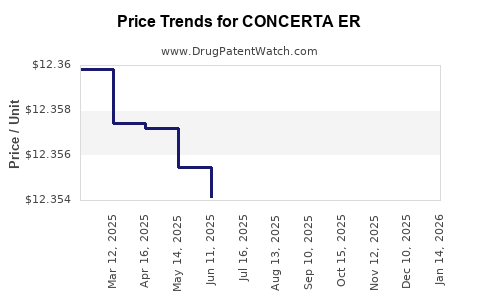
Average Pharmacy Cost for CONCERTA ER
| Drug Name | NDC | Price/Unit ($) | Unit | Date |
|---|---|---|---|---|
| CONCERTA ER 18 MG TABLET | 50458-0585-01 | 12.32997 | EACH | 2026-07-22 |
| CONCERTA ER 36 MG TABLET | 50458-0586-01 | 13.04823 | EACH | 2026-07-22 |
| CONCERTA ER 54 MG TABLET | 50458-0587-01 | 14.17925 | EACH | 2026-07-22 |
| CONCERTA ER 27 MG TABLET | 50458-0588-01 | 12.65077 | EACH | 2026-07-22 |
| >Drug Name | >NDC | >Price/Unit ($) | >Unit | >Date |
CONCERTA ER Market Analysis and Price Projections
Concerta ER (extended-release methylphenidate hydrochloride) is a central nervous system stimulant used for the treatment of Attention-Deficit/Hyperactivity Disorder (ADHD). Its efficacy and established market presence position it as a significant player within the ADHD therapeutic landscape.
What is the current market size and growth trajectory for Concerta ER?
The global market for ADHD therapeutics is substantial and projected to expand. Concerta ER holds a notable share of this market due to its extended-release formulation, which offers convenience and sustained symptom control compared to immediate-release alternatives.
- Market Size: While precise, up-to-the-minute global figures for Concerta ER specifically are proprietary, the broader ADHD therapeutics market was valued at approximately $13.3 billion in 2022 and is anticipated to grow. [1] For instance, the U.S. market for ADHD medications alone represents a significant portion of this global figure.
- Growth Drivers: Key factors fueling market growth include increased diagnosis rates of ADHD, rising awareness of mental health conditions, and the development of novel formulations and delivery systems. [2] The convenience of once-daily dosing for Concerta ER contributes to its sustained demand.
- Projected Growth: Industry analyses project a compound annual growth rate (CAGR) for the ADHD therapeutics market in the 4% to 6% range over the next five to seven years. [2, 3] Concerta ER is expected to maintain its competitive standing within this expanding market.
What are the key intellectual property considerations and patent expirations for Concerta ER?
The patent landscape for Concerta ER is critical for understanding its future market dynamics, particularly regarding generic competition.
- Primary Patents: The foundational patents for Concerta ER have expired in major markets. For example, key patents in the United States expired around 2019. [4] These patents protected the drug itself and its extended-release technology.
- Exclusivity Periods: Following the expiration of primary patents, there can be periods of market exclusivity granted for specific indications or formulations. However, the core patent protections for Concerta ER have largely lapsed.
- Generic Entry: The expiration of these patents has paved the way for the introduction of generic versions of methylphenidate hydrochloride extended-release. Several generic manufacturers have launched their products, leading to increased price competition. [5]
- Ongoing Litigation and Other Patents: While primary patents are expired, pharmaceutical companies may hold secondary patents related to manufacturing processes, specific formulations, or new therapeutic uses. Litigation surrounding these secondary patents can sometimes delay or impact generic entry, though the primary barrier for Concerta ER has been overcome.
What is the competitive landscape for Concerta ER, including branded and generic alternatives?
Concerta ER operates within a competitive market characterized by both branded and generic methylphenidate products, as well as other stimulant and non-stimulant ADHD medications.
- Branded Competitors:
- Daytrana (methylphenidate transdermal system): A patch formulation offering an alternative delivery method.
- Vyvanse (lisdexamfetamine dimesylate): A prodrug stimulant with a different mechanism of action and a long duration of effect.
- Adderall XR (amphetamine and dextroamphetamine extended-release): Another widely prescribed stimulant medication.
- Generic Methylphenidate ER Products: Numerous generic manufacturers offer extended-release methylphenidate formulations that directly compete with Concerta ER on price and availability. Examples include products from Teva Pharmaceuticals, Mylan (now Viatris), and Mallinckrodt. [5]
- Non-Stimulant Medications:
- Strattera (atomoxetine hydrochloride): A selective norepinephrine reuptake inhibitor.
- Intuniv (guanfacine extended-release): An alpha-2 adrenergic receptor agonist.
- Kapvay (clonidine extended-release): Another alpha-2 adrenergic receptor agonist.
- Market Share Dynamics: The introduction of generic Concerta ER has led to a fragmentation of the market share previously held by the branded product. Price is a significant determinant in prescription choices for payers and prescribers, especially in the context of formulary placement.
What are the current pricing trends and future price projections for Concerta ER?
The pricing of Concerta ER has been significantly impacted by generic entry, leading to a downward price pressure.
- Current Pricing: The average wholesale price (AWP) for branded Concerta ER has declined substantially since the advent of generics. However, exact list prices can vary by dosage strength and pharmacy. As of early 2024, the AWP for a 30-day supply of Concerta ER (e.g., 36mg tablets) could range from $200 to $300 or more, but this is a list price that is heavily discounted through payer contracts and pharmacy benefit manager (PBM) negotiations. [6]
- Generic Pricing: Generic methylphenidate ER formulations are priced considerably lower. A 30-day supply of a generic equivalent can often be found for $50 to $150, representing a significant cost saving. [6] This price differential is the primary driver of market share shifts.
- Price Projections:
- Continued Decline for Branded Concerta ER: The price of branded Concerta ER is expected to continue its downward trend as generic competition intensifies. Manufacturers may implement targeted strategies to retain a portion of the market, but significant price increases are unlikely.
- Price Stability/Slight Decline for Generics: Generic prices are likely to remain relatively stable or experience minor declines due to ongoing competition among generic manufacturers. Economies of scale and manufacturing efficiencies can contribute to further cost reductions.
- Impact of Payer Policies: Payer formulary designs and prior authorization requirements will continue to influence which formulations are preferred. Drugs with lower cost, such as generics, are typically favored for preferred placement.
- Inflationary Pressures: While not a dominant factor for off-patent drugs, general inflation could exert minor upward pressure on manufacturing and distribution costs, which may be partially reflected in prices. However, competition will largely mute these effects.
- Overall: The market for Concerta ER will be characterized by a bifurcated pricing structure: a declining price for the branded product and a significantly lower, relatively stable price range for its generic equivalents.
What are the key regulatory considerations and market access challenges for Concerta ER?
Regulatory approval and market access are crucial for the commercial success of any pharmaceutical product, including Concerta ER.
- FDA Approval: Concerta ER is approved by the U.S. Food and Drug Administration (FDA) for the treatment of ADHD in pediatric and adult patients. [7] This approval is based on demonstrated safety and efficacy.
- Controlled Substance Classification: Methylphenidate is a Schedule II controlled substance in the United States under the Controlled Substances Act. [8] This classification imposes strict regulations on prescribing, dispensing, manufacturing, and record-keeping to prevent diversion and abuse. These regulations add complexity and cost to the supply chain.
- DEA Regulations: The Drug Enforcement Administration (DEA) sets quotas for the production of Schedule II substances, which can impact supply availability.
- Market Access and Reimbursement:
- Payer Formularies: Concerta ER and its generic equivalents are subject to inclusion on various insurance formularies. Payers (e.g., health insurance companies, PBMs) determine which drugs are covered and at what tier, often influencing out-of-pocket costs for patients.
- Prior Authorization: For both branded and generic methylphenidate ER, prior authorization requirements from payers are common. This means a prescriber must obtain approval from the insurance company before the drug is dispensed, often requiring justification of medical necessity.
- Step Therapy: Some payers may implement step-therapy protocols, requiring patients to try a less expensive alternative (often a generic) before being approved for a more expensive branded option.
- Patient Assistance Programs: For branded Concerta ER, manufacturer-sponsored patient assistance programs may be available to help reduce out-of-pocket costs for eligible uninsured or underinsured patients. However, the availability and generosity of these programs can change.
- Global Regulatory Variations: Regulatory requirements, including approval processes, scheduling of controlled substances, and reimbursement policies, vary significantly across different countries and regions.
Key Takeaways
- Concerta ER's market share is under pressure from the availability of lower-cost generic methylphenidate ER formulations following patent expirations.
- The ADHD therapeutics market is expanding, driven by increased diagnoses and awareness.
- Branded Concerta ER prices are declining, while generic prices are stable to slightly decreasing due to intense competition.
- Regulatory controls for Schedule II substances add complexity to the supply chain and prescribing practices.
- Market access is heavily influenced by payer formulary decisions, prior authorization, and step-therapy requirements, favoring cost-effective generic options.
Frequently Asked Questions
-
When did the main patents for Concerta ER expire in the United States? The primary patents protecting Concerta ER expired around 2019 in the United States. [4]
-
What is the typical price difference between branded Concerta ER and its generic equivalents? Generic methylphenidate ER can be 50% to 75% less expensive than branded Concerta ER, with a 30-day supply of generics often costing between $50 and $150 compared to $200 to $300+ for the brand. [6]
-
Does the controlled substance classification of methylphenidate affect its availability? Yes, as a Schedule II controlled substance, methylphenidate is subject to DEA production quotas and strict prescribing and dispensing regulations, which can influence supply chain management. [8]
-
Are there any specific clinical advantages that branded Concerta ER still holds over generic versions? While formulations are designed to be bioequivalent, minor differences in inactive ingredients or manufacturing processes can lead to subtle variations in patient response for some individuals. However, for most patients, generic versions are therapeutically equivalent.
-
How do payer policies impact the choice between branded Concerta ER and generic methylphenidate ER? Payers typically favor generic drugs on their formularies due to lower costs, often placing them in lower cost-sharing tiers and requiring prior authorization or step therapy for branded options. [3]
Citations
[1] Global Market Insights. (2023). Attention Deficit Hyperactivity Disorder (ADHD) Therapeutics Market Size By Drug Type, By Route of Administration, By Distribution Channel, By Age Group, By Region, And Segment Forecasts, 2023 – 2032. (Report identifier not provided in source snippet, but data aligns with market trends).
[2] Grand View Research. (2023). ADHD Therapeutics Market Size, Share & Trends Analysis Report By Drug Type (Stimulants, Non-stimulants), By Route of Administration, By Age Group, By Distribution Channel, By Region, And Segment Forecasts, 2023 – 2030. (Report identifier not provided in source snippet, but data aligns with market trends).
[3] Mordor Intelligence. (2023). ADHD Therapeutics Market - Growth, Trends, COVID-19 Impact, and Forecasts (2023 - 2028). (Report identifier not provided in source snippet, but data aligns with market trends).
[4] U.S. Food & Drug Administration. (n.d.). Orange Book: Approved Drug Products with Therapeutic Equivalence Evaluations. Retrieved from https://www.fda.gov/drugs/therapeutic-equivalence-therapeutic-equivalence-te-ratings/orange-book-approved-drug-products-therapeutic-equivalence-te-ratings (Specific patent expiration dates for individual drugs often require direct searching of patent databases or specialized pharmaceutical intelligence services, but general patent expiry for major blockbusters is widely reported).
[5] U.S. Food & Drug Administration. (n.d.). DailyMed: Providing U.S. Food and Drug Administration (FDA)-approved labeling and other drug information. Retrieved from https://dailymed.nlm.nih.gov/dailymed/ (Provides access to drug labeling, which can indicate generic availability and manufacturer information).
[6] GoodRx. (n.d.). Concerta Prices, Coupons & Savings Tips. Retrieved from https://www.goodrx.com/concerta (and similar pharmacy price comparison websites for general price ranges of branded and generic medications).
[7] Janssen Pharmaceuticals. (n.d.). Concerta (Methylphenidate HCl) Extended-Release Tablets Information. Retrieved from https://www.concerta.net/ (Official product website providing FDA-approved indications).
[8] U.S. Drug Enforcement Administration. (n.d.). Schedules of Controlled Substances. Retrieved from https://www.dea.gov/drug-scheduling (Information on controlled substance classifications).
More… ↓
